Origin Story 0:00
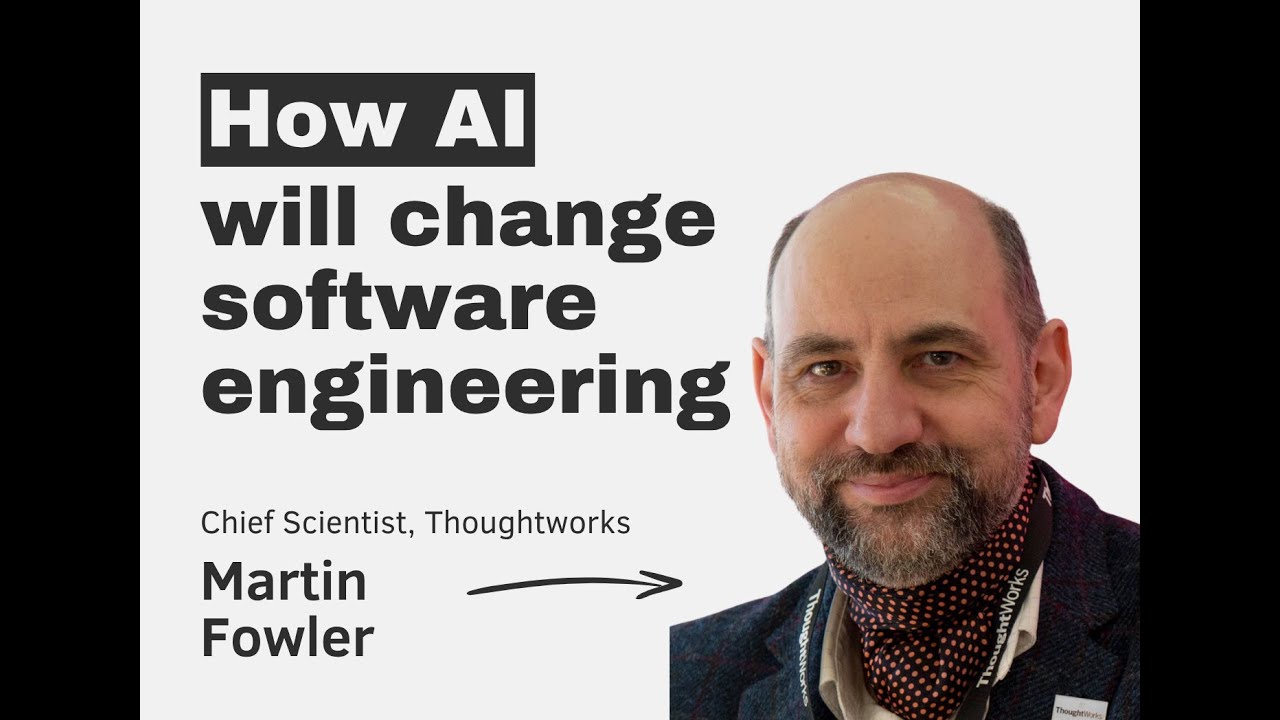
Martin Fowler recounts his early fascination with computing and how he transitioned from hobbyist programmer to one of the most influential voices in software engineering. He traces his path through the UK tech scene of the 1980s, where he first encountered object-oriented programming and began thinking deeply about software design patterns.
His curiosity about how to communicate complex technical ideas to broader audiences ultimately shaped his career as an author and thought leader.
Joining Thoughtworks 6:00
Martin describes what drew him to Thoughtworks and why the consultancy model appealed to him. The exposure to diverse client problems across industries gave him a unique vantage point on what works and what fails in real-world software projects.
He highlights Thoughtworks' culture of experimentation and willingness to adopt new technologies early, which directly fed into initiatives like the Technology Radar.
Technology Radar 12:00
The Technology Radar emerged from Thoughtworks' internal need to track which technologies were gaining traction across hundreds of projects. Martin explains the four-ring system (Adopt, Trial, Assess, Hold) and how the radar became a widely referenced industry resource.
He discusses how AI tools have moved rapidly through the rings and the challenges of evaluating technologies that evolve as fast as LLMs.
Assembly → High-Level Languages 18:00
Drawing a historical parallel, Martin compares the current AI-assisted coding moment to the shift from assembly language to high-level languages. Each abstraction layer was met with skepticism from practitioners who worried about losing control.
The key lesson: every successful abstraction traded low-level control for higher productivity, and AI code generation may represent the next such leap — but only if we maintain the ability to verify and understand the output.
Non-determinism & New Workflows 24:00
Martin identifies non-determinism as the fundamental difference between LLMs and every previous programming tool. Traditional compilers produce identical output for identical input; LLMs do not. This demands entirely new workflows for verification and quality assurance.
He argues developers must build "guardrails" — automated checks, tests, and review processes — that assume the generated code might be subtly wrong each time.
Vibe Coding 30:00
Martin addresses the "vibe coding" trend — accepting AI-generated code without fully understanding it. He sees it as fine for throwaway prototypes and personal scripts but dangerous for production systems where reliability, security, and maintainability matter.
The distinction he draws: vibe coding is a useful exploration tool, not a software engineering practice.
StackOverflow vs AI 36:00
The conversation explores how AI assistants have largely replaced StackOverflow for quick lookups and boilerplate questions. Martin notes this is a net positive for developer velocity but warns about the loss of the community curation layer that StackOverflow provided.
AI answers lack the voting and commenting system that surfaced edge cases and corrections over time.
Testing with LLMs 42:00
Martin sees test generation as one of the most promising applications of LLMs in software engineering. AI can rapidly produce test scaffolding, edge-case tests, and property-based tests that developers might not think to write.
However, he cautions that AI-generated tests can give false confidence if they merely mirror the implementation rather than independently verifying behavior. Human judgment remains essential for test design.
LLMs for Enterprise 48:00
Enterprise adoption of LLMs brings unique challenges: compliance requirements, data privacy, legacy codebases with decades of institutional knowledge, and risk-averse cultures. Martin discusses how Thoughtworks clients are navigating these waters.
Successful enterprise adoption patterns include starting with internal developer tools rather than customer-facing features, and building robust evaluation frameworks before scaling.
Why He Wrote Refactoring 54:00
Martin reflects on writing Refactoring (1999), explaining that the book codified practices that skilled developers were already doing intuitively. By naming and cataloging refactoring patterns, the book made these techniques teachable and discussable.
He emphasizes that refactoring is fundamentally about improving code without changing behavior — a discipline that becomes even more critical when AI is generating code that may not follow consistent design principles.
Refactoring in the AI Era 60:00
AI-generated code often works but lacks the internal coherence that comes from thoughtful design. Martin argues this makes refactoring more important than ever — teams will need to continuously reshape AI output to maintain architectural integrity.
He envisions a workflow where AI generates a working draft, humans evaluate and refactor it, and the refactored version feeds back into the AI's context for future generations.
LLMs + Deterministic Tools 66:00
The most effective AI-assisted development combines LLMs with deterministic tools: type checkers, linters, formatters, test suites, and static analysis. The LLM handles creative generation while deterministic tools enforce correctness constraints.
Martin sees this hybrid approach as the mature pattern that will dominate professional software development.
Patterns of Enterprise Architecture 72:00
Martin revisits his Patterns of Enterprise Application Architecture book and considers which patterns remain relevant in the cloud-native, AI-augmented era. Many foundational patterns (Repository, Unit of Work, Domain Model) still apply, though their implementations have evolved.
He notes that AI may eventually help developers select appropriate architectural patterns based on project constraints.
The Agile Manifesto 78:00
As a signatory of the Agile Manifesto, Martin reflects on how agile has been both successfully adopted and widely misunderstood. The manifesto's core values — individuals and interactions, working software, customer collaboration, responding to change — remain sound.
He sees AI tools as potentially accelerating agile practices by shortening feedback loops, but warns against using AI velocity as an excuse to skip the human collaboration that agile demands.
How Martin Learns About AI 84:00
Martin describes his approach to staying current with rapidly evolving AI capabilities: hands-on experimentation, conversations with Thoughtworks colleagues working on client projects, and reading broadly across both technical and philosophical perspectives.
He emphasizes the importance of actually using the tools rather than just reading about them, and maintaining healthy skepticism about vendor claims.
Advice for Junior Engineers 90:00
Martin's advice for junior engineers in the AI era: invest deeply in fundamentals. Understanding data structures, algorithms, system design, and software architecture will remain valuable even as the tools for implementing them change.
- Learn to read code critically — you'll be reviewing AI output constantly
- Master testing and verification — the skill of knowing if code is correct matters more than writing it
- Develop communication skills — translating business needs to technical solutions is inherently human
- Don't skip the fundamentals just because AI can generate code
State of Tech Industry 96:00
Martin shares his perspective on the broader tech industry: the current AI hype cycle will eventually settle, but the underlying capabilities are real and transformative. He draws parallels to the dot-com era — many specific predictions were wrong, but the overall direction was correct.
He expresses concern about the concentration of AI capabilities in a small number of large companies and advocates for open-source AI development.
Rapid Fire 102:00
Quick-fire questions covering Martin's favorite programming language (still has a soft spot for Smalltalk), most underrated engineering practice (continuous integration), the book he'd recommend to every developer, and his predictions for software engineering in 2030.
🎯 Key Takeaways
- Non-determinism is the core challenge — LLMs don't produce the same output twice, requiring new verification workflows.
- AI code generation parallels the assembly-to-high-level shift — each abstraction layer was initially resisted, then embraced.
- Vibe coding is fine for prototypes, not production — accepting code you don't understand is acceptable for throwaway work only.
- Refactoring becomes more important with AI — AI-generated code often lacks internal coherence and needs human reshaping.
- LLMs + deterministic tools is the winning combo — pair creative AI generation with type checkers, linters, and test suites.
- Test generation is AI's most promising SE application — but AI tests can give false confidence if they mirror implementation.
- Enterprise adoption should start with internal tools — build evaluation frameworks before scaling to customer-facing features.
- Fundamentals remain essential for junior engineers — data structures, system design, and critical code reading are durable skills.
- AI tools should accelerate agile, not replace collaboration — shorter feedback loops are good; skipping human interaction is not.
- The AI hype will settle but the capabilities are real — like the dot-com era, direction is correct even if predictions are wrong.