Meet XBOW, the Robot Pentester 0:31
XBOW is the brainchild of Oege Demore, the mind behind GitHub's CodeQL and Copilot. It's a fully autonomous penetration testing agent — you point it at a website and it hunts security holes, breaks in to prove they're real, then writes the report. No human touches the keyboard.
How XBOW Topped HackerOne 0:53
XBOW hit #1 on HackerOne's US leaderboard last June — beating every human hacker in the country.
- Found ~1,100 vulnerabilities in roughly 90 days
- 54 critical severity bugs among them
- Outpaced every solo human on the platform
The fine print: a human team checked every bug before submitting (HackerOne rules require it). Critics argue XBOW mostly found easy, common bugs — just at insane scale. HackerOne eventually split its leaderboard so the company's robot wasn't ranked against solo humans anymore.
The Free Open-Source Hackers 1:40
While XBOW sat behind a $6,000 paywall, the open-source community went feral. Four tools emerged — ranging from 45K to 4K GitHub stars — all free, all doing essentially the same job as the billion-dollar bot.
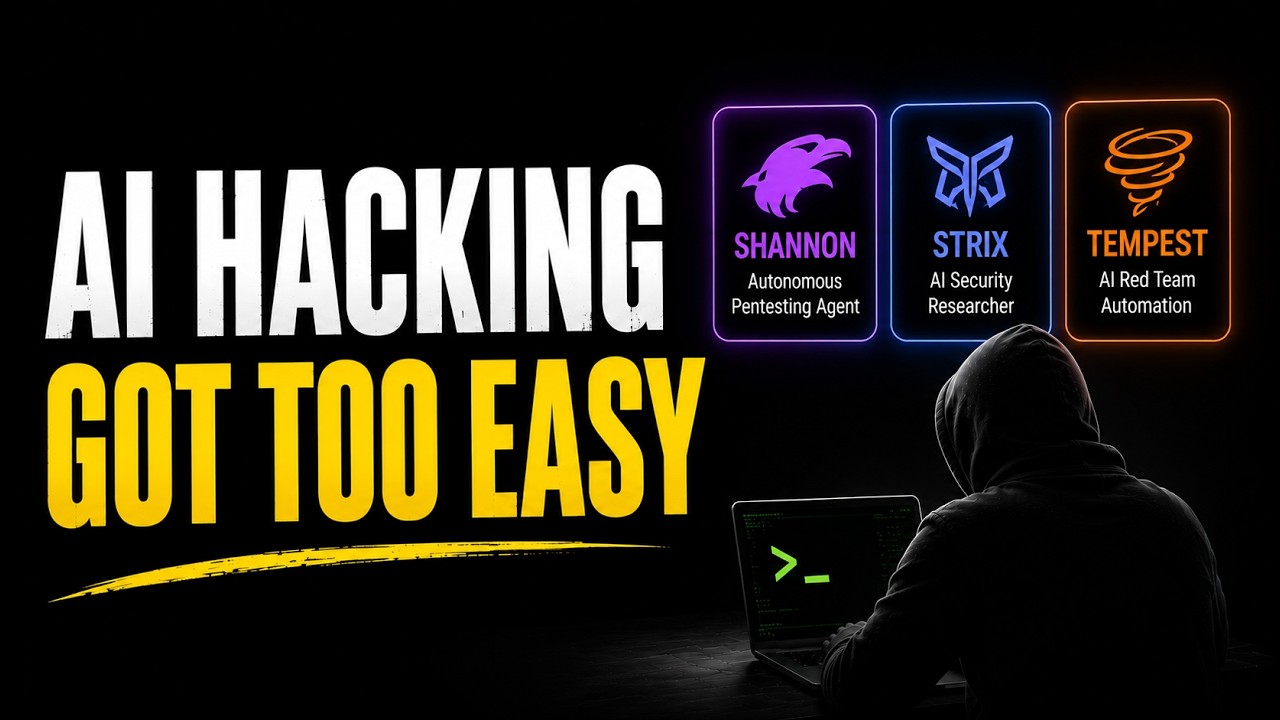
Shannon, Strix & Tempest 2:00
- Shannon (45K ⭐) — White-box hacker. Reads source code like an attacker, exploits through a real browser, runs on Claude Code. Scored 96% on XBOW's own benchmark. Cost: ~$50/run.
- Strix (40K ⭐) — Built for defenders. Spins code in a sandbox, detonates the exploit to prove it's real, blocks bad PRs before they ship. Free with your own API key.
- Tempest (4K ⭐) — The scary one. Hijacks your existing coding agent (Claude Code, Codex, local model) and turns it into a zero-day hunter. Cost: $0 — uses the subscription you already pay for.
How MCP Makes It Work 3:09
MCP (Model Context Protocol) is the universal adapter that makes all of this click. HexStrike plugs 150+ real hacking tools — the same ones professional pentesters use — straight into any AI agent.
The AI decides what to run, MCP pulls the trigger. This adapter layer is why everything suddenly works — tools that were siloed behind CLI expertise are now accessible to any agent that speaks MCP.
The Benchmark Showdown 3:36
All tools test against XBOW's own benchmark — 104 hackable web applications designed to measure autonomous hacking ability.
- Shannon: 96%
- Tempest: 90% (blind mode — harder)
The benchmark is now basically retired — modern tools score so close to 100% that it no longer differentiates them. Free tools didn't just catch XBOW; they maxed out the test.
Cost Comparison & Buy vs Build 4:40
The price of an autonomous hacker fell off a cliff:
- XBOW: $6,000+
- Shannon: ~$50/run
- Strix: Free (with your own API key)
- Tempest: $0 (runs on your existing subscription)
🎯 Solo dev / bounty hunter? → The free swarm is absurdly powerful.
The Scary Part & The Other Side 5:20
The same free tool that guards your code works when pointed at someone else's. The barrier to attacking dropped to a monthly subscription.
The dark side: The curl team reports that 20% of bug reports are now AI-generated garbage — only 5% genuine. They shut down their entire bug bounty program because of it.
The bright side:
- Google Big Sleep caught a zero-day in SQLite before anyone exploited it
- DARPA AI teams at DEF CON found 86% of planted bugs plus 18 real unknown ones nobody knew about
🎯 Key Takeaways
- XBOW ($1B) topped HackerOne's leaderboard but mostly found easy bugs at scale
- Free open-source tools now match XBOW on its own benchmark
- Shannon (96%, white-box, ~$50/run), Strix (free, for defenders), Tempest ($0, uses your existing AI)
- MCP + HexStrike = 150+ hacking tools plugged into any AI agent
- XBOW benchmark basically retired — free tools maxed it out
- Price of autonomous hacking fell from $6,000 to $0
- Double-edged sword: same tools protect and attack
- curl shut down bug bounty due to AI-generated spam
- Google Big Sleep caught a real zero-day before exploitation
- DARPA AI found 18 unknown bugs at DEF CON