🏷 The model, correctly named 0:00
He opens by calling it "DeepSeek-V4-Lite-1017", then "DeepSeek V4.1 Flash 1017", and keeps switching. The repositories settle it:
| Repository | Created | Note |
|---|---|---|
deepseek-ai/DeepSeek-V4.1-Flash | 10 Sep 2026 | The original release |
deepseek-ai/DeepSeek-V4.1-Flash-1017 | 17 Oct 2026 | The continued-training checkpoint — hence "1017", MIT licence |
brandonmusic/…-1017-TrellisMX-K2-Mix | 20 Oct 2026 | The community mixed-precision quant he benchmarks, 312 downloads |
DeepSeek-V4-Lite-1017 | — | Does not exist; "Lite" appears to be him misremembering the name on camera |
🔬 What is inside 0:00
From the published config, which matters because every hardware decision below follows from these numbers:
| Property | Value |
|---|---|
| Layers | 40 |
| Hidden size / heads | 5,120 / 64 heads, 1 KV head, head dim 512 |
| Routed experts | 384, six active per token, plus one shared expert |
| Approximate total parameters | ~552 B (expert matrices dominate) |
| Context window | 1,048,576 tokens (1 M), YaRN rope scaling |
| Released weights | Already heavily quantised: FP8 with FP4 experts, 510 GB of files |
📊 The benchmark results 2:45
| Benchmark | V4.1-Flash 1017 | GLM 5.3 Flash (NVFP4) | Verdict |
|---|---|---|---|
| Terminal-Bench 2.1 | 92% (82/89), OMP harness | 82% | Ten points clear — but the benchmark is near saturation |
| Terminal-Bench 4L | — | higher | GLM wins, contradicting most published TB4 numbers |
| Cybersecurity categories | — | better | GLM 5.3 Flash is unusually strong on security work |
| Media / science categories | weak | — | His heat map shows the soft spots clearly |
🎲 The 2-bit surprise 21:56
The experiment that gives the video its title: the community mixed-precision quant — 2/3/4-bit, 264.8 GB, roughly half the official checkpoint — scores the same 92%, 82 of 89 as the full-precision model, when run on a Dell tower in tensor-parallel 2.
| Check | Result |
|---|---|
| Score | Identical: 82/89 on both |
| Was TP4 accidentally run instead? | Ruled out — the PCIe switch was dead; no TP4 machine existed at the time |
| Were results copied between runs? | Ruled out — different tasks passed |
| Overlap | Three tasks unique to native, three unique to the quant |
🧪 Same score, different model 23:14
Here is the detail the video does not mention, and it reframes the result. The quant's own model card publishes the fidelity measurements against the official checkpoint:
| Metric | Value |
|---|---|
| Mean tokenwise KL divergence (reference vs candidate) | 0.131 nats |
| Top-1 token agreement | 87.6% |
| Evaluation set | 128 windows × 8,192 tokens, plus 512 fresh 2,048-token sequences |
| Quantisation method | TrellisMX, mixed 2/3/4-bit, official FP8 Engram tables retained |
🪙 The token tax 3:33
The consistent complaint about this family, and he repeats it: it spends 3× to 15× more tokens than GLM 5.3 Flash to reach a comparable result. What changed in 1017 is not the token count but the interaction count.
| Version | Tokens | Your involvement |
|---|---|---|
| Original V4.1-Flash | High | High — it iterated without converging, so you re-prompted |
| 1017 | Still high | Low — it iterates until the job is done, so you leave |
He adds a concrete data point: within three days of release it became the most-used local model he has ever run, measured by tokens — partly because it is useful, partly because it is verbose.
⏱ Why nobody agrees on tokens/sec 6:03
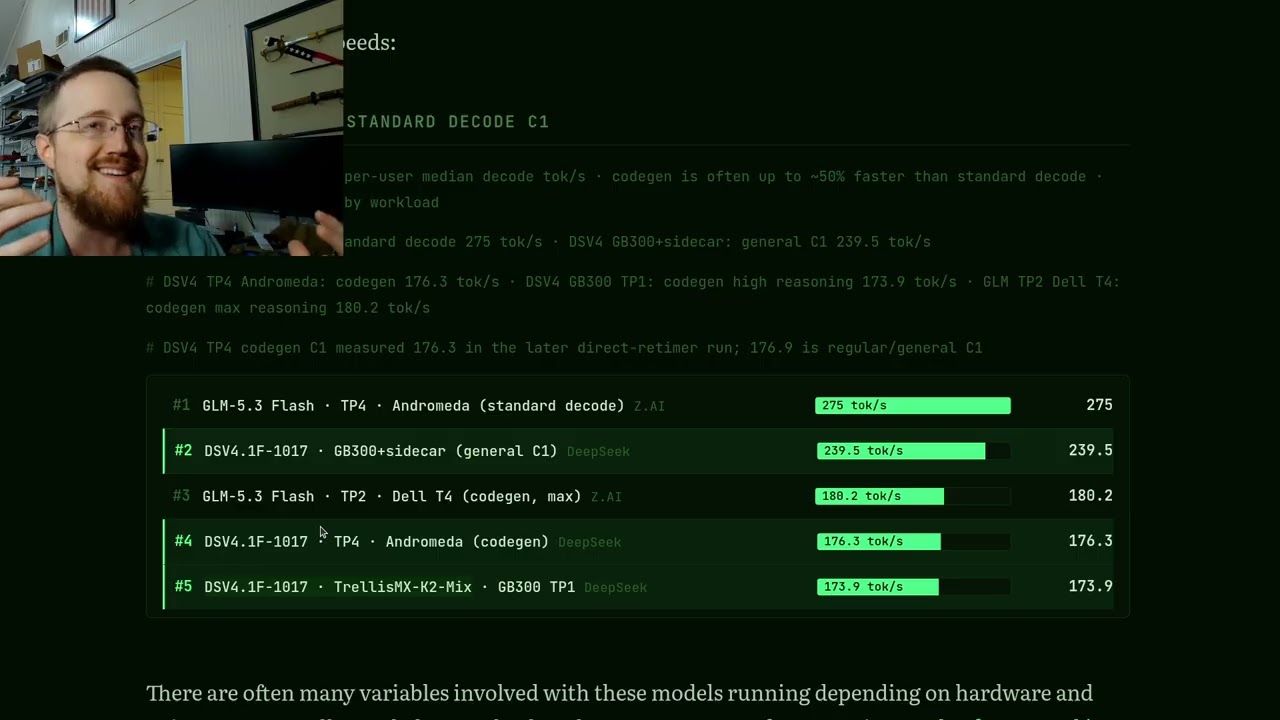
This segment should be required reading before anyone compares local inference numbers. He walks through why the same model is "240", "500" and "800" tokens per second depending on who is posting.
| What people report | What it actually measures |
|---|---|
| 240 tok/s | Average across general text, including thinking and tool calls |
| 400–500 tok/s | Code generation only — the fast path |
| 800 tok/s | A lucky short burst, or an overclocked memory/GPU configuration |
The other half of the problem is the rig: cards in motherboard slots versus MCIO cables through retimers, PCIe 4 versus 5, x8 versus x16, cards power-capped at 420 W instead of the default 600 W.
🖥 The hardware menu 16:26
| Option | Config | His assessment |
|---|---|---|
| DGX Station (GB300 class) | Single package with HBM, ~288 GB | List around $120k; negotiable. "If I won the lottery" — best scaling for multi-agent concurrency |
| Dell Precision T4 | 2 × RTX Pro 6000 Max-Q, 96 GB each | From about $38,600; "the right buy"; quiet, half the power |
| Dell Precision T2 | 1 × RTX Pro 6000 | Cheapest sane entry; he reports buying a whole T2 for less than a bare card |
| Custom build with PCIe switch | 4 cards, MCIO, retimers | Fastest on paper, most fragile in practice — his switch died |
| Two "Spark"-class boxes | Small unified-memory nodes | ~$10–12k speculative idea for a 2-bit run at home; not tested here |
❄️ Workstation versus Max-Q 13:16
The claim: the 600 W workstation card is not meant for multi-GPU builds, and the Max-Q variant is. The vendor positioning agrees, and the reason is mechanical.
| Edition | Power | Cooling | Intended |
|---|---|---|---|
| Workstation Edition | 600 W | Open-air | Single-GPU desk-side systems — dumps heat inside the chassis |
| Max-Q Workstation Edition | 300 W | Blower, exhausts out the rear | 2–4 GPU towers and rack builds |
| Server Edition | Up to 600 W, configurable | Passive | Rack chassis with front-to-back airflow |
📐 The VRAM arithmetic 27:18
He says you "just need like 200 gigs of VRAM" to run this at home. The actual numbers are a bit worse, and the difference explains the speeds he is unhappy with.
| Artefact | Size | Fits in |
|---|---|---|
| Official checkpoint (FP8 + FP4 experts) | 510 GB | Nothing domestic; needs multiple GPUs or offload |
| Mixed 2/3/4-bit quant used here | 264.8 GB | 288 GB HBM (DGX Station) — but not 192 GB of two 96 GB cards |
| Two Max-Q cards | 192 GB VRAM | ~73 GB of weights must live in system RAM or NVMe |
🔥 The thermal bill 10:36
The most expensive lesson in the video, told almost as an aside: while running tensor-parallel 4 over MCIO cables with the side panel off and large fans, the VRM overheated badly enough to take out the motherboard's networking chip — and his PCIe switch died and had to go back to Germany for repair.
| Failure | Cause he identifies |
|---|---|
| Networking chip thermally shut down permanently | VRM heat with the side panel off and inadequate directed airflow |
| PCIe switch dead | Voltage regulator failure in the switch itself |
| Cards "sandwiched" by other builders | Open-air workstation cards blow heat upward into the next card |
✅ Claims checked
| Claim | Verdict | Evidence |
|---|---|---|
| The model is "DeepSeek-V4-Lite-1017" | Misnamed | The repositories are DeepSeek-V4.1-Flash (10 Sep) and DeepSeek-V4.1-Flash-1017 (17 Oct); no "V4-Lite-1017" exists |
| 1017 is continued training of the original, released 17 October | Correct | Checkpoint created 17 Oct 2026, MIT |
| The model is already mostly 4-bit | Correct | Config: FP8 weights with FP4 expert dtype; 510 GB of files |
| Terminal-Bench 2.1: 92% (82/89) for 1017, 82% for GLM 5.3 Flash | His measurement | Own harness (OMP); not directly comparable to other published runs |
| GLM 5.3 Flash beats 1017 on Terminal-Bench 4L | Reported | Contradicts most published TB4 tables; his harness-forcing hypothesis is untested |
| The 2-bit quant scores the same 82/89 | Reported, with checks | TP4 mix-up and result-copying both ruled out; three task swaps each way |
| Therefore the quant is effectively the same model | No | The quant card reports 87.6% top-1 agreement and 0.131 nats KL divergence versus the official checkpoint |
| It burns 3–15× more tokens than GLM 5.3 Flash | His measurement | Consistent with earlier reporting on this family; not independently instrumented |
| You need about 200 GB of VRAM | Understated | The quant is 264.8 GB; two 96 GB cards require ~73 GB of offload |
| Workstation cards are single-GPU, Max-Q is for multi-GPU | Correct | Vendor positioning: 600 W open-air for desk-side; 300 W blower validated for 2–4 GPU builds; all editions 96 GB at 1,597 GB/s |
| Max-Q costs about half the power and some performance | Correct in substance | 300 W vs 600 W; independent testing puts sustained compute roughly 20% behind |
| DGX Station list is around $120k and negotiable | His claim | Not verified against a quote; the advice to negotiate is anecdotal |
| Dell T4 with two Max-Q cards from about $38,600 | His figure | Configuration-dependent; treat as a starting point, not a price |
| Kimi 3.1 at 2.8 T parameters needs about eight RTX Pro 6000s at 2-bit | Rough estimate | 2.8 T at ~2.5 bits is around 875 GB of weights, slightly beyond 8 × 96 GB — his own numbers point at the boundary |
| He is a Dell ambassador and was not paid for this video | Disclosed on camera | Affiliate links to Asus and Dell are present and excluded here |
Basis note. Built from the full 31:32 recording and checked against the Hugging Face model cards and configs for both the official checkpoint and the community quant, the vendor documentation for the three RTX PRO 6000 editions, and the published fidelity metrics on the quant itself. Benchmark figures are his own harness runs and are labelled as such — the video's own thesis is that numbers measured through different harnesses should not be compared. Affiliate and sponsor links are excluded.
🔑 Key takeaways
- The name is DeepSeek-V4.1-Flash-1017 — 552 B parameters, 384 experts with six active, 1 M context, released 17 October.
- It ships already quantised: FP8 weights with FP4 experts, 510 GB. Any further compression removes bits that already survived one pass.
- 92% on Terminal-Bench 2.1 — ten points over GLM 5.3 Flash, on a benchmark that is close to saturated.
- Benchmarks measured through different harnesses are not comparable. The TB4 reversal is what that looks like.
- A half-size 2-bit quant reproduced the same score, with three tasks swapping in each direction — noise, not a result.
- Same score does not mean same model: the quant agrees with the original on 87.6% of next tokens. Aggregates hide divergence that compounds.
- Ask for KL divergence and top-1 agreement before trusting a quant; this one publishes both, which is rare.
- Tokens are the tax, prompts are the cost. 3–15× token use is a good trade when you own the GPUs and a bad one on per-token pricing.
- Size the quant to the memory pool: 265 GB fits a 288 GB unified box outright, and needs ~73 GB of offload on two 96 GB cards.
- "200 GB of VRAM" is a third short — and the missing third is why the model pushes traffic through CPU and NVMe.
- Max-Q is the multi-GPU card: 300 W, blower, rear exhaust, same 96 GB and bandwidth, roughly 20% less sustained compute.
- Thermals are a purchase decision. A model this size heats VRM, chipset and NIC, and one sensor cannot tell you what is cooking.
- His PCIe switch and a networking chip died proving the point: the fast configuration is the fragile one.
- Standardised public benchmarks are the only apples-to-apples comparison — better than any screenshot of tokens per second.
- Disclosure matters: he is a Dell ambassador with affiliate links; the opinions are informed but not independent.
🔗 Resources
- The video — sentdex, 31:32 (sponsor/affiliate links excluded here)
- deepseek-ai/DeepSeek-V4.1-Flash-1017 — official checkpoint, MIT
- The TrellisMX mixed-precision quant — with its published KL and top-1 agreement figures
- His write-up — the heat maps and tables behind the video