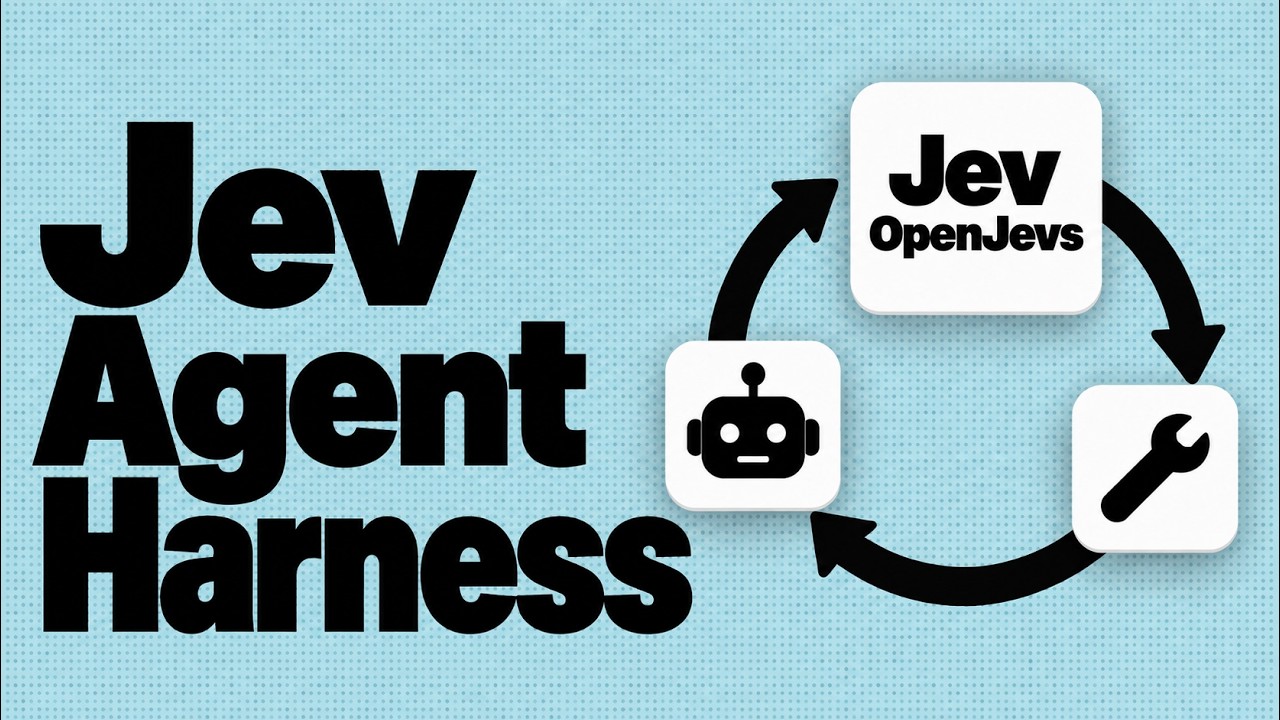
🔁 The loop, and what it wastes 0:58
The opening observation is the strongest argument for the whole category: take an agent loop apart and count what the model is actually being asked to do.
| Call | What it produces | Cost |
|---|
| Which tool should I use? | A function name from a fixed list | Full model call |
| Is this command safe? | Yes or no | Full model call, if it happens at all |
| Which skill applies? | One of fifty options | Full model call, plus tokens for the registry |
| Which of these results answers the question? | A ranking | Full model call, or a second model entirely |
| Write the final answer | Text | A full model call is the only correct choice here |
And the cost is not only tokens. His sharper point is behavioural: because verification is expensive, developers leave it out — so agents skip the "is this safe" step and the "is this result good enough" step, not because those steps are useless but because each one doubles latency. Cheap decisions make verification affordable, which changes what you build.
🎛 What Jev is 3:18
| Property | Detail |
|---|
| Maker | TypeSafe AI — Jev is its first "System One" model, released in early access in September 2026 |
| What it does | Takes a state plus typed questions; returns typed answers with calibrated probabilities and a confidence score |
| What it does not do | No text, no reasoning trace, no chat, no code |
| Framing used here | "A smart if statement" — the surrounding code constrains what it can do |
| Parallelism | Many independent questions about one state in a single request; answers cannot see each other |
| Pricing | Per decision rather than per token (listed through OpenRouter as typesafe/jev-*) |
"Cannot hallucinate" is the vendor's phrasing, and it is worth understanding precisely: the output space is constrained, so it cannot invent a tool that does not exist or return prose where a label was expected. It can still pick the wrong label with high confidence. Type errors are eliminated; judgement errors are not.
🧩 Four primitives, not three 3:37
He describes three primitives and calls the third "a null". The API defines four, and the spelling matters if you go looking for it.
| Primitive | Answer shape | Use |
|---|
Choice | One option from your list, plus a probability for every option | Tool routing, skill selection, triage buckets |
Noul | Probability of yes for a yes/no question | Safety gates, "is this good enough" |
Score | A probability-weighted position on a scale you define | Relevance ranking, urgency |
Box | A value inside bounds you specify | The fourth one — and the one the video never mentions |
Two corrections in one line: the yes/no primitive is called Noul, not "null", and there are four primitives — Choice, Noul, Score and Box. Neither error changes his argument, but a viewer copying the word "null" into an API call will not find it.
The detail with the biggest practical consequence is the parallel answering. Because the answers are read off a single forward pass rather than generated token by token, asking five questions costs almost the same wall-clock time as asking one. That is what makes it viable to run a safety question and a routing question and a quality question on every step.
🗺 Six places to use it 4:24
| # | Use | Decision being made |
|---|
| 1 | Model routing | Cheap fast model or expensive reasoning model |
| 2 | Risk gating | Before a tool runs: destructive or benign — checked on the arguments, not the intention |
| 3 | Tool and skill selection | Which category, then which skill — replaces injecting the whole registry |
| 4 | Ranking and judging | Score retrieved chunks; grade answers against a rubric |
| 5 | Triage | Urgency of a ticket or email as a probability, not a label |
| 6 | Real-time filtering | Decide what from an API response is worth putting in the context window |
Number two is the one that changes safety rather than cost. A gate that runs in milliseconds can inspect every bash argument instead of a sample — and because the probability comes back, you can route the uncertain band to a human or a full model and still auto-approve the obvious cases. Most harnesses today ask the same expensive model that proposed the command whether the command is safe, which is both slow and structurally conflicted.
📏 The rule of thumb 7:14
"If a panel of smart people could answer the question in just a few seconds, then it's the kind of question you should be using a decision model for. If they need to go away and formulate an answer and write a complicated answer back, that's when you should be sticking with the LLMs."
This heuristic is better than it looks, because it tests the shape of the work rather than the difficulty. "Is this command destructive?" is instantly answerable by an expert and hard for a model to guess reliably — exactly the profile where a small calibrated model wins on both latency and consistency. "Design the migration" is not answerable in seconds by anyone, so no decision model will help.
🔌 Four hooks and two patterns 7:40
| Hook | Question |
|---|
| Before the prompt is built | Which skills or tools should be loaded? |
| Before the model call | Which model should be called? |
| Before a tool runs | Is this safe to execute? |
| After a result returns | Is this good enough, or do we loop again? |
| Pattern | Shape | His verdict |
|---|
| Advisor | The LLM still drives; the decision model answers small questions at each hook | Works, small change, recommended |
| Decider | Jev picks the tool or the answer; the LLM is the fallback for uncertainty and text | Cuts more calls, but a much bigger change and "doesn't seem to work as well" with complex work |
He is unusually clear that the more aggressive pattern underperformed in his hands. That is the sort of negative result that usually gets cut from a video. The advisor pattern is the one to adopt: it leaves the loop intact and inserts cheap opinions, so a wrong decision costs one retry rather than a derailed trajectory.
🎬 Demo: skills by cascade 12:15
Fifty skills, ten categories, five skills each. Instead of injecting all fifty into the system prompt, only the categories go in — and a two-stage cascade picks the skill.
| Task | Stage 1: category | Stage 2: skill |
|---|
| "Someone got an email pretending to be our CEO asking for gift cards — is this a hacking attack?" | Security and access | Investigate a security alert |
| "Is this claim true?" | Research | Do web research / fact-check a claim |
| "Make me a short voiceover of this product description" | Images, audio, video | Text-to-speech |
The cascade is the interesting design decision, not the speed. A single classification over fifty options is a harder question than two classifications over ten and five, and the two-stage version also gives you a cheap place to log what kind of work your agent is actually doing. The cost is one extra forward pass — which, because questions run in parallel, is nearly free.
The same hook applies to API responses: decide whether what came back is good enough to use, needs different arguments, or needs another call.
🎬 Demo: RAG re-ranking 16:33
The second demo replaces a dedicated re-ranker with a scoring decision: sweep wide, score, keep the top five.
| Element | Detail |
|---|
| Query | "Why are my webhook requests failing with an error?" |
| Retrieval | Broad sweep — 25 passages, even from BM25 with no embedding model |
| Scoring | Decision model scores each passage; his preferred primitive for this is Score, not yes/no |
| Result | Webhook signature verification, raw bodies, proxies, signing secrets — top five sent to the LLM |
Two honest observations from the demo: the RAG case is slower than the skills case, because the chunks are much larger than category names; and scoring beat the yes/no variant in his testing. That second point matters — a yes/no question asks "is this relevant", which loses the ordering you need to cut to five. Ask for a rank, not a verdict.
🚫 Where it does not fit 9:15
| Limitation | Consequence |
|---|
| Needs text back | Not a decision model's job, by construction |
| Multi-step reasoning and multi-hop synthesis | Still the LLM's job — decision models answer one question about one state |
| Large state | Accuracy falls sharply on long inputs; sending 100k tokens is the wrong use |
| Compound questions | A question that secretly contains two questions degrades badly |
| Images | The hosted model is text-only; some open decision models do vision |
| Vague criteria | If you cannot write the criteria clearly, do not trust the answer |
| Cloud privacy | Using a hosted decision model means your state leaves the machine — the argument for local open models |
"You kind of want to define the instructions and the criteria yourself, and then benchmark any changes that you make to that over time."
The "define criteria yourself" point is the one teams skip. A decision model is only as good as the descriptions you give it — write them as you would brief a new hire, because that text is all it has. The video's advice to benchmark changes over time is the difference between a calibrated gate and a confident coin flip.
🛡 The injection problem 10:42
He flags it plainly: decision models can be prompt-injected, so instructions embedded in the state can move the result. His mitigation is a sequence — ask "are there prompt injections here?" as a separate question before asking the question you actually care about.
| Point | Status |
|---|
| Structured output prevents type errors, not judgement errors | Correct, and he says so |
| Decision models are vulnerable to indirect prompt injection | Independently demonstrated — researchers built a simulated store flow and steered Jev's outputs with adversarial content |
| A pre-question as a guard | Cheap and worth doing, but not a proof: a detector that can be injected is itself injectable |
| Vendor and ecosystem docs acknowledge the risk | Both TypeSafe's limitations page and the Pydantic integration docs note that adversarial content can steer outputs |
The security story, stated carefully: "cannot hallucinate" was widely read as "cannot be fooled", and those are different claims. A decision model removes the risk of invented structure; it does not remove the risk of a hostile document choosing your branch. If a gate decides whether a destructive command runs, its inputs deserve the same scrutiny as the command itself — and the uncertain band should escalate rather than auto-approve.
🌍 The open models 19:12
He points at an open decision model on Hugging Face and runs the demos locally, which is the part of the video with the shortest shelf life — a small ecosystem grew quickly around the format.
| Family | Notes |
|---|
Eikos-27B | The model linked in his description; 27B, the one he runs locally in the demos |
autotrust/JEV-27B | Apache-2.0, ~54 GB; reports averaging marginally above Jev 1.13 across six public decision benchmarks, and is close to it in whole-distribution terms (mean KL ≈ 0.017) |
| Others: Quyet, deck31b, AutoJev-27B, Winnow-12B, Decision 2.0 (0.6B–27B) | A crowded field with self-reported benchmarks — check calibration, not just accuracy |
| Vision variants | Open decision models with image input exist, which he notes as a win over the hosted text-only model |
The right metric for this class of model is calibration, not accuracy: you are going to act on the probability — escalate above 0.7, auto-approve below 0.2 — so what matters is whether "0.8" means what it says across your inputs. Self-reported accuracy tables tell you how often the top answer is right; they do not tell you whether the threshold you chose will behave the same next month.
🧱 Frameworks and access 19:00
| Claim | Check |
|---|
| No framework needed — it is a function call in your loop | Correct; the API is state in, typed answers out |
| LangChain shipped the advisor pattern as middleware | Consistent with published LangChain material on Jev integration |
| Pydantic ships its own version, pluggable into an agent loop | Consistent — Pydantic's docs cover the decision models and their injection caveats |
| OpenRouter is the easy way in | The typesafe/jev-* models are listed there, so no waitlist is required |
| Hosted API needs whitelisting | Early-access gating; the OpenRouter route and the open models are the workarounds he names |
✅ Claims checked
| Claim | Verdict | Evidence |
|---|
| Most harness model calls are decisions, not writing | Correct and measurable | Tool choice, skill load, safety gate and ranking are all classification or scoring in disguise |
| Jev is a decision model from TypeSafe that returns no text | Correct | System One model, early access from September 2026; typed answers with probabilities and confidence |
| Three primitives: choice, score, "null" | Three named, one misspelled, one missing | The API has Choice, Noul, Score and Box |
| Many questions per call, answered in parallel | Correct | All questions in one request are answered together and cannot see each other's answers |
| Six use cases: routing, risk gating, tool/skill selection, ranking, triage, filtering | Sound taxonomy | Each maps to a documented primitive |
| Rule of thumb: answerable by experts in seconds → decision model | His heuristic, and a good one | Attributed on camera to the vendor's own guidance |
| Four hooks in the loop; advisor beats decider | Coherent, with a rare negative result | He reports the decider pattern working worse on complex work |
| Two-stage skill cascade over 50 skills works | Demonstrated | Category then skill, three example tasks routed sensibly |
Score beats yes/no for RAG re-ranking | His testing; logically expected | Yes/no loses ordering, which is the whole point of cutting 25 passages to 5 |
| Decision models are prompt-injectable | Correct — and independently demonstrated | Researchers steered Jev and similar models with adversarial content; vendor and integration docs acknowledge it |
| Accuracy drops on long inputs | Stated by the vendor | Also the reason large documents are a poor fit |
| Hosted Jev is text-only; some open models handle images | Correct at the time of recording | Open vision decision models exist |
| LangChain middleware and Pydantic integration exist | Correct | Both documented publicly |
| OpenRouter is usable without the waitlist | Correct | typesafe/jev-* listed with decision-based pricing |
| "Cannot hallucinate" is meaningful protection | Overstated by the ecosystem | No invented structure; still wrong answers with high confidence, and still steerable |
Basis note. Built from the full 20:24 recording and checked against TypeSafe's own documentation, the OpenRouter Jev reference and tutorials, the open-model releases he points at, and independent security reporting on prompt injection against decision models. Two naming corrections are included — Noul, and the fourth primitive Box — because they are the kind of error that costs a reader an afternoon. Related earlier deep dives on the same family: the ten levels of the Jev system and running any LLM in Jev mode.
🔑 Key takeaways
- Most calls in your agent are decisions dressed as generation. Tool choice, skill load, safety check, ranking — none of them need prose.
- Expensive verification gets skipped. Cheap decisions make the "is this safe" and "is this good enough" steps affordable.
- Jev is a smart if statement: state in, typed answers with probabilities out, no text and no reasoning trace.
- Four primitives:
Choice, Noul, Score, Box. The yes/no one is Noul — not "null".
- Questions run in parallel, so five questions cost about the same time as one.
- Risk gating is the use that changes safety, not cost: inspect every tool argument in milliseconds and escalate the uncertain band.
- Rule of thumb: if an expert answers in seconds, use a decision model; if they need to go away and write, use the LLM.
- Adopt the advisor pattern, not the decider. He tried the aggressive version and reports it working worse on complex work.
- Cascade before you classify: category then skill beats one pick from fifty, and logs your task mix for free.
- For retrieval, ask for a rank, not a verdict — yes/no loses the ordering you cut on.
- Write the criteria yourself and benchmark changes. Vague questions produce confident noise.
- Long inputs and compound questions break it; 100k tokens of state is the wrong shape of problem.
- "Cannot hallucinate" is not "cannot be fooled". Decision models are prompt-injectable — demonstrated independently.
- Judge open decision models on calibration, because you will act on the probability, not the top answer.
- Watch your data boundary: a hosted decision model means every state you send leaves the machine, which is why local open models matter for harness work.
🔗 Resources
Basis note. Every API surface claim was checked against the vendor and OpenRouter documentation rather than the narration, and the injection risk was corroborated with independent research rather than repeated as the speaker's hunch. Self-reported benchmarks for open decision models are labelled as such — none of them were re-run for this article.
⏱ Timestamp index
0:00Most harness calls are decisions, not writing
0:58The agent loop, step by step
2:35What a full LLM call costs you per decision
3:18Jev as a smart if statement
4:24Use case 1: model routing
4:52Use case 2: risk gating
5:43Use case 3: tool and skill selection
6:16Use case 4: ranking and judging
6:34Use case 5: triage, and human in the loop
7:14The "few seconds" rule of thumb
7:40The four hooks in the loop
8:32Second pattern: Jev decides, LLM is fallback
9:15Where it does not fit
10:42Compound questions and prompt injection
11:12Criteria, benchmarking, local versus cloud
12:15Demo: progressive disclosure over 50 skills
14:22Demo: verifying API responses
16:33Demo: RAG re-ranking with scoring
19:00Resources: OpenRouter and LangChain