📼 What this recording is 0:00
First, the packaging. The upload is titled "Anthropic Engineer Reveals: Stop Prompting Claude… Build AI Systems That Prompt Themselves", on a channel that is not the speaker's, with 267 views. The recording itself is a straightforward conference talk: Lamis, member of technical staff on Anthropic's applied AI team (the group between research, product and go-to-market, working with startups building agents at the frontier), speaking at AI Devcon about context engineering.
🗓 One year of context engineering 3:22
The recap is the most useful part of the talk, because each step is presented as "what worked, what broke, what came next" rather than as a feature launch.
| Step | What worked | What broke |
|---|---|---|
CLAUDE.md at session start | "Unreasonably effective" — a short markdown file steers an agent towards your conventions and preferences | Context bloat: the file that must hold your most important preferences keeps growing |
| Memory tools, in-band | Autonomy: the agent decides when to read, write and update memories during a session | Built-in conflict — the session is both the thing being done and the thing being curated |
| Skills | Progressive disclosure: the agent reads a two-sentence front matter, then loads detail only when relevant | Still opinionated by humans about which processes deserve a skill |
| Memory as a file system | Markdown files, searched with plain tools; agents are already good at bash and grep | Needs indexing to be searchable at scale |
grep.
🎯 Three learnings 8:01
| Rule | Why |
|---|---|
| Markdown is great for memories | Human-readable, agent-writable, diffable, tool-friendly |
| Let memories grow; give agents index and search | Retrieval at use time beats compression at write time |
| Give agents autonomy when writing | They notice what mattered in a session better than your schema does |
And the payoff he promises from those three, if you build only this much: repeat tasks get better, because the agent has notes about what went wrong last time.
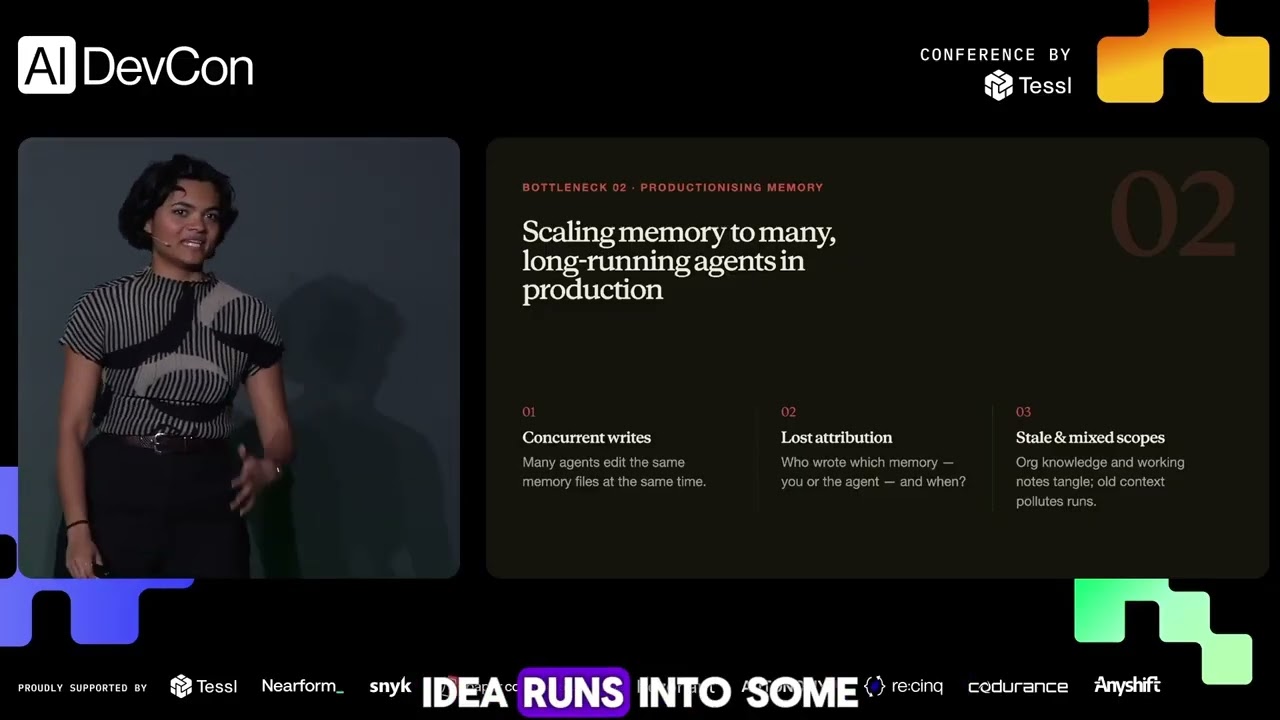
🏭 Where the neat idea breaks 8:37
| Failure mode | Why it is worse than it sounds |
|---|---|
| Concurrent writes | Many agents, one memory file, no arbiter |
| One agent edits organisational context | An incorrect edit propagates to every agent that reads it — a fleet-wide outage from one bad write |
| Humans and agents co-editing | Lineage disappears; nobody can say why the memory says what it says |
| Staleness | Yesterday's truth, quietly asserted today |
| Injection into memory | A memory written by a hostile input becomes trusted context forever after |
🛡 Four guardrails 10:21
| Guardrail | Implementation he describes |
|---|---|
| Versioning | Store versions so you can roll back; record which session and transcript produced each change, and who made it — agent or human |
| Concurrency | Hash the memory → draft the edit → re-hash before committing; if the hash moved, re-read, redraft, retry |
| Permissioning | Organisation-wide context read-only for agents; per-agent scratch pads writable; middle tiers by team or cross-section |
| Portability | Clean API so curated memory is usable across product surfaces and systems |
🚧 The in-band bottleneck 15:02
Here is the argument that justifies a new product rather than a new setting, and it is a good one:
| Limitation | Consequence |
|---|---|
| Split focus and resources | One agent is asked to finish the task and invest capacity in curating memory for a future run — a hard trade-off with no right answer, plus latency |
| Visibility limited to the session | It cannot see patterns across sessions, so "the agent keeps making the same mistake" is invisible to the agent making it |
| No fleet view | Failures shared by many agents in many environments never get aggregated anywhere |
| Memories go stale | Something has to check that what is written is still true |
💤 Dreaming 17:53
The proposal: a second-order, out-of-band process over memory. It runs in batch, asynchronously, with its own allocated budget, and its job is to make the memory store itself better.
| Stage | What happens |
|---|---|
| Inputs | An existing memory store, plus a batch of session transcripts over a period |
| Fan-out | An orchestrator deploys a fleet of subagents to analyze the transcripts — including tool calls and metadata, not just the conversation |
| Pattern detection | Where do agents consistently fail? Is a topic missing? Is a tool misconfigured? Is a convention not written down? |
| Output | A new memory store proposing changes, with example transcripts and prevalence statistics |
| Human gate | You accept or reject each proposed change |
| Steering | You tell the process what matters in your organisation, so curation is not generic |
instructions to steer it, and produces a separate output memory store — a clone of the input — so the original is untouched and you can inspect the result and discard it.
🏫 The school analogy 16:56
| School | Agent system |
|---|---|
| Students do the work and hand it in | Agents run sessions and write memories |
| Teachers have dedicated capacity to help students learn | Out-of-band curation with its own token budget, focused on improving future runs |
| A head teacher reviews everything and spots curriculum gaps | The orchestrator aggregates subagent findings and proposes organisation-wide context changes |
His three illustrations of a proposed change are worth keeping as test cases: a topic entirely missing from the curriculum (memory gap), every student answering in radians instead of degrees (tool misconfiguration), and a fleet-wide habit you dislike, such as too many em dashes (a style rule to write down once).
💰 Why spend tokens to save tokens 24:27
The obvious objection is cost: you are adding a batch process that burns tokens on transcripts nobody asked about. His answer is that the memory improvements pay for it downstream.
| Effect of a good memory store | Mechanism |
|---|---|
| Higher accuracy on repeat tasks | The agent has notes about what went wrong last time |
| Fewer tokens per task | It one-shots work it previously explored |
| Lower latency | Fewer turns, less rediscovery |
| Developer attention freed | Self-curation runs in the background rather than in your backlog |
🗄 "Are we reinventing databases?" 29:41
An audience member asks the sharpest question of the session: with versioning, concurrency and durability, at what point are you rebuilding a database from first principles? His answer is the most interesting thirty seconds in the recording.
The other two questions are worth noting: on choosing a memory store for enterprise use, he points to Anthropic's own managed memory and dreaming APIs (having joked that he is not allowed to make product calls to action); on scaling dreaming across users with different permissions, his answer is that you choose which session transcripts to attach, so a dreaming job can mirror whatever permissioning your agents already have.
📚 What the docs add 28:18
Because this shipped, the constraints the talk skips are published — and they are the ones that decide whether you can use it.
| Detail | From the documentation |
|---|---|
| Status | Research preview; access by request |
| Inputs | One memory store plus 1–100 prior sessions |
| Output | A separate memory store; the input is cloned, not modified — inspect and discard if you dislike the result |
| Steering | instructions string, e.g. focus on coding-style preferences and ignore one-off debugging notes |
| Model | Chosen per dream from a supported list, so you can spend a strong model on curation |
| Compliance | Not eligible for zero-data-retention or HIPAA during preview |
| Alternative | Anthropic publishes a cookbook recipe for building your own with prompts and models you choose |
✅ Claims checked
| Claim | Verdict | Evidence |
|---|---|---|
| The upload's title reflects the talk | No | The talk is about context engineering and memory; nobody advises abandoning prompts |
| Speaker is on Anthropic's applied AI team, working with startups | As introduced on stage | Opening remarks; unverified beyond the recording |
CLAUDE.md was "unreasonably effective" | Consistent with public guidance | Anthropic has documented memory files in Claude Code since launch |
| Skills use progressive disclosure — front matter first, body on demand | Correct | This is exactly how Agent Skills are specified |
| Best practice is to model memory as a file system and let agents search it | Their stated position | Matches Anthropic's memory-tool approach: plain files, agent-run search |
| Concurrency via hash-draft-rehash | Coherent design | Optimistic concurrency control; the published memory API documents stores and stores' versions but not this internals detail |
| In-band memory has a split-attention and a visibility problem | Well argued | Structural: one context window cannot see cross-session patterns |
| Dreaming is out-of-band, batch, with its own budget | Correct | Dreams run as asynchronous jobs with a chosen model |
| Dreaming reads a store plus recent transcripts and proposes a new store | Correct | Docs: 1–100 sessions in, separate output store out |
| You can steer the process and accept or reject changes | Correct | instructions parameter; cloned output store you can discard |
| It is a shipped product, not a research idea | Correct — with caveats | Research preview in the managed-agents platform, access by request, not ZDR/HIPAA eligible |
| Dreaming pays for itself by cutting downstream tokens | Plausible, unmeasured here | Depends on task repetition and cost of errors; measure before assuming |
| "Dreaming" appeared first in a Claude Code leak | Audience claim | Moot now that it is documented publicly; no primary source examined |
Basis note. Built from the full 31:37 recording and checked against the published Dreams and memory documentation for the managed-agents platform. The sourcing itself required correction: this is a conference talk re-uploaded under a misleading title by a channel that is not the speaker's, so the article attributes the content to the speaker and treats the upload as a transcript carrier. Timings and API specifics in the docs win wherever they differ from the stage.
🔑 Key takeaways
- Intelligence does not compound on its own. The context an organisation needs is orthogonal to the model, so context engineering multiplies whatever intelligence you buy.
- Do the simple thing that works. A markdown file at session start was "unreasonably effective" before anything more elaborate existed.
- Plain files beat bespoke memory APIs, because agents already know how to use
bashandgrep. - Let memory grow; retrieve at use time. Indexing beats pre-emptive compression.
- Autonomy in writing, guardrails in editing: the split is the whole design.
- A memory store is a long-lived influence channel. Inject once, influence every future session — treat it as a security boundary.
- Four guardrails for production memory: versioning with provenance, optimistic hashing for concurrency, tiered permissions, and a portable API.
- In-band curation is structurally handicapped: split attention, and no visibility across sessions or fleets.
- Dreaming is a second-order process: batch, asynchronous, budgeted, reading transcripts and proposing a new memory store.
- Propose, don't apply. The output is a separate store; the human gate is what keeps a bad consolidation out of production.
- The 100-session window is a design constraint. Choose cadence deliberately, not by default.
- Steer curation with instructions — generic dreaming produces generic memory.
- The Q&A is the most valuable minute: "are we reinventing databases?" and the honest yes, deliberately.
- Boundaries move toward determinism. What starts as agent freedom ends as harness code once evidence accumulates.
- Measure the economics. "Dreaming pays for itself" holds only where tasks repeat and misses are expensive.
🔗 Resources
- The recording — an AI Devcon talk by Anthropic's applied AI team, re-uploaded under an inaccurate title
- Dreams documentation — inputs, output store, instructions, supported models, preview status
- Agent memory documentation — memory stores, pruning, and how dreaming fits
- Anthropic: the components of agent memory — the memory hierarchy the talk describes, in written form
- Claude Managed Agents — where memory, dreaming and orchestration live
⏱ Timestamp index
CLAUDE.md and its context bloat