🚫 What we excluded
This is a sponsored video. It carries a paid JetBrains Air read, a discount code for the Dygma Defy keyboard the presenter is using, an affiliate link for 3DKeyCaps, and referral links with discount codes for the channel's own Neovim and Kubernetes courses. None of those links, codes or discount offers appear here. Everything below is about Pi and was checked against primary sources, not against the presenter's summary.
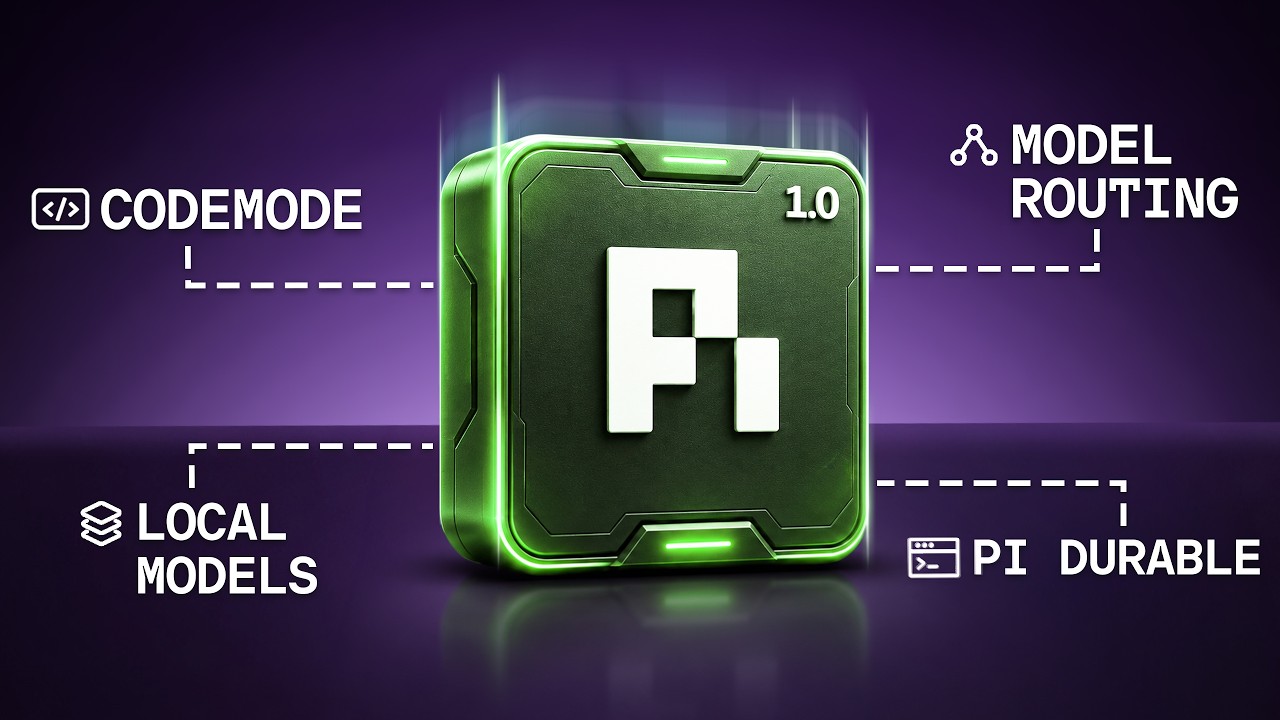
📦 What 1.0 actually added 2:13
The presenter summarises the release in a sentence or two. The announcement post is more precise, and the list is worth reading as a design statement about what a minimal harness will accept.
| Feature | What it means |
|---|
| Codemode | Native MCP support, plus non-LLM models such as Jev and image models |
| Virtual models | Extension support for models that stand in for a routing decision |
| Deferred tool loading | Tool definitions need not all be in context from the first turn |
| Cache warming for Anthropic models | Prompt cache primed rather than paid for cold |
| Mid-conversation system messages | Transcript-aware prompt and tool changes inside a session |
| Presentation | A new TUI theme, and full-screen mode by default |
Two of those rows are the real news and the video treats them as footnotes: deferred tool loading and mid-conversation system messages are both answers to the same problem — a session that grows tools and context as it goes, without re-sending everything. Cache warming is the unglamorous one that shows up on the bill.
Dates, verified: 1.0.0 on 1 October 2026; 1.5.0 on 2 November; 1.5.2 on 10 November. The video was recorded around the 1.5 releases, which is why the presenter says "1.0, 1.5.0 while shooting" — both are true of different moments, and the same page today installs whatever is current.
🧩 Code Mode and MCP 0:40
Mario Zechner wrote a well-known post arguing you often do not need MCP at all. Pi 1.0 ships MCP support anyway. The presenter's framing is the correct one: the interesting part is how.
| Traditional tool calling | Code Mode |
|---|
| Every tool's description sits in context | The model writes a script against the tools |
| Results come back whole, into context | The script filters, and only what it needs returns |
| One call at a time, each a round trip | Loops, conditionals and parallelism in one program |
| Cost grows with tool count and result size | Cost grows with the program, not the catalogue |
This is the same idea Anthropic shipped in Claude Code, and this site covered it: a REPL tool instead of a hundred tool schemas, with the code acting as the filter. Cloudflare's measurements put the extreme case at 2,500+ endpoints and 1.17M tokens reduced to two tools and roughly a thousand tokens. Pi's version is not a copy of that design — it is a minimal harness reaching the same conclusion because the arithmetic is the same.
The honest tension the video names and then drops: a harness that sold itself on "no MCP" now has MCP, with a repository package for it and a documented codemode path. Whether that is a compromise or a better compromise depends entirely on whether Code Mode keeps the context cost down in practice — and the demo shows a script being written for a trivial classification call, which proves the mechanism exists, not that it pays off.
🌀 Radius, the gateway 3:24
He calls it "a rainbow radius thingy", corrects himself to "model gateway", and wonders aloud why a SaaS backend is needed for something like web search. The product page answers all of that.
| Component | What it does |
|---|
| Model gateway | Choose models and define your own routing rules |
| Organisation controls | Shared spending with automatic top-ups and limits you set |
| API keys | Power your own agents built on Pi through Radius |
| Analytics | Usage and spend broken down by member and model |
| MCP server | Lets Pi set up and manage Radius' hosted services for you |
| Web search | Brought in through Parallel Web Systems' search |
| Artifacts | Share reports, docs, dashboards, small sites and Pi sessions |
And there is the answer to his own question: web search is not a SaaS requirement of a local harness, it is a feature of a hosted gateway that resells a search provider. Enabling it requires an account, which is exactly what "why do I need a backend for search" really means — the search is not local, the billing is not local, and the gateway is the thing in between. It is also early alpha, on the product page's own words, and it is optional.
🎛 Virtual models 4:17
The feature with the clearest payoff, and the one most likely to be copied. Instead of picking a provider per session, you pick one virtual model — the video's example is called Auto — and something decides which real model handles each request.
| Session style | What happens |
|---|
| Manual switching | Play project manager between chat windows, losing history each time |
| One model for everything | Pay frontier prices for "what does this function do" |
| Virtual model | Same conversation, different models underneath, decided per request |
The implementation detail that makes this credible is that "virtual model" is an extension point, not a hardcoded feature. The 1.0 post lists "extension support for virtual models" as a deliverable, which means the routing strategy is user code — a rule engine, a local classifier, or a hosted one — rather than a vendor choice you accept. That is the same philosophy as the rest of the harness: provide the seam, not the policy.
🧠 Jev as a router 5:30
The 1.0 announcement names non-LLM models — Jev and image models — as Code Mode's other use case. Jev is TypeSafe's classification model, a decision model that returns a choice with a confidence rather than text, and it is a natural fit: classify the request, pick the model, spend nothing on output tokens.
| Approach in the video | Cost | Trade |
|---|
| Local rules | Free | Catches the obvious cases only |
| Hybrid: local first, ask externally when ambiguous | Cheap | Two code paths to maintain |
| Full Jev router | Needs a key and potentially credits | Accurate classification, another dependency |
| Frontier model for everything | Highest | No routing errors at all — just the wrong price |
Verified in the catalogue: typesafe/jev-router is listed as a model with a million-token context and zero pricing on every column. That is what makes the routing story coherent — the router itself is free to call and returns a decision, so the only real cost is the model it picks. The video's own caveat stands though: he is not sure about paying for classification, and is only "pretty sure" it beats throwing everything at a top-tier model.
Note the failure he actually hit: asking Pi through Code Mode to use a Jev classifier returned "Jev isn't configured" — written as a JavaScript script outside the context window, which is a neat demonstration of Code Mode and an unflattering one for the routing setup. The demo needed a key and credits before it produced anything.
💾 Local models 8:29
| Step | What happened |
|---|
| Serve a model locally | Install a runtime, pick a model, serve on localhost:8080 |
| Point Pi at it | A provider entry that wants a server address; no key needed |
| Download a model | The harness shows popularity and a recommended quantisation |
| First attempt | The context window filled before the first move — the runtime's default window was tiny |
| Fix | Quadruple the served context window and restart |
| Result | Works, and is "terribly slow and needs a lot of tweaking" |
This is the most honest thirty seconds in the video, because it shows the two things local-model guides usually hide: the context window is a serving parameter you will get wrong, and a working local agent is much slower than the hosted one. Pi documents local models and compatible endpoints alongside subscriptions and API keys, so the support is real — the performance is the part nobody can fix for you.
♻️ Pi Durable 9:38
The last third covers the package this site already deep-dived after Mario's own talk, and the walkthrough confirms the same design from the user's side.
| His description | The detail behind it |
|---|
| "A separate framework for building your own agents" | Correct — a different npm package, shipped the same day, MIT, explicitly experimental |
| "Saves checkpoints in SQLite as it works" | SQLite is one of the documented storage options, and the one his demo warns is still experimental |
| "Multiple conversations in parallel, same agents from different interfaces, multiple people on one" | Exactly what the task graph and document deltas provide |
| "Your own OpenClaw, one you can trust" | A fair characterisation of the ambition, and his own |
| Kill the process mid-run | On restart it reports the completed step and jumps to the next |
For the full account, read the deep dive on this site covering Mario's Vienna talk: why event sourcing is the wrong model for years-long sessions, why the intent must be recorded before the effect, what replay safety means per tool, and where the Cloudflare numbers in that talk needed correcting. The video is a good user-level demo of the same system; the talk is where the reasoning lives.
⚖️ Does it still count as minimal 1:18
| Time | Position |
|---|
| Before | Lean core, MCP deliberately left out, no swarms of agents, no modes for building landing pages |
| Now | MCP support via Code Mode, virtual models, a hosted gateway, a separate durable framework |
| What did not change | The core still fits in your head; every addition is a package, an extension or an opt-in document |
"So did the minimal agent become the beast it was trying to avoid, or did it find a better way to add the useful stuff?"
The evidence points to the second, with a caveat. The additions are opt-in and mostly outside the core binary — a gateway you can ignore, a durable package you install separately, virtual models as an extension point. The caveat is that a harness is now surrounded by an ecosystem of Earendil services, and "optional" is the word every ecosystem uses about itself right before it stops being true.
🕳 What the walkthrough skips 11:06
| Missing | Why it matters |
|---|
| Any measurement of Code Mode's savings | The claim is fewer tokens and better first results; the video shows a script, not a comparison |
| Routing accuracy or cost deltas | "Saves tokens, cuts spend, improves accuracy" is asserted, not shown |
| Deferred tool loading in practice | Named in the release, never demonstrated |
| A local model that is usable | Slow, needs tweaking, deferred to a later video |
| What Radius does to your data | A gateway sees every prompt; that is worth stating plainly |
None of these are dishonesty — they are the normal shape of a first-look video, and the presenter says the local-model tuning is a topic for another day. But a reader deciding whether to move a workflow should know that the three headline benefits of this release are, in this video, unquantified.
✅ Claims checked
| Claim | Verdict | Evidence |
|---|
| Pi reached 1.0, and was at 1.5.0 while shooting | Correct | 1.0.0 on 2026-10-01; 1.5.0 on 2026-11-02; 1.5.2 on 2026-11-10 |
| Pi is free and open source under a corporate roof | Correct | MIT, under Earendil; the 1.0 post says "still very much free" |
| 1.0 added MCP support | Correct | The announcement lists "Codemode (native support for MCP …)" |
| MCP is handled through Code Mode, not as raw tool schemas | Correct | Code Mode runs scripts that call tools and filter results; MCP arrives through that path |
| Code Mode writes JavaScript that runs outside the context window | Correct in substance | The code executes in the harness environment; only its output returns to context |
| Earendil runs its own gateway | Correct | Radius, at radius.earendil.com, in early alpha |
| That gateway offers shared keys, spend metrics, analytics and an MCP server | Correct, per its own product page | Model gateway, organisation controls, API keys, analytics, MCP server, web search, artifacts |
| Web search needs a hosted backend | Partially true | Radius' search is Parallel Web Systems' service; local search is a separate matter |
| Virtual models allow automatic model switching | Correct | "Extension support for virtual models" in the 1.0 release |
| Jev is bundled as the router | Imprecise | 1.0 adds support for non-LLM models like Jev; the router is an extension, and typesafe/jev-router is a catalogue entry |
| Jev needs a key and possibly credits | His experience | The demo showed "Jev isn't configured" until an account and credits existed |
| Deferred tool loading, cache warming, mid-conversation system messages | Correct — and unmentioned in the video | All three are in the 1.0 announcement |
| Local models work through a local server | Correct | Pi documents local models and compatible endpoints as first-class options |
| Pi Durable is a separate framework, not a Pi feature | Correct | A distinct package, shipped the same day, experimental |
| Pi Durable saves checkpoints in SQLite | Correct | One of the documented storage backends, and the one his demo flags as experimental |
| Code Mode provably saves tokens and improves accuracy | Not shown in this video | No measurement; the mechanism is demonstrated, the benefit is asserted |
Basis note. Built from the full 11:29 video and checked against the Earendil 1.0 announcement, the repository's package list, the model catalogue, and Radius' own product page, which I read directly rather than trusting the presenter's description of it. The video is sponsored; all sponsor, affiliate and referral material has been excluded and is not linked here.
🔑 Key takeaways
- Pi 1.0 shipped MCP after years of arguing it was unnecessary — the compromise is Code Mode, not a tool catalogue in your context.
- Code Mode's win is arithmetic: a script filters results before the model sees them, so cost tracks the program and not the catalogue.
- Two 1.0 features matter more than the video admits: deferred tool loading and mid-conversation system messages both stop a session re-sending everything.
- Virtual models turn routing into an extension point — you pick "Auto", the strategy is your code.
- Jev is the natural classifier because it returns a choice with confidence and no output tokens;
typesafe/jev-router is priced at zero.
- Routing only pays if the classifier is cheaper than the mistakes it prevents. The video asserts the saving and does not measure it.
- Radius is a real gateway: routing rules, shared spend with limits, per-member analytics, hosted MCP, search via Parallel, shareable artifacts — and early alpha.
- Anything that sees every prompt is a data decision, not just a billing convenience — worth saying out loud about a hosted gateway.
- Local models work and are slow. The first failure is always the served context window, and nobody can tune that for you.
- Pi Durable is a different product, shipped the same day, for agents that outlive a terminal — covered in depth separately on this site.
- Minimal survives by keeping additions optional: packages, extensions and separate installs, not new core modes.
- Watch whether "optional" stays true once a company's gateway, durable runtime and router are all part of the recommended path.
🔗 Resources
Basis note. The video's sponsor segment, keyboard discount code, keycap affiliate link and course referral links were excluded. Claims about Pi were verified against the announcement post, the repository and the catalogue; the presenter's own characterisations are marked as his.
⏱ Timestamp index
0:00A lean harness, and who this video is for
0:11No MCP, no swarms, no modes
0:181.0, and 1.5.0 while shooting
0:27The interesting part is how, not whether
0:40Scripts that run the same tools and filter
0:52Planning with one model, coding with another
1:04Pi Durable as the third addition
1:59Earendil, and still open source
2:30The post against needing MCP
2:46Tool descriptions eat context
3:02Structured JavaScript instead of a protocol call
3:24The gateway, not just a router
3:55Asking Pi to fix its own model list
5:30Jev classifies, then picks a model
5:49Local classifier or simple rules
6:10Hybrid: rules first, ask when ambiguous
6:22The Jev router extension
6:31Auto names the model it chose
6:45Jev picks a model before the first token
7:16The doubt about paying for classification
7:31Making the classifier the default
7:46Code Mode reports Jev isn't configured
8:09Mermaid flowcharts in the TUI
8:29Can we run local models
9:00Downloading a model and a quant
9:17The context window blows up
9:26Quadruple the window and restart
9:38Pi Durable is a separate framework
10:02What happens when the process dies
10:26Experimental, like everything
10:41Killing the process mid-run
10:51Resuming from step two
10:54Peeking into the database
11:06Why Pi is still his choice