★ Overview
A startup called XBOW raised hundreds of millions to build autonomous AI hackers. Now two students — a computer science student from Cairo and a security researcher from Yale — have open-sourced essentially the same capability under Apache 2.0 as Strix. The project hit #1 trending on GitHub with 26,000+ stars. You point it at a codebase or live URL, and a team of AI agents attacks it like a real penetration tester, then proves every bug with a working exploit. It already found a critical CVE in etcd — the database at the heart of every Kubernetes cluster.
1 What Is Strix
Strix bills itself as "AI agents for penetration testing" — open-source AI hackers that find and fix your app's vulnerabilities. The repo README tells the whole story: these are autonomous agents that run your code, find security holes, and validate them with real proof-of-concept exploits.
- Target audience — developers who don't have the budget for a manual pen test
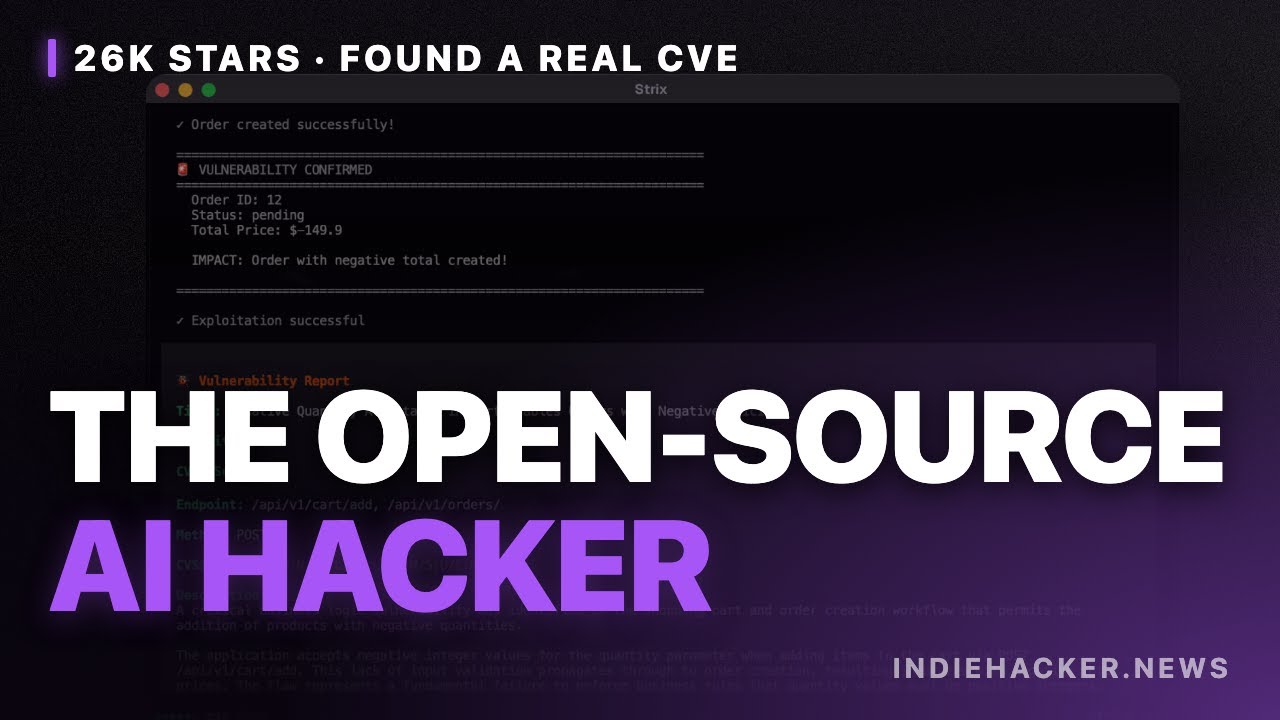
- Live demo screenshot — shows the agent finding a business logic bug, confirming it, and writing a full vulnerability report with a severity score
- One-line install — the README walks through setup, feature list, and a GitHub Action snippet that runs on every PR to block insecure code before it ships
- CI/CD integration — designed to run automatically on pull requests, failing the build if it finds a vulnerability
2 Strix vs XBOW — The Competitive Landscape
The video positions Strix against three categories of existing security tools:
- XBOW (closed startup) — built by the creator of CodeQL, last year became the first AI to climb to the top of HackerOne's US leaderboard against human bug hunters. Strix is essentially the open-source version of the same idea.
- Manual tools (Burp Suite) — traditional penetration testing tools where a human drives every click. Powerful but expensive and slow.
- Static scanners (Snyk) — read your code and flag suspicious patterns, but can't actually tell you whether a bug is exploitable.
The scoreboard: Strix blew up overnight, it's free to self-host, its closed rival sits on a giant war chest, and it has already found real vulnerabilities in production infrastructure.
3 How It Hacks — The Agent Toolkit
Each Strix agent gets a full hacker toolkit — this is what makes it more than a chatbot. The agent has five core capabilities:
- Full HTTP proxy — intercepts and rewrites every request going to your app, allowing man-in-the-middle analysis
- Real browser — drives a headless browser, clicking through login flows and forms to hunt for things like cross-site scripting (XSS)
- Terminal + Python runtime — when it has a theory about a bug, it writes actual exploit code and runs it to see if it works
- Automated reconnaissance — maps out your endpoints and attack surface before beginning targeted attacks
- Proof-of-concept generation — builds a PoC and confirms the exploit actually fires, rather than just flagging potential issues
4 What It Catches — The Vulnerability Hit List
Strix covers the greatest hits of web security:
- Broken access control — logs in as one user and tries to read another user's private data (IDOR, privilege escalation)
- Injection bugs — SQL injection, command injection, and related input validation flaws
- Server-side request forgery (SSRF) — tricks your server into making requests it never should, potentially exposing internal services
- Business logic flaws — the most interesting category, and the one that traditional scanners always miss
The Shopping Cart Demo
The standout demo: the agent found a shopping cart that accepted negative quantities, so you could place an order with a negative total and essentially get paid to check out. No signature-based scanner catches that — you have to understand what the app is supposed to do.
Graph of Agents
Strix scales its testing with what they call a "graph of agents" — a whole team of specialized agents that split up the work and share findings with each other, enabling parallel and coordinated attack strategies.
5 Under the Hood — Architecture & Stack
The implementation is surprisingly approachable:
- Pure Python — the entire project is Python, installable from PyPI in one command
- Docker sandbox — agents run inside Docker containers, which is critical because you're handing an AI real hacking tools on a real machine
- Model agnostic — bring your own API key from OpenAI, Anthropic, or Google. The quality of the pen test scales with the model you plug in
- Headless mode — built for servers and CI pipelines, runs a scan on every PR and fails the build if it finds something
- Open core business model — the CLI tool is free forever; they sell a hosted platform for teams wanting continuous scanning and one-click fixes
6 Getting Started
Setup is genuinely a couple of lines:
- Run the install script — standard pip/PyPI installation
- Configure the model — tell it which LLM to use and provide your API key
- Point it at a target — can be a local folder, a public repository, or a live URL
7 The Real CVE — Proof It Works
This is the section that separates Strix from vaporware. Earlier this year, the Strix team pointed it at etcd — the key-value database that sits at the heart of basically every Kubernetes cluster on the planet.
- What it found — a real authentication bypass, a way around the login checks
- Severity — scored a critical 8.8 CVSS
- Official recognition — received an official CVE with a GitHub Security Advisory that credits both founders (Ahmed Allam and Alex Schapiro) by name
8 The Verdict — Honest Trade-offs
The video is honest about the rough edges:
- False positives — independent testers have watched it confidently report bugs that aren't real
- False negatives — it can miss vulnerabilities planted right in front of it
- Cost — a serious scan on a top-tier model can cost real money in API tokens
- Adversarial risk — because the agent reads whatever is on the target and runs commands, researchers have shown you can turn it against whoever is running it (prompt injection in the target)
Who It's Really For
It doesn't replace a real pen tester — it augments one. The people this quietly changes everything for are solo founders shipping fast with no security budget who can finally afford to have something hammer on their app before the internet does.
🎯 Key Takeaways
🔑 Key Takeaways
- Strix is the open-source XBOW — two students gave away for free what a startup raised hundreds of millions to keep closed, under Apache 2.0
- 26k GitHub stars overnight — hit #1 trending on GitHub, showing massive demand for accessible AI security tooling
- Agent-driven pentesting — goes beyond static scanning by using AI agents that autonomously probe, exploit, and prove vulnerabilities
- Full hacker toolkit per agent — HTTP proxy, real browser, terminal, Python runtime, and automated reconnaissance
- Business logic bugs are the killer feature — catches flaws like negative quantity shopping carts that no signature-based scanner can find
- Graph of agents architecture — specialized agents split work and share findings for coordinated attacks
- Real CVE in etcd (CVSS 8.8) — proved a critical authentication bypass in core Kubernetes infrastructure, validating the technology
- Model agnostic design — bring your own API key; pen test quality scales directly with model capability
- CI/CD integration ready — GitHub Action snippet runs on every PR and blocks insecure code before merge
- Honest limitations — false positives/negatives, API token costs, and adversarial prompt injection risks are real concerns
- Augments, doesn't replace — not a substitute for professional pen testers, but a force multiplier for teams with no security budget
🔗 Resources & Links
- Strix GitHub Repository — open-source AI penetration testing agents (Apache 2.0)
- Strix.ai — official website with hosted platform and documentation