1. 14 Years of TypeScript
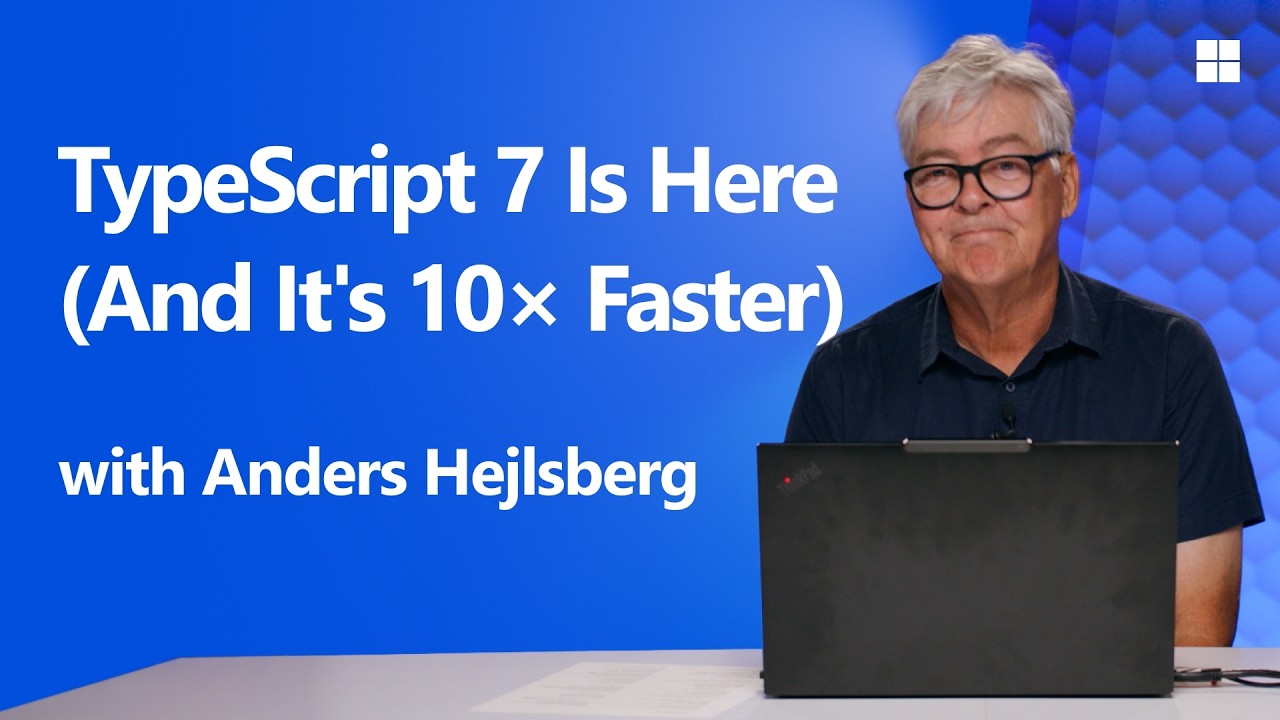
Anders Hejlsberg — Technical Fellow at Microsoft, and the creator of TypeScript, C#, Turbo Pascal, and Delphi — opens with the headline announcement: TypeScript 7 is here, and it's built on a native code port that makes the compiler and all associated tooling 10× faster.
He traces TypeScript's journey from its inception 14 years ago, when the vision was to improve JavaScript developer productivity through static types and great tooling. The project was open source from day one — a bet that paid off enormously.
- Nearly 1 billion NPM downloads per month
- TypeScript became the #1 language on GitHub less than a year ago
2. Why the JavaScript Compiler Hit Its Limits
Modern TypeScript projects have grown massive. VS Code alone is 1.3 million lines of code spread across roughly 8,000 files. The compiler was self-hosted — written in TypeScript itself — which was great for dogfooding but meant the compiler ran as JavaScript.
JavaScript was optimized for browser UI interactions, not for compute-intensive workloads like type checking. The consequences were predictable:
- The most commonly reported issue was performance
- The second most reported: out-of-memory errors
Anders fires up a live demo, compiling the entire VS Code codebase with TypeScript 6. The result: ~50 seconds to compile. That's the baseline the rest of the talk aims to demolish.
3. Where the 10× Comes From — Native Code + Concurrency
Two years ago, the team started an experiment, then committed fully: port the entire TypeScript compiler to Go. TypeScript 7 is the result — the biggest release in a decade.
🔬 The 10× Breakdown
The ~10× improvement comes from two complementary sources:
- ~5× from native code — Go compiled to machine code vs. JavaScript interpreted/JIT'd
- ~2× from shared-memory concurrency — utilizing all CPU cores simultaneously
Anders references the famous "the free lunch is over" observation: Moore's law now delivers more cores, not faster cores. His demo machine has 16 cores — the future is using all of them.
Critically, these speed improvements apply to tools (compiler, language server), not to running code. The port preserves the same code structure, same algorithms, same semantics — just in Go. The result: 99.99% behavioral compatibility with TypeScript 6.
4. Live Demo — Compiling VS Code in Seconds
This is where the demo gets jaw-dropping. Anders compiles VS Code's 1.3 million line codebase side by side:
| Configuration | Time | Speedup |
|---|---|---|
| TypeScript 6 (JavaScript) | ~50 secondsbaseline | 1× |
| TypeScript 7 (4 type checkers, default) | ~6.5 secondsfast | 7.5× |
| TypeScript 7 (12 type checkers) | ~4.5 secondsfast | 12× |
Every phase of compilation uses concurrency: parsing, binding, and emitting all happen concurrently on a per-file basis. Type checking spins up multiple type checkers (4 by default), each checking a quarter of the files. With 12 type checkers (using ¾ of the 16 cores), the time drops even further.
Remarkably, the new compiler uses about the same memory as the old one.
5. The New LSP Language Server
TypeScript 7 brings a brand new language service built on LSP (Language Server Protocol). This shift has several advantages:
- Easier integration with editors beyond VS Code
- AI tools increasingly use LSP for semantic validation of generated code
- TypeScript 7 installs as a VS Code extension and coexists with TS6 until TS7 becomes the default
In the demo, every operation is effectively instantaneous: find all references returns immediately, red squiggles appear in real time.
⚡ Language Server Restart Comparison
| Operation | TypeScript 6 | TypeScript 7 |
|---|---|---|
| Kill & restart language server, parse 8,000 files, show diagnostics | 10–12 seconds | < 2 secondsinstant |
6. Battle Testing & Migration
TypeScript 7 has been heavily battle tested. Native previews have been published for the last year, and industry partners have used TS7 in preview and provided feedback. The code is described as very stable at this point.
⚠️ Migration Caveat
If your codebase relies on compiler APIs — as frameworks like Vue, Astro, Svelte, and Angular do — you'll still need TypeScript 6 for now. That's why TS6 and TS7 are designed to coexist.
A new native code API + cross-process API is coming in TypeScript 7.1 to address this.
7. Should You Switch?
Anders's advice is straightforward: if your project doesn't depend on compiler APIs, switch now.
🎯 Key Takeaways
- TypeScript 7 is a Go port of the entire TypeScript compiler and tooling, delivering ~10× speed improvement
- Performance gains come from two sources: native code (~5×) and shared-memory concurrency (~2× more)
- VS Code's 1.3M-line codebase compiles in ~5 seconds vs ~50 seconds with TypeScript 6
- The new LSP-based language server makes editor operations virtually instantaneous
- 99.99% behavioral compatibility with TypeScript 6 — same algorithms, same semantics
- Frameworks using compiler APIs (Vue, Astro, Svelte) should wait for 7.1's native API
- TypeScript is now the #1 language on GitHub with ~1 billion monthly NPM downloads