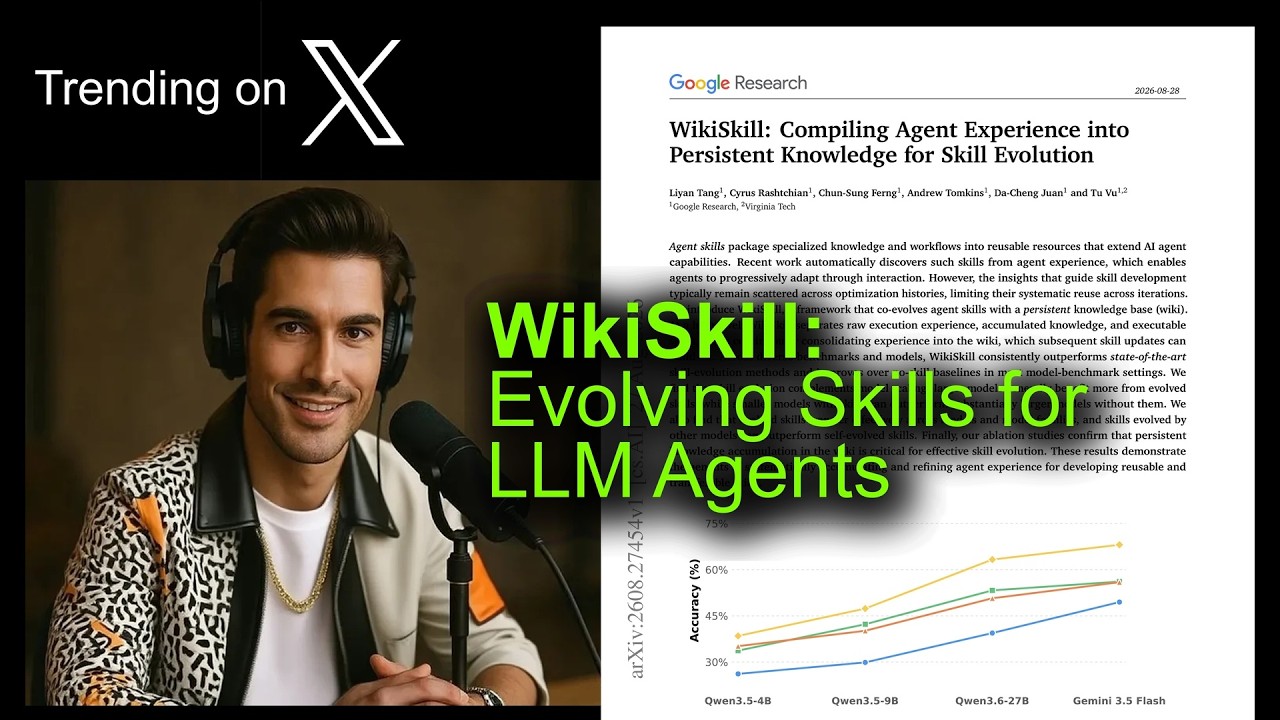
🎯 The Problem
Published Aug 27, 2026 (Google Research). The core problem: valuable lessons are lost over time. Current approaches scatter error logs across messy run records, so programs forget important lessons whenever an experiment fails. 0:00
🔗 arxiv.org/pdf/2608.27454 (paper) · github.com/ashutoshsinghpr7/wikiskill (reference implementation — Hermes Agent backend, MIT, pip install wikiskill)
🏗️ The Architecture
A four-step evolutionary loop with a workspace divided into three tiers. 1:15
| Tier | What it holds |
|---|---|
| Raw execution traces | Immutable history |
| Persistent wiki | Consolidated patterns + failure causes |
| Executable skills | Validated procedures |
📊 Results
Across five inference models and benchmark tasks, WikiSkill achieved the highest average accuracy — outperforming the strongest baseline by 3–12 percentage points (EvoSkill, SkillOpt). The yellow curve shows larger models benefit even more, widening the advantage on Gemini 3.5 Flash. 1:45
🔀 Cross-Model Transfer
Table 2 tested whether skills evolved on one model can boost another. 2:10
🔬 Ablation
Table 3 tested the role of persistent knowledge on Gemini 3.5 Flash. 2:38
| Configuration | Average accuracy |
|---|---|
| Wiki access only for the skill proposer (default) | ~64% |
| Wiki access disabled from the proposer | under 49% |
📖 Case Study (ALF World)
Figure 3 shows wiki-guided evolution: the persistent wiki records rejected proposals, chronological logs, and recurring failure patterns; the active skill layer uses that history to draft a concrete skill called break-repetition-loop. 3:06
💡 Key Takeaways
- Compiling raw agent experience into persistent knowledge enables continuous skill evolution — without updating model weights.
- Three tiers (traces / wiki / skills) with a validation-gated rollback that keeps failed knowledge.
- Beats the strongest baseline by 3–12 points across five models and benchmarks.
- Skills transfer across model families — and stronger models' skills often beat self-evolved ones.
- Agents build compounding practical knowledge without retraining.