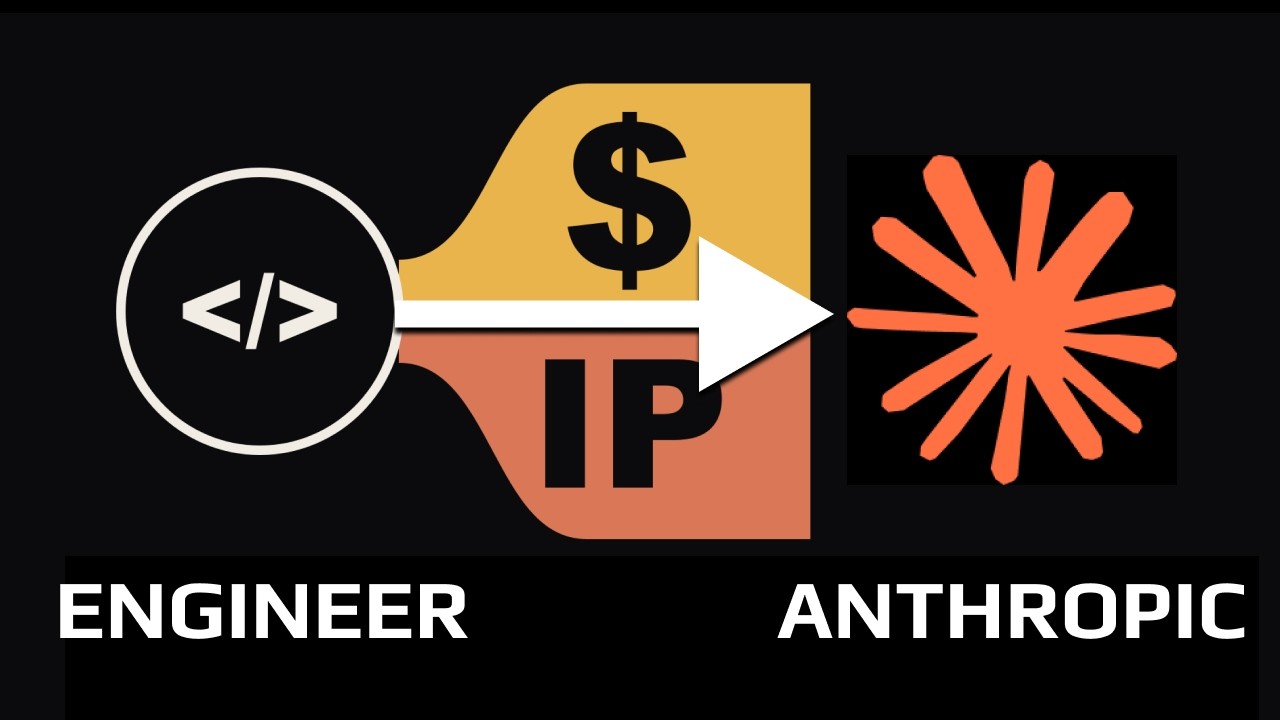
💰 The second payment 0:00
The framing device comes from Satya Nadella, and the host quotes it directly: you pay for intelligence twice — once with money, and again with the proprietary knowledge you must reveal to make that intelligence useful. The better you want the model to perform, the more of that knowledge you have to feed it.
Alex Karp of Palantir supplies the second quote, about technical customers wanting control over their compute, their models, their data stack, their alpha — and wanting to know the means of production is not being transferred to someone else.
The host is explicit that he does not agree with either take entirely, but considers both valid. He also sets a standard for the episode that is worth holding him to: if the question cannot be answered with supporting ground truth data, it does not get answered at all.
His own framing is that language models are meaningfully worse than search on this axis. A search engine gets your query. An agent gets the workflow, the traces, the system prompts — the operating knowledge of the business.
⚖️ The answer, up front 1:58
The headline question gets answered in the first third of the video, which is the right structural choice: no, Anthropic is not stealing your data.
The host repeats throughout that this is not an attack on Anthropic, and that he is a genuine fan. He also generalises the argument: this is a story about what platforms are, and Google and OpenAI run the same play. Anthropic is simply the largest and clearest example to point at.
🌀 The tumbler 3:16
The central metaphor is a coin tumbler. Every customer's prompts go into the same bucket, get anonymized and randomised, and what comes out the other side is no longer attributable to anyone.
The host's point is that anonymisation does not destroy the signal it is usually assumed to destroy. You can still identify the value proposition each prompt, each agent, each trace delivered. The output is not your data — it is a map of the market.
He also draws the ownership line sharply: when you prompt in Claude Code or Codex, you are renting the model. The harness, the traces, the prompts, the system prompts, the outputs — all yours. The intelligence underneath is not. From fifteen years of engineering he names it in familiar terms: dependency risk, keyman risk, key technology risk.
🔁 One is coincidence, four is confirmation 4:20
This is the evidential core of the argument, and it is presented as a sequence rather than an accusation:
| Usage signal | What followed |
|---|---|
| Cursor scales | Claude Code |
| Figma MCP usage explodes | Claude Design |
| Security tooling takes off | Claude Security |
| Life science usage | Claude Life Science |
The host's own formulation: one is a coincidence, three is a pattern, four is a confirmation of the pattern. He grants that competing in a single domain would be entirely reasonable for a platform with that access — it is the repetition that changes the reading.
He describes the mechanism as a four-step process: see the usage → learn the trends → enter the vertical → cut access. And then, importantly, he qualifies his own claim. The access-cutting largely stopped; he cites the earlier restrictions on Cursor and Windsurf as historical rather than current. The principle survives even though the practice has faded.
📄 Clio, and what the docs say 6:20
The host is emphatic that none of this is speculation or leaked information — it is in the terms of service, and users agreed to it.
Clio is Anthropic's aggregated, privacy-preserving analysis system for gaining insights into real-world impacts and usage patterns while maintaining user privacy. The host's reaction is genuinely positive: without such a system, many enterprises simply could not use the technology at all.
He then connects it to something visible. The Anthropic Economic Index — the published breakdowns of how AI is used across regions, sectors and socio-economic groups — is built from this data. There is no secret about it.
The setting worth changing
A practical aside, demonstrated live: in Claude, Cmd+Shift+, opens settings, and under Privacy sits the help improve our AI models toggle. The host's recommendation is to switch it off if you are doing IP-sensitive work, and notes that the privacy statement's "may conduct aggregated anonymized analysis" is, in practice, "does".
He gives credit where it is due: the data is not sold to third parties, and deletion requests are honoured promptly. He also flags one carve-out — a 30-day retention requirement tied to cybersecurity harms, the same policy that reportedly triggered a ban in one government context.
🎚️ Not all customers are equal 8:19
The tiering is straightforward once stated, and most users have never checked which tier they are in:
| Tier | Data treatment |
|---|---|
| Free | Everything is used, including for training. If it is free, you are the product. |
| Pro / Max | Consumer terms. Data feeds Clio and the aggregate reports. |
| Teams / Enterprise / API | Commercial terms. Materially stronger protections. |
This is the hinge between the problem and the solution: the same keystrokes carry different data protections depending entirely on which account issued them.
🔒 Incentives, not goodwill 9:56
The host's answer to "why should we believe them?" is refreshingly unsentimental. It is not trust, and it is not corporate values.
He adds the honest limit of his own analysis: he is addressing what is in the public record. What happens outside it, nobody knows — and he means that for every lab, not one of them.
✅ Four claims, two survive 10:44
The host invites viewers to guess which of four claims hold up before revealing the answers:
| Claim | Verdict | Basis |
|---|---|---|
| They see aggregate patterns | TRUE | Disclosed; this is what Clio does |
| They train on your code and prompts | FALSE | Terms of service say no |
| They own your outputs | FALSE | Terms of service say you own them |
| They compete with your product | TRUE | Four verticals entered, and counting |
The host is careful about why the fourth is not a loophole: it is aggregate data, not your data. Everyone's, not yours. That distinction is what makes it permissible, and it is written into the agreement rather than hidden from it.
The test he offers is a single question: are you in a growing domain, and how big? If the answer is a large growing domain, expect a lab to enter it eventually. He also notes why this is more plausible now than it was — what a single engineer can accomplish with agentic tooling is exponentially higher than a few years ago, which makes entering a vertical far cheaper than it used to be.
🧪 Commodity agents vs IP agents 14:14
The solution starts by refusing to solve the problem where it does not exist. The host frames it as a senior engineer's instinct: if you do not have to solve the problem, do not waste time on it.
| Commodity agents | IP agents | |
|---|---|---|
| Contents | Prototypes, CRUD, boilerplate, glue code | Domain logic, hand-farmed evals, traces, workflows, user-data insights |
| Character | Replaceable; anyone could prompt it in a weekend | Scarce, asymmetric, compounding |
| Distribution | Inside the normal distribution the models already know | The sub-percent tail the training data never saw |
| Action | Ship it; do not lose sleep | Defend it |
He is blunt that most engineering work is commodity work, and says so without condescension: that work is still valuable, it is simply not IP-defensible. By his estimate the genuinely defensible portion is 20%, or 10%, or 5%. For most engineers, the rest of the video does not apply — and he says so directly rather than manufacturing urgency.
🪜 The AI sovereignty ladder 17:41
The ladder is the practical spine of the episode. Each rung trades convenience for control:
| Tier | What it is | Data exposure |
|---|---|---|
| 0 | Consumer subscription | Lowest protection; used in aggregate |
| 1 | Commercial API | Better terms; only sampled in aggregate, ZDR options |
| 2 | Own the control plane — your VM, gateway, router | You hold every trace; switch models freely |
| 3 | Model cloud (AWS, GCP Vertex, Azure Foundry) | No lab sampling at all |
| 4 | Hybrid private — rent GPUs, own the open-weight model | Only GPU usage leaves your control |
| 5 | On-prem metal | Total, and financially out of reach for almost everyone |
Two moments of intellectual honesty stand out here. First, the host corrects himself mid-explanation: tiers 2 and 3 are probably in the wrong order, because an LLM gateway and a VM give you less protection than moving onto a cloud provider. He says plainly that he made a mistake and needs to swap them.
Second, he is candid about the ceiling. Owning GPUs on premises is the theoretical optimum and, in his words, financial suicide unless you are very wealthy or can write serious cheques. His recommended landing zone is tier 4: rent the GPUs, own the model.
🎯 Which tier is yours 19:38
The recommendations are segmented by who you are, not by maximalism:
| Who you are | Recommended tier | Why |
|---|---|---|
| Individual engineer | Tier 0–1 | Best return on both IP protection and spend; commercial API only samples in aggregate |
| Individual, $1M+ revenue, non-commodity work | Move up | The economics now justify the effort |
| Small / medium business (2–100) | Tier 2–3 | On a model cloud your data is not sampled at all |
| Enterprise | Tier 4 | Own the model, the traces, the evals, the routing |
On the model cloud option he explains the mechanism: Anthropic has arrangements with the major clouds to mount its technology on their hardware and then step away. You transact with your cloud provider, not with the lab.
He also addresses the objection he clearly received on a previous video about API spend, and does not retreat from it: compute is still relatively expensive, but the price per intelligent agent task keeps falling. Spend to win.
🔓 Open weights, with a caveat 23:41
Open-weight models are named as the only real escape hatch — Kimi K3, GLM 5.2, Minimax, the Qwen family. The host gives the Chinese labs genuine credit: they are scorching the earth and commoditising the closed US labs, and he frames that as good for engineers.
His reasoning is about enforceability rather than accusation: terms of service across those jurisdictions cannot be reliably enforced. He acknowledges his own position — he says he is skeptical partly because he is a US engineer, and concedes he cannot prove US labs are cleaner, only that he does not believe otherwise. He is empathetic toward anyone early in their career for whom the discount APIs are the only affordable option.
One more honest caveat: self-hosting wins on secrecy and trace ownership, but not automatically on price. Moving up the ladder requires means, and means come from success — cash and product-market fit. If you have no business and are simply paranoid, he says, this will be cost-prohibitive.
🔮 Three scenarios, one defence 25:52
The closing analysis lays out three futures and marks clearly which is speculation:
| Scenario | What happens | Host's read |
|---|---|---|
| Best | Labs stay labs — best models, best prices, out of the application layer | Would love it; only NVIDIA looks close |
| Mid | Current behaviour continues; platforms keep entering verticals | What he is betting on |
| Worst | Anonymisation is a catch-all and prompts get absorbed into lab IP | Explicitly flagged as speculation he does not believe |
The worst case is where the host is most careful. He describes a possible "legal alchemy" — once data is anonymized it is no longer yours, so it can be trained on or built against — and immediately labels it as ungrounded speculation he does not buy, while noting it is probably close to what Alex Karp believes.
The final answer restates the verdict. Anthropic is not stealing your data — the public record says so and the incentive structure backs it. But your usage shapes what they build next, and the list of verticals is easy to extend. Same verdict for OpenAI. This is what platforms are.
The closing image is the one from the opening: never has a technology asked you to pay in cash and in know-how. The host's answer is not to stop using these tools — he is emphatic about admiring the work — but to own the learning loop and run your own router, so that access to the frontier is a choice rather than a dependency.
💡 Key takeaways
- The answer to the title is no. They are not stealing data and not training on your prompts — the terms of service say so, and the incentive structure enforces it. The interesting question is the one underneath.
- Anonymised aggregate is still a market map. Tumbling everyone's traces together removes attribution but preserves the signal about which problems are valuable and growing.
- Four verticals is not a coincidence. Cursor → Claude Code, Figma MCP → Claude Design, security tooling → Claude Security, then Life Science. The host's rule: one is coincidence, three is a pattern, four confirms it.
- None of this is leaked or hidden. Clio is documented, the Economic Index is built from it, and users agreed to the terms. The discomfort is about what is permitted, not about a violation.
- Your privacy posture is your contract, not your tool. Free means you are the product; Pro and Max sit under consumer terms; teams, enterprise and the commercial API get materially stronger protections. Claude Code inherits whichever account you are in.
- Incentives protect you, not goodwill. A single terms violation would trigger an enterprise exodus. That commercial exposure is the real firewall.
- Ask one question about every prompt. If a competitor could read your full agent trace, would it matter? That single test separates commodity work from IP work.
- Most work is commodity work, and that is fine. The host puts genuinely defensible work at 5–20% and tells the rest of the audience the video does not apply to them.
- The ladder has six rungs. Consumer subscription → commercial API → own control plane → model cloud → rent GPUs and own open weights → on-prem metal. Climb as the business grows.
- Tier 4 is the recommended landing zone. Rent the GPUs, own the model. On-prem hardware is the theoretical optimum and, in his words, financial suicide for almost everyone.
- Open weights does not mean overseas APIs. Download and run the model, or you have swapped one dependency for a less enforceable one.
- Self-hosting wins on secrecy, not on price. Climbing the ladder requires means, and means come from revenue and product-market fit.
- The defence is the same in all three futures. Own the traces, own the evals, keep a second model path, rent GPUs and own the model. No forecast required.
- The host marks his own uncertainty. He corrects his tier ordering mid-argument, labels the worst-case scenario as speculation he does not believe, and concedes his skepticism of overseas labs is partly positional. That is what makes the grounded claims worth weighing.
🔗 Resources & links
- Is Anthropic STEALING Your Data? (While You PAY FOR IT)Source video — IndyDevDan, 34:29
- Anthropic Consumer Terms of ServiceGoverns Free, Pro and Max accounts
- Anthropic Commercial Terms of ServiceGoverns Teams, Enterprise and API usage
- Anthropic API and Data RetentionRetention policy documentation
- Model-specific data retention requirements (ZDR)Including the 30-day carve-out discussed in the video
- Anthropic Economic IndexThe published output built from aggregate usage analysis
- Satya Nadella — the reverse information paradoxSource of the "pay twice" framing
- Alex Karp — control your alphaThe second quote opening the video
- Fusion HarnessReferenced when discussing API spend
- Forget Loop Engineering, Focus On Software FactoriesRelated background on the software factory idea
- 2026 Anthropic PredictionThe earlier prediction referenced in the closing