📋 Overview
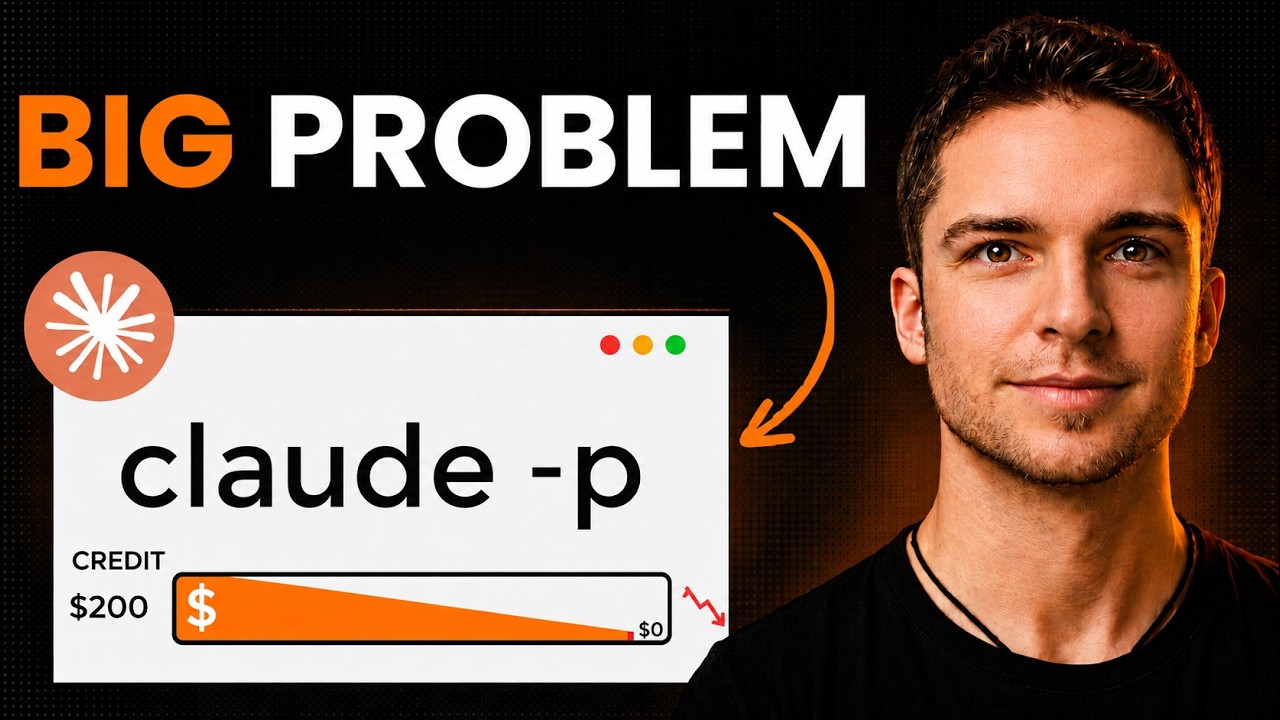
Anthropic is splitting claude -p (headless mode) and the Agent SDK out of the flat subscription starting June 15, 2026. They'll now consume a separate credit pool ($20–$200 depending on your plan) billed at API rates instead of being included in your subscription. Mansel Scheffel walks through who this affects, why panicking is the wrong response, and the systematic way to audit your usage, measure your token spend, and migrate scheduled work into Anthropic's native infrastructure — Cowork scheduled tasks and Routines — so you're never caught off-guard by billing changes again.
1 The Billing Change
Anthropic has announced that starting June 15, 2026, two features that currently sit inside your Claude subscription will move to a separate, usage-based billing model:
claude -p(headless mode) — running Claude non-interactively, typically from cron jobs, background scripts, or IDE integrations that call Claude silently.- The Agent SDK — importing Claude's SDK into your own apps and scripts to programmatically use Claude's capabilities.
Until now, everything — interactive use, headless runs, and SDK calls — was bundled into a single subscription price. After June 15, headless and SDK usage will draw from a new credit pool that's billed at API rates, fundamentally changing the economics for anyone who relies heavily on automation.
claude -p) and Agent SDK usage.2 What claude -p & the Agent SDK Actually Are
Mansel breaks down the two affected features for anyone who's not clear on what they are:
claude -p— "essentially just running Claude headlessly for you." If you've set things up with a cron job or running something silently in the background, that'sclaude -p. It's the flag that tells Claude to operate without an interactive terminal session.- Agent SDK — the importable SDK you'd use inside any app or script to programmatically leverage Claude's capabilities. This is the building block for custom AI agents and automated workflows that live outside of Claude's own interface.
Both of these are the backbone of any "AI Operating System" (AIOS) setup. If you've built automated agents, background processors, or scheduled intelligence tasks, you're almost certainly using one or both of these.
3 Who Gets Hit Hardest
Mansel identifies a clear spectrum of impact:
- Light users (cron jobs, simple automations) — "that's much simpler to solve." If you're running a few scheduled tasks, the migration is straightforward and you might even fit within the new credit allocation.
- IDE/software development users — anyone using Claude in an IDE for background code analysis, testing, or generation will be affected since those background runs use
claude -p. - AIOS builders from "hype channels" — this is the group that gets hit hardest. Those who built "elaborate front-end systems where they have named agents that run away and build things for you and everything is clickable on a front-end prototype." These systems are entirely dependent on headless Claude execution.
4 The New Credit System
The new billing model introduces a credit pool that scales with your subscription plan:
- Pro plan → $20 in credits
- Scales up to → $200 for the max plan
These credits are consumed at API rates, which Mansel notes "costs way more than it actually needs to compared to running it inside your subscription." Once you exhaust your credit pool, execution stops unless you have extra usage credits enabled — but he explicitly warns against that due to the cost differential.
The critical point: interactive Claude usage (desktop app, IDE interactive sessions, web chat) remains unchanged and within the subscription. This is only about headless and SDK usage.
5 Step 1 — Measure Before You Panic
Mansel's first and most emphatic piece of advice: "do not panic." Instead, take a data-driven approach:
- Inventory what's running — map out every automated process, cron job, and background agent.
- Measure for 7 days — track tokens consumed, run frequency, data volume returned, and downstream systems touched.
- Understand the cost — use observability tools to see cost-per-run over the last 30 days per model.
- Count invocations — check how many times each skill was invoked under the skills/MCP tab.
He demonstrates his own observability dashboard showing skill costs: his most expensive skill is the "Sketch Note Illustrator" used for video slides. The key insight is that you need actual data before making any decisions.
6 Observability & Dashboards
Mansel recommends setting up proper observability for your Claude environment. His dashboard shows:
- Which skills are running — complete activity log of all automated processes
- How long each skill runs — execution time per invocation
- Cost per run — broken down by model used over the last 30 days
- Invocation counts — how many times each skill was called
- Context and security data — broader environmental health metrics
All of this is done by reading local logs — no cloud claude -p runs needed for the monitoring itself. He specifically calls out his "mission control task board" as something people shouldn't be using because it "unnecessarily wastes tokens."
7 Deciding What to Move
Once you have the data, the decision tree is simple:
- If total cost fits within credits → probably don't need to change anything. Even if you have an elaborate system, if it fits within $20–$200, you're fine (though Mansel still recommends simplifying).
- If cost exceeds credits → sort your tasks into categories and migrate them to native Anthropic infrastructure (Cowork scheduled tasks or Routines).
The sorting is critical: you need to understand which tasks need always-on execution, which are periodic, how much token budget each consumes, and whether they require cloud infrastructure or can run locally.
8 Option 1 — Cowork Scheduled Tasks
The first migration target is Cowork scheduled tasks — essentially cron jobs that run inside Anthropic's ecosystem:
- How it works — same concept as a cron job, but because it runs inside Anthropic's infrastructure, you're not charged at headless API rates.
- Setup — create tasks manually or use Claude as a co-pilot to help configure them.
- Limitation — runs locally on your device. "You don't need to have your device always on" is listed as an advantage of Routines over this option, implying Cowork scheduled tasks do require your device to be running.
Mansel shares his own example: his scheduled tasks are "so minor" that he doesn't need to move them even with the $200 credit cap. But his lead generation task, which "only runs once a week" but "consumes a lot of tokens," will need to be migrated.
9 Option 2 — Routines
Routines are the cloud-based alternative that Anthropic offers:
- Runs in Anthropic's cloud — no need to keep your device on 24/7.
- Same functionality — can do everything a Cowork scheduled task does, but with Anthropic's infrastructure handling execution.
- Rate limits — between 5 and 15 concurrent routines depending on your plan tier. "That will probably change as the product matures."
The decision between Cowork and Routines comes down to a practical question: do you have an always-on device?
- Always-on device → use Cowork scheduled tasks (simpler, no routine slot limits).
- No always-on device → use Routines (cloud execution, but limited slots).
10 The Over-Built AIOS Problem
For those with elaborate "AI as an employee" systems with task boards and multi-agent orchestration, Mansel is blunt:
- "You're going to have to re-architect this entire thing" — every single run these agents make uses
claude -p. It's all headless, all outside Anthropic's infrastructure, and all now billable at API rates. - The fix is the same — your skills are "universal" and can be ported directly into Cowork. The underlying capabilities don't change; only where and how they execute.
- The elaborate front ends are the problem — the custom UIs, task boards, and named-agent systems from "hype channels" were built on the assumption that headless execution would remain free. That assumption just broke.
Mansel says these systems "probably really weren't working in the first place" and that the re-architecture, while painful, is an opportunity to build something more robust.
11 Why This Was Predictable
Mansel argues this change was entirely foreseeable:
- Anthropic is building Kairos — a leaked always-on task management agent. The signals were clear: Anthropic wants to own the agent execution layer.
- OpenAI already did it — they "didn't even give anyone credits to run things in headless mode. You just have to pay for the API automatically."
- Ecosystem lock-in strategy — both companies are clearly "trying to lock everyone into the ecosystem." Third-party headless execution was always going to be penalized.
This is why Mansel "stepped away from making really pretty front ends and things like that" on his channel — the writing was on the wall.
12 The Boring-But-Resilient Path Forward
Mansel's closing argument is for boring reliability over flashy systems:
- Use native tools — Cowork and Codex are "great products." Stick with the platforms' own infrastructure.
- Open-source alternative — if vendor lock-in doesn't sit well, "you can go and use Open Claw and run an open-source model."
- Skills are the core asset — "Get really good at making skills and then just schedule them." Your business SOPs turned into skills are portable and resilient.
- Human in the loop — "There is never going to be an AI grader that can learn something without you, the human in the loop, deciding whether what it's actually outputting is good or not."
- Determinism over adaptiveness — "In business you want reliability, determinism, and you want to make sure that it's just doing the same thing that you're doing every day."
🎯 Key Takeaways
🔑 Key Takeaways
- June 15 billing split —
claude -pand the Agent SDK move from subscription-included to a separate credit pool billed at API rates ($20–$200 depending on plan). - Interactive use is unaffected — IDE, desktop app, and web chat sessions remain inside your subscription as before.
- Measure before migrating — audit your token usage, run frequency, and cost-per-skill over 7 days before making any changes. Data-driven decisions beat panic.
- Set up observability — a local dashboard reading your logs can show you exactly which skills cost what, without any additional
claude -poverhead. - You might fit within credits — if your automated tasks are lightweight, the $20–$200 credit allocation might cover everything without changes.
- Cowork scheduled tasks for always-on devices — the simplest migration path if you have a machine that's always running. Same as cron, but inside Anthropic's billing umbrella.
- Routines for cloud execution — if you don't have an always-on device, use Routines (5–15 slots depending on plan). Trade device dependency for slot limits.
- Over-built AIOS systems face re-architecture — elaborate front-end agent systems built on headless execution are the most impacted and need the most work to migrate.
- This was predictable — Anthropic's Kairos leak, OpenAI's API-only headless stance, and the general ecosystem lock-in trend all pointed here.
- Skills are portable — your business logic in skill form can move between platforms. The execution layer is what's changing, not the capability.
- Boring beats flashy — reliable, deterministic systems built on native platform tools will always outlast elaborate custom front-ends built on pricing assumptions.
- Open-source as escape hatch — if vendor lock-in is unacceptable, tools like Open Claw with open-source models offer a path outside the Anthropic/OpenAI duopoly.
🔗 Resources & Links
- Build Your Own AIOS Cowork — Mansel's guide to setting up an AI Operating System inside Cowork
- Build Your Own AIOS in VS Code — Alternative AIOS setup using VS Code as the platform
- Set Up Observability for Claude Code — How to build the monitoring dashboard shown in the video
- Claude Code Routines, Step by Step — Detailed walkthrough of setting up Routines in Claude