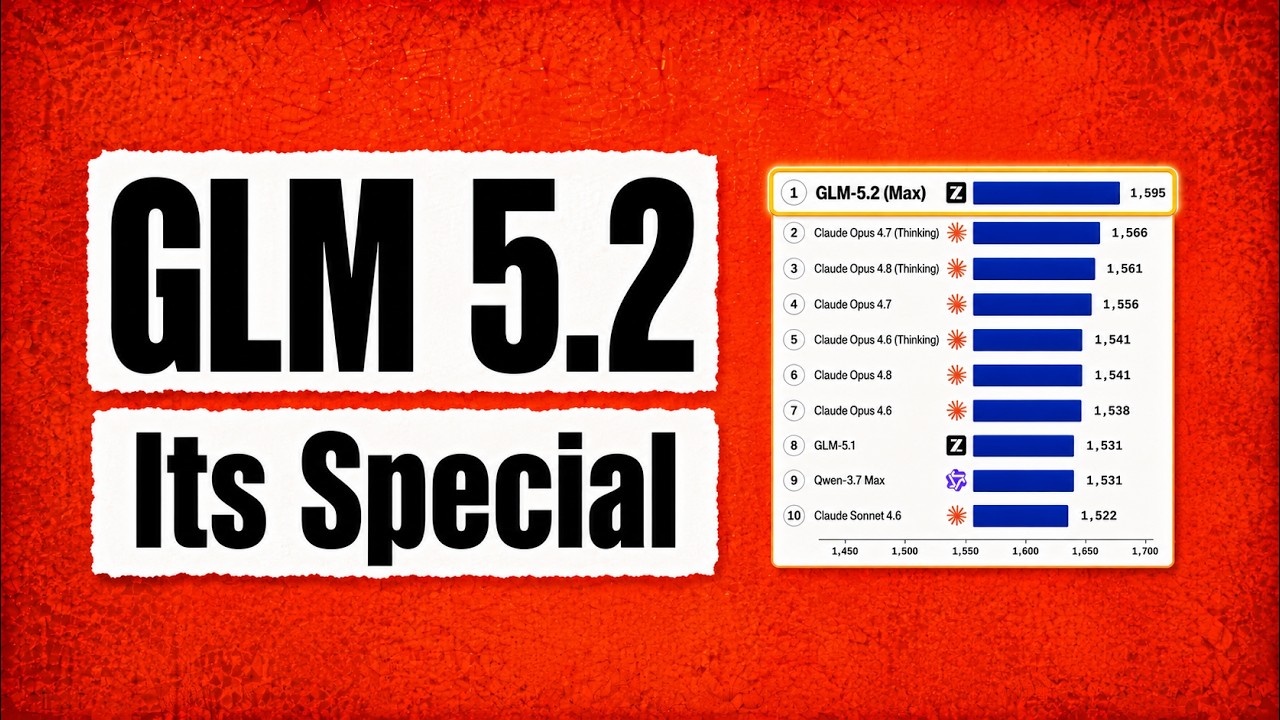
Overview
Prompt Engineering breaks down GLM 5.2 by Z.ai (Zhipu AI) — a 744B parameter Mixture-of-Experts model under MIT license that's being called the first open-weight model truly close to the frontier. The video focuses on the architectural innovations behind its low cost: MoE with 384 experts (~40B active per token), a 1 million token context window via sparse attention with "index share" (2.9× fewer compute ops), and multi-token prediction that boosts inference speed by ~20%. On agentic coding, it delivers 74.4% on Frontier SWE, tying with Opus 4.6 — at roughly 10× cheaper than Claude Max.
1 Why GLM 5.2 Matters — Efficiency Is the New Frontier
GLM 5.2 isn't just another model with impressive benchmark scores — it represents a pattern shift in how frontier-class models are built. Chinese labs (DeepSeek, MiniMax, and now Z.ai) are consistently winning not by throwing more compute at the wall, but by winning on efficiency.
Key facts at a glance:
- MIT licensed — fully open weights, download and run yourself
- 1 million token context — 5× the previous generation
- 744B parameters — but only ~40B active per token (MoE)
- First open-weight model close to frontier performance
2 MoE Architecture — 384 Experts, 40B Active
GLM 5.2 is a Mixture-of-Experts (MoE) model with 744 billion total parameters split into 384 separate experts. For any given token, a small router picks only a handful of those experts to do the work — roughly 40 billion parameters fire per token.
Picks experts
out of 744B
This is a trend across the industry — more and more models are adopting MoE because it delivers much less compute per token while maintaining the knowledge capacity of a much larger dense model. It's the architectural trick that makes the pricing possible.
3 Sparse Attention & Index Share — The Key Innovation
The 1M token context window creates a massive compute challenge. In classic attention, every token looks at every other token — the number of connections grows with the square of the context length. At 1 million tokens, this "wall of connections" is where cost explodes.
Sparse Attention
GLM 5.2 builds on DeepSeek's sparse attention approach. A small, cheap component called an indexer scans the full context and picks out just the tokens that actually matter. The expensive attention then runs only on those selected tokens.
Index Share — The 2.9× Trick
The model has many layers, and naively you'd run the indexer fresh in every layer. Index Share solves this: compute the indexer once and reuse it across four consecutive layers. Three-quarters of the indexing work simply vanishes.
| Metric | Result |
|---|---|
| Compute reduction per token at 1M context | 2.9× fewer operations |
| Index sharing span | 1 indexer serves 4 layers |
| Indexing compute eliminated | 75% (3 out of 4 layers skip indexing) |
4 Multi-Token Prediction — Faster Output
Beyond reading efficiency, GLM 5.2 also optimizes writing speed with multi-token prediction (MTP) — an approach becoming standard across frontier models.
- The model guesses several tokens ahead simultaneously
- Verifies all guesses in a single forward pass
- Good guesses are kept — multiple tokens for the price of one step
- Acceptance rate improved by ~20%, directly translating to inference speedup
Combined with Index Share, both reading (input processing) and writing (token generation) at long context get significantly cheaper.
5 Thinking Effort Modes
GLM 5.2 provides two thinking effort levels for reasoning tasks:
- High mode — balances performance against token consumption for standard tasks
- Max mode — opens up fully for the hardest problems, burns more tokens
This follows the industry trend where model providers offer multiple reasoning budgets per task — you pick the cost-vs-capability trade-off instead of being stuck with a single setting. Crucial for production use where not every query needs maximum reasoning.
6 Benchmarks & Coding Performance
The model launched initially without benchmarks, but the open-weight release included full results:
| Benchmark | GLM 5.2 | Comparison |
|---|---|---|
| Frontier SWE (long-horizon agentic coding) | 74.4% | Ties with Opus 4.6, beats GPT-3.5 |
| Frontend UI design tasks | Near Opus 4.8 | "It's a beast" for UI coding |
The presenter emphasizes that the main story isn't benchmarks — the real differentiator is practical coding performance, especially on frontend UI design where users report it's remarkably close to Opus 4.8.
7 Pricing & Self-Hosting Options
This is where Chinese labs are "actually winning" — despite being supposedly compute-constrained, the pricing compared to US counterparts is remarkable:
- ~10× cheaper than Claude Max for similar token amounts
- US-based hosting providers also offer inference (avoiding data sovereignty concerns)
- Self-hosting possible with the open weights — but requires multiple H100 GPUs
Being open-weight under MIT license gives maximum flexibility — you're not locked into a single provider. The open-weight release is explicitly described as the "escape hatch" for data-sharing concerns.
8 Limitations & Practical Considerations
- Text-only — no vision capabilities. Can't process images.
- Harness matters — the model performs best with a harness tuned specifically for GLM 5.2. Using it in generic tools like Claude Code (which isn't optimized for it) may not showcase its full potential.
- Data-sharing concerns — when using the hosted API, consider your comfort level with data going to Z.ai's servers. Self-hosting eliminates this concern.
- Hardware requirements — self-hosting needs multiple H100s, putting it out of reach for most individual developers.
🎯 Key Takeaways
🔑 Key Takeaways
- Efficiency is the new frontier — Chinese labs (DeepSeek, MiniMax, Z.ai) are consistently winning through architectural efficiency, not raw scale
- 744B MoE with ~40B active — 384 experts, router picks a handful per token, keeping compute costs low while retaining massive knowledge capacity
- Index Share enables 1M context — sparse attention indexer computed once and reused across 4 layers, yielding 2.9× fewer compute operations at full context
- Multi-token prediction boosts speed ~20% — guesses multiple tokens ahead and verifies in one pass, directly accelerating inference
- Two thinking modes — high (balanced) and max (full reasoning) let you tune cost-vs-capability per task
- 74.4% on Frontier SWE — ties with Opus 4.6 on long-horizon agentic coding; near Opus 4.8 on frontend UI tasks
- ~10× cheaper than Claude Max — dramatic pricing advantage with comparable performance
- MIT licensed open weights — download, self-host, or use through US-based inference providers to avoid data sovereignty concerns
- Text-only limitation — no vision capabilities; best results require a GLM-tuned harness
- The pattern is clear — "unglamorous tricks" like Index Share are quietly moving the cost needle while matching frontier performance