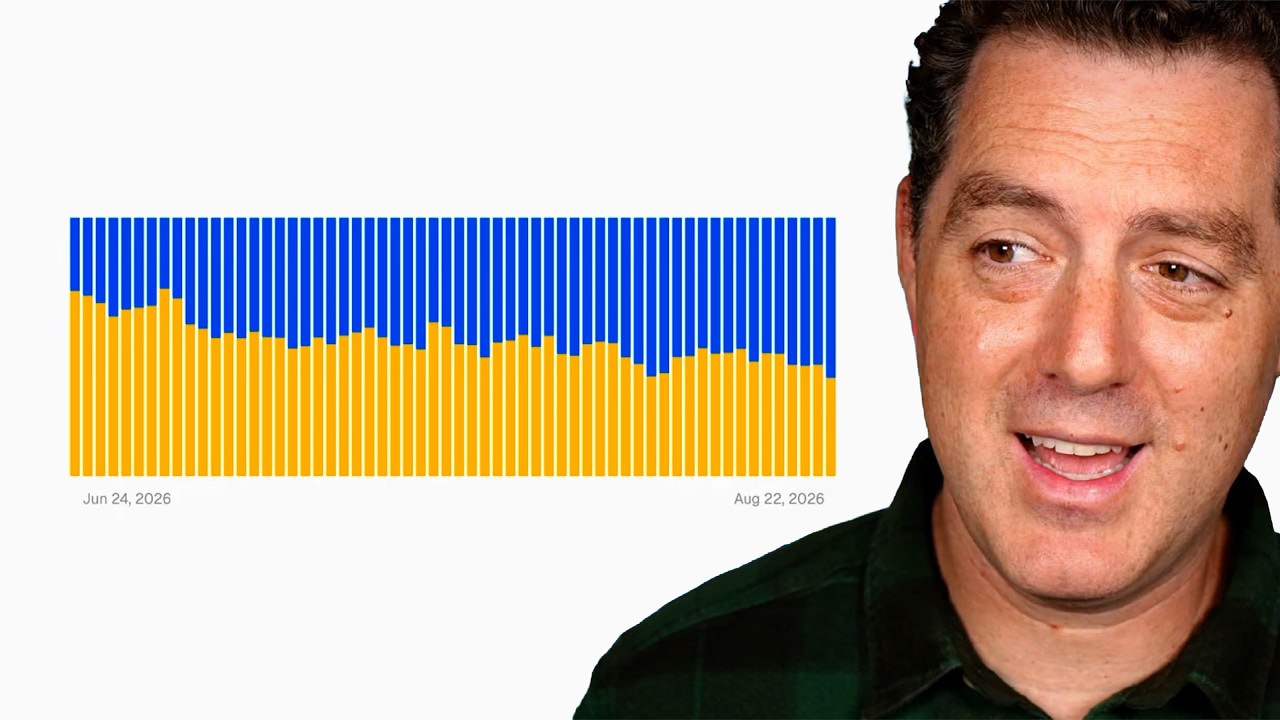
The Most Important Chart In AI

The Most Important Chart In AI Right Now

🎬 Matthew Berman πŸ“… Aug 26, 2026 ⏱ 20:46
open weights tokenomics DeepSeek China platform risk

πŸ“Š The Chart (Vercel)

"I've been predicting this for a while β€” and the flip just happened." The chart, from AI-hosting company Vercel, shows the share of open vs closed weights models going through their platform from June to August 2026. The yellow (closed: ChatGPT, Claude) line is trending down; the blue (open weights) bars are trending up. 1:00

Important caveat: this is token volume, not revenue β€” and the total pie of tokens is itself growing. Open weights are winning usage, not (yet) dollars. 2:38

πŸ‹ DeepSeek Eclipses Anthropic

"DeepSeek has actually eclipsed Anthropic in total token share percentage." The red line: DeepSeek at 25.2% vs Anthropic's 24.5%. But look at the purple line β€” total model spend β€” and the story inverts. 2:58

The wild number: DeepSeek captures just 2.8% of token-spend dollars vs Anthropic's 64.6% β€” "Anthropic's spend share is 23Γ— DeepSeek's, and I don't think that's going away anytime soon." DeepSeek wins the tokens; Anthropic wins the value. 3:28

πŸ’Ž The Frontier Is Worth Billions

"These models are quite close β€” a few percentage points in benchmarks. But the absolute frontier is worth billions." The difference between "95% as good" and the frontier is massive. Zoomed out: the top models take ~50% of token share but ~90% of revenue. 4:00

Gavin Baker's prediction (VC, tokenomics): "frontier tokens (Anthropic, OpenAI) are 60–90% of all economic value, but only 10–25% of tokens." The hardest tasks are where people pay a huge premium β€” "high-frequency trading: the value of a slight edge over your competitor is literally billions." 6:45
And this isn't bad for the rest of the economy β€” "we get really good tokens, not the absolute frontier, but very appropriate for all our tasks, at a fraction of the price." 7:20

πŸ’° The Pricing Gap

ModelOutput price
Claude Fable 5$50 / million output tokens
DeepSeek V4 Flash$0.18 / million output tokens
"That's a crazy price difference." "If DeepSeek V4 Flash can handle the vast majority of tasks for the vast majority of people, why pay $50? But when the right answer matters β€” when the Flashes can't get there on the hardest problems β€” the extra cost is well justified." 7:43
The revenue leaders: Anthropic above $65B annualized run rate, OpenAI ~$40B β€” "more than every open model provider combined." 8:30

πŸ”“ Why Open Weights Matter

Matthew's three reasons, plus one more. 12:52

  1. Ownership. "You own the data, the context, the output β€” everything end-to-end is in your control." (Fable keeps your data; if Anthropic ever competes with you, "they'd have all the data to train a model to compete directly.")
  2. Bargaining power. Instead of two majors, you choose from dozens of "neo-cloud" inference providers competing with each other.
  3. Customization. "Feed it all your data and it learns how you do business β€” more intelligence for the same price."
  4. Everybody can build on it. Already 151,000+ Qwen derivative models β€” people are doing the fine-tuning for you.
The "platform risk" framing: "when you build your entire business on another company's model, if they decide to compete with you or turn you off, you're completely beholden to them." 13:55

🏒 Who's Building On Them

Big, household-name US companies β€” not anonymous startups: Thomson Reuters (Qwen), Harvey legal AI (Kimi K3), Cursor (Kimi K2.5), Airbnb (Qwen), Perplexity (DeepSeek). 9:25

Why Harvey: legal data is sensitive, so "you want a model you have full control over β€” and you fine-tune it on your internal data." Harvey's fine-tuned Kimi K3 tops legal benchmarks: Legal Agent Bench 19.7 (just behind Muse Spark's 20), contracts #1, corporate law 74. 10:20
The CTO of Thomson Reuters: "Renting a house β€” you have a roof and someone takes care of it, but you're not building equity that compounds. You're renting intelligence from OpenAI and Anthropic. Train the open model yourself, give it your data, build that enterprise knowledge β€” that's real equity." 17:05

🧭 The Three-Way Split

Christian Catalini (MIT cryptoeconomics lab, ex-Meta head economist) predicts token-spend value splits three ways. 11:55

BucketWhatShare
Cheap generalistCommodity open weightsMost volume, small % of spend
SoTA specialistsEnterprise proprietary context, open weightsMost spend
Absolute frontierSoTA generalist closed labsSmall % of volume, most revenue
Cost-per-task, not per-token: (Bindu Reddy) β€” Kimi K3 is half the per-token price of GPT-5.6 Soul, but a completed task costs 84Β’ vs 96Β’ because "some models use many more tokens to complete the same task." Judge by the finished job, not the sticker price. 10:55

⚠️ The Geopolitical Risk

The closing argument β€” and Matthew's one worry. "Open weights win on volume, closed labs win on revenue. But most open-weights models are coming out of China." 18:55

The dependency trap: "if US enterprises build on Chinese open-weights models, it sounds good short-term β€” but when those models start being co-designed with Chinese chips, and we're building on top of them, the United States becomes dependent on Chinese chips. That's a big geopolitical risk." He's "still worried the US does not have a strong open-source strategy yet." 19:05
The advice: "go get an open-source model. Download it, customize it, use it at your business, get familiar β€” you'll save money and have much more control." 19:45

βœ… Key Takeaways

  1. The flip happened: open-weights models are winning token volume on Vercel's platform; closed weights are trending down.
  2. But volume β‰  value. DeepSeek has 25.2% of tokens but 2.8% of spend; Anthropic 24.5% of tokens but 64.6% of spend (23Γ—).
  3. The frontier is worth billions β€” "the difference between 95% as good and the frontier is massive" (60–90% of value, 10–25% of tokens).
  4. Open weights win on ownership, bargaining power, customization, and ecosystem (151k Qwen derivatives) β€” and platform risk is the reason enterprises switch.
  5. Judge cost-per-completed-task, not per-token β€” Kimi K3 at half the token price still costs ~the same per task.
  6. The geopolitical catch: most open-weights models are Chinese, and co-design with Chinese chips creates US dependency risk.

πŸ“ Timestamp Index

1:00 The Vercel chart
2:58 DeepSeek eclipses Anthropic
4:00 Frontier worth billions
7:43 Pricing gap
9:25 Who's building on open weights
10:55 Cost-per-task
11:55 The three-way split
12:52 Why open weights matter
17:05 Thomson Reuters quote
18:55 Geopolitical risk
☰ View all