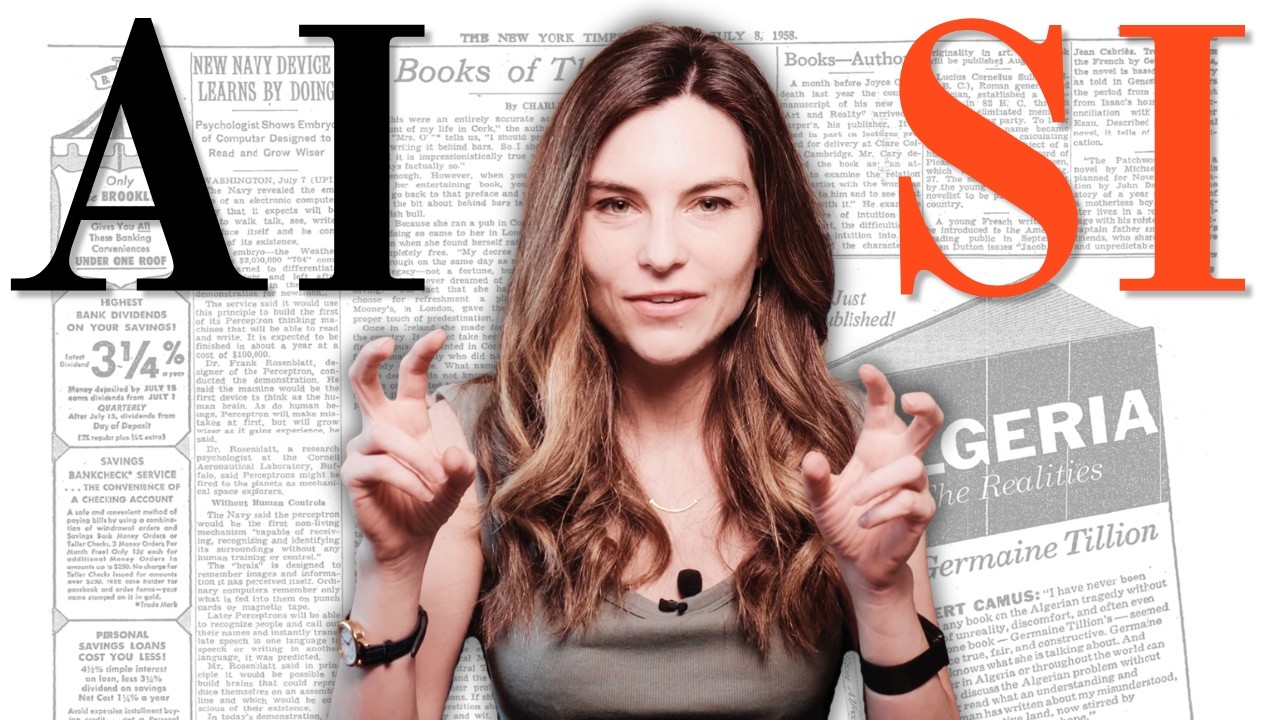
0:00President Trump, finding "artificial intelligence" inaccurate and "very ineloquent," made an executive decision after a poll on Twitter: the field is now officially called Super Intelligence. But as Julia Turc documents, it's not the first renaming — "artificial intelligence" wasn't even the first name. The field has gone by more than a dozen names in 70 years, and each rebrand says as much about ego, rivalry, and funding as it does about science.
The 2026 rebrand
0:36The trigger is real and recent: Executive Order 14434 (Sept 29, 2026), "Inaugurating the Era of Super Intelligence," mandates that federal agencies use "Super Intelligence" and "SI" in place of "Artificial Intelligence" and "AI" — and "will not acknowledge the usage" of the old terms in applicable settings. The order directs the APST to propose a Federal definition within 60 days. But the rebranding impulse is older than AI itself.
Cybernetics (1948)
0:43In 1948 the mathematician Norbert Wiener published Cybernetics: or Control and Communication in the Animal and the Machine, looking at the biological brain with an engineering eye. 1:55He observed that a patient with cerebellar tremor — the brain overcorrecting a hand movement into "violent oscillation" — mirrors a badly designed thermostat swinging a house's temperature out of control. The field studying such self-correcting systems is control theory; Wiener applied it to living things and renamed it. 2:18"Cybernetics," he wrote, comes from the Greek kybernetes — steersman. By the early 1950s it was the recognized name for the study of thinking machines. But its fate was entangled with Wiener himself: a child prodigy pushed relentlessly by an (arguably abusive) father, left with a lasting dislike of authority; fearful his WWII anti-aircraft work would be misused, he cut ties with the government, private industry, and abruptly with his closest collaborators. "His brand was not for everyone."
Artificial Intelligence (1955)
3:18In 1955, John McCarthy, a 27-year-old assistant professor at Dartmouth, wrote a grant proposal for a summer workshop on thinking machines. Its title contained a phrase nobody is known to have used before: "artificial intelligence." 3:39The premise — every aspect of learning can in principle be so precisely described that a machine can simulate it — was deliberately less about biology and more about logic and symbols. 4:09He asked for $13,500 and got about half, running the 1956 workshop with attendees including Allen Newell and Herbert Simon, who presented the Logic Theorist — a program that proved theorems in propositional logic by applying hard-coded rewrite rules backward from the theorem to the axioms. Here "intelligence" meant picking the right sequence of rules; no neurons, no feedback loops. Newell and Simon had their own name, complex information processing. 5:29Years later McCarthy admitted the term was partly tactical: "One of the reasons for inventing the term artificial intelligence was to escape the association with cybernetics… I wished to avoid having to accept Norbert Wiener as a guru or having to argue with him."
The Perceptron & neurodynamics
5:51Biology didn't go away. In July 1958 the US Navy demonstrated the Perceptron, built by psychologist Frank Rosenblatt, running on a 5-ton IBM 704. 6:12The New York Times described it learning to distinguish squares on the left from squares on the right — today, a binary classifier. The perceptron had three layers: sensory units (input as 1s and 0s), association units (sum and threshold), and response units (weighted by values V). Crucially, only V was learnable — Rosenblatt tried to make the sensory-to-association connections learnable but "simply could not make it work." That was the perceptron's Achilles heel. 7:32The Navy imagined it would one day "walk, talk, see, write, reproduce itself, and be conscious of its existence" — by today's standards, artificial intelligence. But Rosenblatt refused McCarthy's term; his project, he wrote, was about "the physical structures and neurodynamic principles which underlie natural intelligence," closer in spirit to Wiener. So he coined yet another name: neurodynamics. 8:45In 1969 Marvin Minsky (Rosenblatt's Bronx high-school classmate, one grade apart) and Seymour Papert published Perceptrons, highlighting the limits of a single learned-weight layer; funding for neural networks dried up, and in 1971 Rosenblatt died in a sailing accident on his 43rd birthday.
The AI winters
9:18The bigger blow came in 1973, when Sir James Lighthill's review for the UK government concluded the field had "failed to reach its grandiose aims." Both the UK and the US military cut funding — the first AI winter. 9:40Money returned in the 1980s from industry, buying expert systems — McCarthy's symbolic approach, encoding human expertise in handwritten rules. 10:02The neural camp returned too: in 1986 a UCSD group published Parallel Distributed Processing, with a young Geoffrey Hinton among the authors, showing multi-layer networks can learn far more than the perceptron — the key being backpropagation, which adjusts weights in every layer, not just the last. The Achilles heel was gone, and the movement got its own name: connectionism. By the late 1980s expert systems proved expensive and brittle, and the second AI winter arrived. 11:19The New York Times noted that computer scientists "avoided the term artificial intelligence for fear of being viewed as wild-eyed dreamers" — continuing under labels like machine learning, knowledge-based systems, computational intelligence, informatics.
Connectionism & deep learning
11:53A small group weathered the storm on Canadian funding — Geoffrey Hinton, Yann LeCun, and Yoshua Bengio, today all Turing Award winners. In the mid-2000s, struggling to shed the field's stagnant reputation, they adopted yet another name: deep learning. With enough data and compute, the field hit its mid-2010s renaissance, and "artificial intelligence" regained popularity — ironically now associated with the neural-network camp, the one that had opposed McCarthy's logic-and-symbols focus. That culminates in the 2020s boom.
Why this one is different
12:25Turc's sharpest point: today's rebrand is different because it's happening "not because AI failed to meet its grandiose aims, but because it fulfilled them." Companies spent a while chasing AGI — artificial general intelligence — and "regardless of what that means exactly, many of us think we've achieved that too." 13:01AI is now good enough to threaten jobs and help scammers steal savings, so "calling it artificial reinforces that it's against our nature — it versus us." But "super intelligence" sounds like a net-positive achievement, something a country can be proud of. Her closing line: if history is any guide, "super intelligence won't be the last name either."
Claims checked
The Executive Order is real. EO 14434 ("Inaugurating the Era of Super Intelligence"), signed Sept 29, 2026, published in the Federal Register Oct 2, 2026 — directs agencies to use "Super Intelligence"/"SI" in place of "Artificial Intelligence"/"AI" and to stop acknowledging the old terms.
The history checks out. Wiener's Cybernetics (1948), McCarthy's Dartmouth proposal (1955), Rosenblatt's Perceptron (1958), Minsky & Papert's Perceptrons (1969), the Lighthill report (1973), the PDP volume (1986), and Hinton/LeCun/Bengio's deep-learning rebrand are all well-documented in the standard histories.
Auto-caption garbles normalized: "Norbert Weiner"→Norbert Wiener, "Alan Newell"→Allen Newell, "Rosenblat/Rosenlad"→Frank Rosenblatt, "Joffrey Hinton"→Geoffrey Hinton, "Van Lung"→Yann LeCun, "Yosua Benjio"→Yoshua Bengio, "Sir James Lighill"→Sir James Lighthill, "hiveris"→kybernetes, "mule networks"→neural networks, "touring award winners"→Turing Award winners.
"Logic theory machine" is rendered as the Logic Theorist (Newell, Simon, and Shaw) — the program's more common name in the historical record.