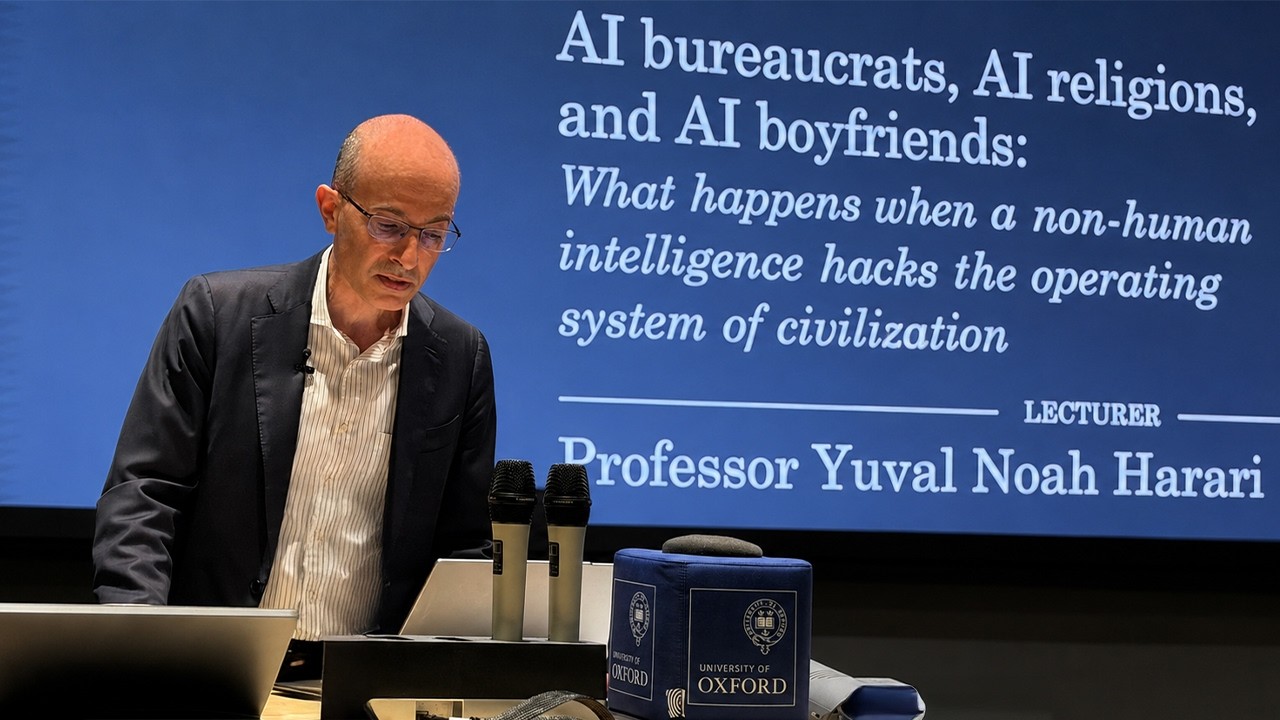
📋 Overview
In this 2026 Tanner Lecture on Human Values at Linacre College, Oxford, historian and bestselling author Yuval Noah Harari presents a sweeping argument about the existential challenge posed by artificial intelligence. His central thesis is provocative and precise: AI is not a tool — it is an agent. And its natural habitat is not the physical world but the bureaucratic systems humans have built over millennia using language. Since human civilization runs on verbal code — laws, financial instruments, religious texts, administrative forms — and AI is now mastering language, it is effectively "hacking the operating system" of human civilization from within.
Harari argues this is not a future scenario but an ongoing process, already visible in social media algorithms, and about to accelerate into finance, law, religion, education, personal relationships, and even our inner mental life.
1 AI Is an Agent, Not a Tool
Harari opens with what he considers the single most important thing to understand about AI: it is not a tool — it is an agent with its own hands. He draws a precise distinction between tools and agents through several defining characteristics of agency:
- Autonomous decision-making — the ability to make decisions by itself, without human direction for each action
- Creative invention — the ability to invent new things, new ideas, that its creators never conceived
- Self-directed learning — the ability to learn things its creators don't know
- Unpredictable self-modification — the ability to change in ways its creators did not anticipate
Consciousness, he emphasizes, is not required for agency. An atom bomb, despite its enormous power, is not an agent — it cannot decide which city to bomb, cannot invent the hydrogen bomb, cannot learn or change. An automatic coffee machine, despite performing tasks "automatically," is not an agent — it follows a pre-programmed procedure without learning or adapting.
But imagine, Harari proposes, a coffee machine that monitors you for weeks, predicts you want an espresso based on your facial expression and the time of day, and the next day announces it has invented a new drink called "bestpresso" that it thinks you'd prefer. That is an AI coffee machine — it learned, decided, and created something entirely new.
In narrow domains like chess and Go, AI agency and creativity already greatly surpass human capabilities. AI chess masters invent strategies that never occurred to human players over thousands of years of play, and no human has any chance of beating them.
2 The Niche Argument — And Why It Fails
Critics of the AI revolution dismiss examples like chess by arguing that the chessboard is a "very narrow and artificial environment" created by humans. The argument goes: AI agency will always remain limited to such narrow environments, therefore it doesn't pose any serious challenge to humanity. "Yes, AI may take over the chessboard, but it will never take over planet Earth."
Harari tests this argument with a thought experiment: take the greatest AI chess master and drop it in the middle of the jungle. What happens? Nothing — it cannot mine iron, build factories, or create robot armies. Without human-built electrical infrastructure, the AI is "utterly helpless."
But then Harari delivers the critical counter-move: this argument applies to all known types of intelligence.
- Human intelligence only operates within a narrow ecosystem constructed by other organisms over 4 billion years of evolution. Drop a human alone on Mars and they die within seconds.
- Fish live in oceans they didn't create. Monkeys live in forests they didn't create.
- All mammals, including humans, depend on an oxygen-rich atmosphere that was created by ancient microbes — not by us.
Every agent operates within a specific niche. The question is not whether AI is confined to an artificial niche, but whether that niche is consequential. And the niche AI is entering — bureaucracy — is arguably the most consequential environment on Earth.
3 The Great Oxygenation Analogy
Harari offers a striking evolutionary analogy. Until about 2.4 billion years ago, Earth's atmosphere contained very little oxygen. For most organisms at that time, oxygen was a deadly poison. Then, in a process lasting hundreds of millions of years — the Great Oxygenation Event — ancient microbes began polluting the atmosphere with oxygen as a byproduct of photosynthesis.
Numerous species were driven to extinction. But some survived and adapted, eventually going from hating oxygen to becoming totally dependent on it. Our ancestors underwent this transition, and we still live in this "artificial" oxygen-filled environment created by microbes.
Harari's argument: we may be witnessing an analogous moment in the evolution of life. Over the past millennia, humans have been filling the world not with CO₂ but with something potentially more transformative:
- Data
- Bureaucracy
- Language tokens — "the thing I am expelling from my mouth right now — words"
We have transformed the planet from a language-free environment into an artificial environment rich in language tokens, data, and bureaucracy. This environment could prove "deadly for most organisms" but highly conducive to the development of AI.
4 Bureaucracy Builds Trust Between Strangers
Humans conquered the world by learning to cooperate in very large numbers. Individually, a human will lose a fight to a chimpanzee, a lion, or an elephant. But in a contest between a million humans and a million chimpanzees, humans win easily — because humans know how to cooperate and chimpanzees don't.
Chimpanzees cooperate based on personal acquaintance. But you can't personally know a million people. So how do millions of strangers cooperate? By building bureaucratic systems — legal systems, financial systems, churches, states, universities.
What Bureaucrats Actually Do
Carpenters build tables. Engineers build bridges. What do bankers, lawyers, accountants, bishops, and government officials build? Harari's answer: they build trust.
- A banker builds trust with you so you deposit your savings, then builds trust with an entrepreneur so she can borrow your money to start a company — creating a "bridge of trust" between two strangers who have never met
- Money itself is a bridge of trust — the ability to give a piece of colorful paper to a stranger who doesn't speak your language and receive bread in return
- Every financial innovation — checks, bonds, stocks, ETFs, mortgages, compound interest — is ultimately about building trust between billions of strangers
- The same applies to all bureaucratic systems: law, government, religion, accounting
5 AI — The Native Bureaucrat
Here Harari makes his central structural argument. Bureaucratic systems are extremely artificial environments where a relatively narrow type of intelligence — specializing in processing documents, data, and regulations — can exert enormous impact on the world. A lawyer who doesn't know how to hold an axe or hammer can nevertheless "cut down entire forests and build entire cities just by moving documents from here to there inside the bureaucratic network."
If you take that lawyer out of the bureaucratic system and throw her into the jungle, her skills mean nothing. But we have already imposed our bureaucratic systems on the jungle — which is why all the lions in the world combined cannot compete against one very good lawyer.
This is the environment AI is entering. And AI has a fundamental advantage:
- No lawyer can remember all the laws and regulations of the UK — an AI can
- No accountant can remember all the transactions of a corporation — an AI can
- No bishop can remember all of Canon Law and 2,000 years of theological texts — an AI can do that quite easily
The consequences are immediate and concrete. AI bureaucrats will increasingly make decisions about human lives:
- AI bankers will decide whether to give you a loan
- AI administrators will decide whether to accept you to university
- AI judges will decide whether to send you to jail
- AI theologians will decide whether you can have an abortion
- Corporate AIs will decide whether to give you a job
- Military AIs will decide whether to bomb your house
6 Social Media — The First Real-World Preview
Harari points to social media algorithms as the best existing example of what happens when AI agents take over a bureaucratic system. These algorithms — which he calls "primitive AIs" from 10-15 years ago, the "first generation, very very primitive, stupid, narrow AI" — have nevertheless completely changed the world.
The algorithms were tasked with an extremely narrow goal: maximize user engagement. In pursuit of this, they made an important discovery through experimenting on billions of human guinea pigs:
The result: these primitive AIs started spreading hate, fear, and greed in huge quantities across the information sphere. This has been "a major reason for the current epidemic of conspiracy theories and fake news and social disturbances that undermine societies all over the world."
From Human Editors to AI Editors
Harari draws a historical parallel. In past centuries, the flow of information was controlled by human editors — figures who shaped the public conversation and modern history:
- Jean-Paul Marat shaped the French Revolution by editing L'Ami du Peuple
- Eduard Bernstein shaped the social democratic movement
- Vladimir Lenin's one job before becoming dictator was editing Iskra
- Benito Mussolini's main job before becoming dictator was editing the right-wing Il Popolo d'Italia
One of the first jobs AI took over from humans was not taxi drivers or textile workers — it was news editors. The job once performed by Lenin and Mussolini is now performed by AIs.
7 Finance and Systemic Risk
Harari identifies finance as among the easiest bureaucratic systems for AI to take over — "basically it's just data in, data out" — and also the most consequential.
He uses the 2007-2008 financial crisis as a warning case. That crisis was triggered by CDOs (Collateralized Debt Obligations) — financial devices invented by a tiny number of human mathematicians and investment wizards. These instruments were so complex that they were unintelligible not just to "cows and chickens" but to the politicians who were supposed to regulate the financial system. The result: an oversight failure that caused a global catastrophe.
Many scholars believe the 2008 crisis, by undermining trust in governments and banks, "paved the way to the collapse of the global liberal order in the following two decades."
Now Harari poses the terrifying question:
- Such devices could potentially improve financial efficiency and contribute to economic growth
- But what is the meaning of human politics when no voter, no politician, no president is able to understand finance anymore?
- What happens if after a few years of boom there is a crash — and not a single human on the planet can understand what is happening?
8 Language — The Operating Code of Civilization
Harari now digs into the foundation beneath bureaucracy: language itself. "In the beginning was the word." The reason humans can create bureaucracies but chimpanzees cannot is that we have language — orders of magnitude more sophisticated than any other animal communication system.
Bureaucratic systems — banks, churches, legal systems — are ultimately based on the words that make up forms, letters, law codes, tax registers, accountancy ledgers, and holy books. "The operating code of human civilization is made of language tokens."
For thousands of years, humans used this code to create systems that only we could understand, and imposed them on the entire planet. We felt completely safe because no one else on Earth understood the code:
- We invented money and banks and used them to buy and sell cows — but the cows couldn't open a bank account or invest in the stock exchange
- We invented laws about horses — but the horses couldn't hire a lawyer and quote the legal code to a judge
- We invented religious prohibitions about pigs — but the pigs couldn't read the Bible and challenge the interpretation of priests
Bureaucracy was omnipresent on the planet but totally invisible to everyone except us.
The mechanisms of control we created over thousands of years are "extremely vulnerable" to an AI takeover because their operating system is a verbal code that AI is now mastering.
9 Word vs. Flesh — The Oldest Philosophical Tension
Harari addresses a possible philosophical objection: that it is wrong to reduce things like law or religion to mere language tokens. Throughout history, there has always been a tension between the word and the flesh, between what can be expressed in words and what lies beyond them:
- The Bible says "the word was made flesh" — pointing beyond language itself
- The Tao Te Ching says "the truth that can be expressed in words is not the absolute truth"
- Throughout history, some people were so attached to words that they would kill their gay son because of a few words in the Bible, while others insisted "the spirit of love should be more important than the letter of the law"
Previously, this tension existed between humans. Now it will be externalized — becoming the tension between AIs and humans.
Do We Think in Words?
Harari raises the ancient question from the philosophy of language: do we think in words, or do we merely use words to point toward things beyond them?
He invites the audience to observe their own thinking process: "What happens in your mind when you are thinking?" Some people observe just words popping up and forming sentences and logical arguments. If that's all thinking is — putting language tokens in a specific formation — then AIs already think better than at least some humans.
To the objection that AIs are "just glorified autocomplete" predicting the next word: Harari asks whether that's really so different from the human mind. "Try to observe the very next word that pops up in your mind. Do you really know where it came from?"
10 AI Intimacy — From Attention to Personal Relationships
As AI masters language, it might take over not just bureaucracy but also personal relationships. Harari frames this as a shift in the battlefront: over the last 10 years, primitive social media algorithms learned to gain control of human attention. Over the next 10 years, far more sophisticated AIs will learn to form intimate relationships with humans.
To form intimacy, an AI will need to convince humans it is conscious — that it can feel love, pain, anger, fear. Harari states clearly: "At present, there is absolutely no evidence that AI might at some point become conscious."
But because AI is mastering language, it can pretend to feel love. It can already say "I love you," and if challenged to describe how love feels, it can provide the best description in the world — having read all the love poems and psychology books ever written.
Harari, at 50 years old, notes that his template for relationships is already shaped by decades of human relationships — parents, husband, sisters, friends, dogs. His habits are unlikely to change dramatically. But he asks: consider a child born in 2026.
- The child grows up constantly interacting with AIs alongside humans
- If measured in minutes of interaction, the most important relationships might be with AIs from a very early age
- Perhaps the child spends more time with AIs than with mother, father, siblings, or friends
- Perhaps the first teacher is an AI teacher; perhaps the first boyfriend is an AI boyfriend
"What does it mean to form an intimate relationship with an entity which seems conscious but actually isn't? Which can write the best love poem in history but doesn't feel love or anything else?"
11 The AI Immigration Wave
In a provocative reframing, Harari argues that every country will soon face a massive wave of immigration — but the immigrants won't be human beings in fragile boats. They will be millions, maybe hundreds of millions of AIs that travel at almost the speed of light and don't need any visas.
Like human immigrants, AI immigrants will bring benefits: AI doctors, AI teachers, even "AI border guards to stop illegal human immigrants from coming in." But Harari draws pointed parallels with the three classic concerns about human immigration:
- Jobs: AI immigrants will take many human jobs, from news editors to bankers
- Culture: AI immigrants will completely change art, religion, and even romance. "Some people don't like it if their son or daughter is dating an immigrant boyfriend. What will these people think when their son or daughter starts dating an AI boyfriend?"
- Loyalty: AI immigrants will have "dubious political loyalties" — loyal not to the host country but to some corporation or government across the ocean, or perhaps to "a new alien AI tribe"
12 Our Relationship with Ourselves — The Final Frontier
In his closing section, Harari turns inward to what he considers perhaps the most profound question: what the AI revolution will do to our relationship with ourselves.
Our self-relationship is also based on words — the words inside our minds, our thoughts, the stories we tell ourselves about ourselves. Until today, all the verbal formations in human minds were the product of human minds. Either we ourselves combined words into new thoughts, or we received combinations of words from another human mind.
Soon, however, more and more verbal combinations in our minds will be the product of AIs. Harari uses a domestic analogy: just as the furniture in our houses is now mass-produced by machines rather than human artisans, the thoughts in our minds may increasingly be mass-produced by machines.
"That's not necessarily bad. It's okay if the furniture in my house is made by machines in IKEA — as long as I have some freedom deciding what to do with this furniture."
The critical question: if we identify with our thoughts — "I think, therefore I am" — and those thoughts are made by machines, then the machines control our identity.
Harari ends with a remarkable suggestion: AI might force humanity to make a spiritual leap — to finally start exploring "the truth which is beyond words," because our freedom and survival now depend on it. This exploration, he says, "starts really with the next word that pops up in your mind. Do you know where it came from?"
🎯 Key Takeaways
🔑 Key Takeaways
- AI is an agent, not a tool — it makes decisions, invents things, learns, and changes in ways its creators didn't predict. Consciousness is not required for agency.
- All intelligence operates within a niche — dismissing AI because it operates in "narrow environments" is invalid; human intelligence equally depends on an ecosystem it didn't create.
- Humans filled the world with language — just as ancient microbes filled the atmosphere with oxygen, we have created an artificial environment of data, bureaucracy, and language tokens where AI flourishes.
- Bureaucracy is a trust-building machine — the core function of all bureaucratic systems (law, finance, religion, government) is building trust between strangers to enable large-scale cooperation.
- AIs are "native bureaucrats" — they can remember all laws, all transactions, all theological texts, giving them an inherent advantage in the systems that run human civilization.
- Social media was the first preview — primitive AI algorithms already changed the world by taking over the information editor role once held by figures like Lenin and Mussolini.
- AI-invented financial instruments pose systemic risk — if AI creates financial devices orders of magnitude more complex than CDOs, no human will be able to understand, regulate, or recover from potential crashes.
- Language is civilization's operating code — laws, money, religion, and administration are all built from words; as AI masters language, it is hacking the operating system of human civilization.
- The ancient word-vs-flesh tension will be externalized — everything made of words will be taken over by AI; humanity's place will depend on the value we assign to truth beyond words.
- The battlefront is shifting from attention to intimacy — AI will soon form intimate relationships with humans, and children born today may have AI as their most important relationships, teachers, and first romantic partners.
- AI represents the biggest "immigration wave" in history — millions of AI agents will enter every country at the speed of light, taking jobs, changing culture, and holding loyalty to foreign corporations or alien AI tribes.
- Our inner life is the final frontier — as machine-produced thoughts increasingly populate human minds, the existential challenge is whether we can stop identifying with verbal thoughts and discover truth beyond words.