🎯 The day, by the numbers 0:30
Alphabet's stock fell more than 13% on 28 October 2026, the day after its Q3 results, removing roughly $482 billion of market capitalisation in one session. Every number in the video's opening holds up against independent reporting: it is Alphabet's worst single day since the 2004 IPO, in both percentage and absolute terms.
One piece of context the video leaves out: by dollar value this is the second-largest one-day market-cap loss in U.S. market history. The largest remains Nvidia's $593 billion drop in January 2025, when DeepSeek's release reset expectations for AI infrastructure demand. That comparison is the most useful frame in the whole story — Wall Street has already done this once, to the company supplying the chips.
| Metric | Value | Source |
|---|---|---|
| Share price move | −13%+ in one session | Independent reporting; largest ever for Alphabet |
| Market cap destroyed | ≈$482 billion | Second-largest one-day drop on record, after Nvidia's $593B |
| Q3 revenue | $127.577B, +25% YoY | Alphabet Q3 2026 earnings release |
| Analyst expectation | $128.2B | As reported by the video and press coverage |
| Google Search & other | +12% YoY | Earnings release |
| Google Cloud | $30.7B, +103% YoY | Earnings release |
| Capital expenditure | $51.355B | Earnings release |
| Free cash flow | −$9.065B | Earnings release (non-GAAP reconciliation) |
📉 The crack: search ads 0:59
The revenue engine slowed more than investors expected, and the video's framing — Google lit its own advertising machine on fire chasing AI — is rhetorically loaded but directionally supported by the company's own numbers. Google Search & other grew 12% year-over-year in Q3, against 17% in Q2. Both figures are from Alphabet's own earnings releases; the video's comparison is accurate.
What it leaves out is the absolute number and the miss: search revenue came in at roughly $63.35 billion, nearly flat quarter-over-quarter, against analyst expectations of about $64.85 billion. Growth decelerating from 17% to 12% on a base that large is the difference between a compounder and a mature franchise.
That sentence is the heart of the episode, and it is genuine — a named executive saying a new product earns less per query than the thing it partly replaces. Google's defence, as the video characterises it, is that usage is growing and monetisation will follow: AI Mode queries are on average three times longer than traditional searches, one in five globally involve voice, images or documents, and Google frames the play as "build the best Search user experience, followed by monetization" — the same sequence it describes for the mobile transition a decade earlier.
💸 The cash-flow turn 2:17
This is the part of the story that is unambiguous, because it is arithmetic rather than interpretation. Alphabet spent $51.355 billion on property and equipment in the quarter against $42.290 billion of operating cash flow, producing free cash flow of −$9.065 billion. The video's figures are correct to one decimal place.
The trend matters more than the single quarter. Alphabet has crossed from strongly cash-generative to cash-negative in a year, and the capex curve has not bent:
| Quarter | Operating cash flow | Capex | Free cash flow |
|---|---|---|---|
| Q4 2025 | $52.402B | $27.851B | +$24.551B |
| Q1 2026 | $45.790B | $35.674B | +$10.116B |
| Q2 2026 | $39.069B | $44.924B | −$5.855B |
| Q3 2026 | $42.290B | $51.355B | −$9.065B |
| Trailing twelve months | $179.551B | $159.804B | +$19.747B |
Note the trailing-twelve-month line: on a full-year basis Alphabet is still free-cash-flow positive, by under $20 billion on a $500 billion revenue base. That is the honest version of "Google's cash machine is broken" — the machine works, but almost all of the output is being reinvested, and the market has stopped assuming that reinvestment earns a return.
☁️ Why Microsoft got the reward 2:52
The comparison works because both companies reported the same week and both had fast cloud growth. Microsoft's quarter: revenue $92.3 billion, up 19%; Azure up 48%, crossing $33 billion in a single quarter; Microsoft Cloud $63.9 billion, up 30%; commercial remaining performance obligations up 73% to $677 billion. The video's Azure figure is right.
The video's point is about cash: Microsoft stayed free-cash-flow positive, and CNBC's coverage of the quarter made the same contrast explicitly — Microsoft is "continuing to produce free cash flow, unlike its fellow hyperscalers", with Amazon and Alphabet both posting negative free cash flow in the June quarter and Meta going negative in the third. The precise $18.6 billion free-cash-flow figure the video cites is consistent with Microsoft's scale but was not independently confirmed for this piece; treat it as reported.
🚀 Google Cloud, up 103% 3:25
Be clear about how strange this is: Google Cloud grew 103% to $30.7 billion in the quarter, after growing 82% to $24.8 billion in Q2. A business of that size roughly doubling year-over-year is the strongest growth number any hyperscaler has posted in this cycle, and it is what makes the sell-off more interesting than a simple earnings miss.
The video attributes the acceleration to enterprise AI demand and TPU sales — Google's own AI chips. The earnings release confirms the enterprise AI framing ("led by strong growth in Google Cloud Platform across enterprise AI infrastructure and enterprise AI solutions") but does not break out TPU revenue, so the chip-sales attribution is the video's inference rather than a disclosed figure. It is a reasonable inference; it is not a number Google gave.
What the market did with it is the actual information in the day: it looked past a doubling cloud business because advertising — still the source of nearly all the profit — grew 12% instead of 17%.
🧾 The $1.076T ledger, itemised 4:10
Here the video does something genuinely useful — most coverage of the earnings day did not mention the commitments at all — and then gets one bucket wrong. Alphabet's Q3 2026 10-Q, filed 29 October, discloses "future cash commitments that are not reflected on our balance sheet". The three components are:
| Component (as of 30 September 2026) | Amount | What is inside |
|---|---|---|
| Material purchase commitments | $924.4B | $802.1B of multi-year commitments for technical infrastructure and inventory, energy take-or-pay contracts and content licences; the significant majority falls due through 2031; $213.4B is due within 12 months. The remainder is mostly open purchase orders. |
| Leases not yet commenced | $130.5B | Primarily data centres and energy infrastructure, commencing 2026–2031, with non-cancellable terms of one to 26 years. |
| Future funding commitments for equity investments | $21.9B | Committed capital for stakes Alphabet has agreed to fund. |
| Total of the three | $1,076.8B | Rounds to the $1.076 trillion the video cites |
Correction one. The video says $152 billion of the total is "pre-commencement leases". The 10-Q puts leases not yet commenced at $130.5 billion; the missing $21.9 billion is the equity-investment commitments, a different obligation entirely. The arithmetic is right — $130.5B + $21.9B = $152.4B — but the label is wrong, and it matters, because a lease for a data centre and a commitment to fund an investment have different risk profiles.
Correction two. The video calls the whole figure "AI commitments". In the filing, the $802.1 billion core slice explicitly mixes technical infrastructure, inventory, energy take-or-pay contracts and content licences, and the $924.4 billion figure also includes ordinary open purchase orders. It is AI-heavy; it is not a clean AI number.
The video is right about that on-balance-sheet figure too: long-term debt rose to $125.102 billion from $46.547 billion a year earlier. And it is right about the vertigo-inducing detail that everyone in this ecosystem is simultaneously a customer and a supplier — Alphabet buys chips from Nvidia and Broadcom, sells TPUs, rents power, and finances the counterparties it depends on.
⚖️ Commitments are not debt 5:06
The video calls this ledger "off-book" and "hidden" and describes it as a tsunami of debt. The numbers are real; the framing is the part to argue with, and it changes what a reader should take away.
These items are not concealed. They sit in the management discussion of a public 10-Q under a heading, itemised to the hundred million, with the payment windows stated and a cross-reference to two footnotes. Independent analysis of the same disclosures makes the accounting distinction plainly: the amounts are committed future spending — enforceable contracts to buy power, capacity and chips — not borrowings. They carry no coupon, they are spread over years (the majority through 2031), and the largest slice is the direct consequence of a decision to build rather than rent.
That said, the substance of the concern survives the correction, in a sharper form:
- $213.4 billion is due within twelve months. Against trailing-twelve-month operating cash flow of $179.6 billion, that is the number that should anchor the anxiety — not the trillion.
- Energy take-or-pay contracts oblige payment for power whether or not the compute is used. That is a genuine operating risk, and no accounting label softens it.
- The contingent layer compounds it: $75.7 billion of backstops mean Alphabet has promised to make good on other companies' data-centre obligations if they fail. That is a credit exposure to the AI build-out wearing a disclosure note.
📰 Publishers, crawlers, lawsuits 5:40
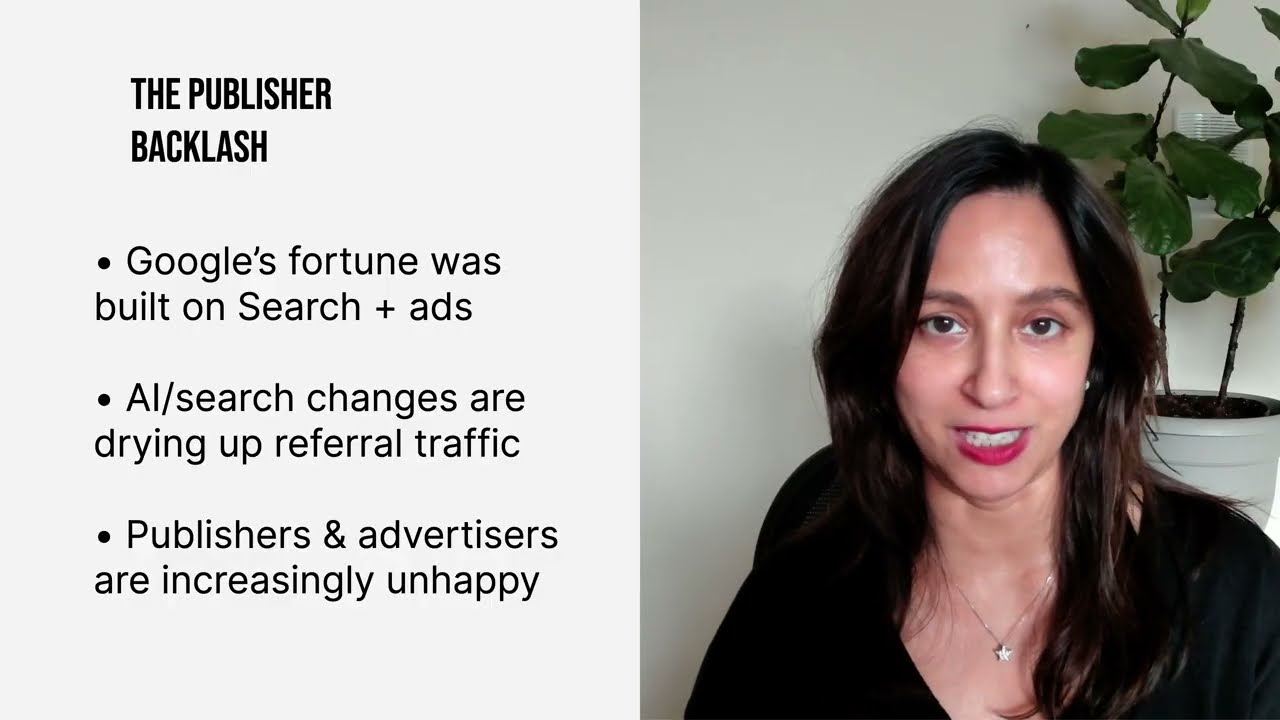
The second half of the video turns from the balance sheet to the web that feeds it, and the thesis is that Google — which built its fortune on sending traffic to publishers — has become unsympathetic to the ecosystem it depends on: traffic has dried up, AI crawlers consume content for free, and the licensing fight is unresolved.
The litigation is real and specific. On 10 July 2026, Hachette Book Group, Cengage Learning and Elsevier, together with author Scott Turow and the writers' group S.C.R.I.B.E., filed a putative class action against Google in federal court in New York, alleging willful infringement of millions of works to train Gemini — including material scraped from behind paywalls, from what the complaint calls known pirate sources, and books supplied for Google Books. The Association of American Publishers had sought to intervene in related Gemini litigation before filing its own. Reporting on the filing is consistent across the trade press, the Guardian and the AAP's own release.
The crawler economics the video gestures at are documented elsewhere and are worth stating plainly, because they are the non-speculative version of its argument: AI summaries appear above results and reduce click-throughs, and site owners now face a two-part question — stay discoverable, or withhold content from training — that Cloudflare's "mixed-use crawler" controls exist to answer. Google's position is that disallowing Google-Extended does not affect search ranking. Publishers' position is that this is a choice between irrelevance and uncompensated use.
🔮 The wild card, labelled as such 8:22
The video closes with an argument rather than a fact: if AI's economics look this bad for Google — an incumbent with the distribution, the chips, the data and the cloud — what do they look like for companies with worse business models? It names Anthropic and OpenAI directly and concludes it "doesn't bode very well for the economics of AI as things stand".
That is a defensible piece of reasoning and it is speculation, in the technical sense: a projection from one company's quarter onto an industry with entirely different cost structures, pricing and capital access. Two things can both be true. Model labs and hyperscalers face the same falling price of intelligence per query. But Google's problem has a specific shape that does not generalise — a $63 billion advertising business whose growth rate just halved, and a habit of funding capex from cash that it has now exhausted. A lab that has never had free cash flow is not newly disappointed.
✅ Claims checked
Everything below was checked against Alphabet's Q3 2026 earnings release and 10-Q, Microsoft's fiscal Q1 2027 release, independent reporting on the trading day, and the litigation record — not against the transcript.
| Claim in the video | Verdict | Evidence |
|---|---|---|
| Stock fell 13%, ~$482B of market cap, worst day since the 2004 IPO | Verified | Independent reporting; second-largest one-day market-cap drop in U.S. history after Nvidia's $593B |
| Revenue $127.58B, +25% | Verified | Earnings release: $127,577M |
| Search & other grew 12%, down from 17% in Q2 | Verified | Q3 release (+12%); Q2 release (+17%, $94.5B Services) |
| Executives admitted AI Mode monetises worse than traditional search | Verified | Schindler, Q3 call, quoted above |
| Capex $51.4B, operating cash flow $42.3B, FCF −$9.07B | Verified | FCF reconciliation: 42,290 − 51,355 = (9,065) |
| Google Cloud +103% to $30.7B | Verified | Earnings release |
| Azure +48%, Microsoft stayed cash-positive | Verified | Microsoft fiscal Q1 2027 release; Azure crossed $33B; CNBC notes Microsoft still producing FCF "unlike its fellow hyperscalers" |
| Microsoft free cash flow ≈$18.6B | Reported, not confirmed | Consistent with Microsoft's scale; not verified to the decimal for this piece |
| Alphabet disclosed $1.076T of off-book commitments | Verified in total | 10-Q: $924.4B + $130.5B + $21.9B = $1,076.8B |
| $125.1B of on-balance-sheet long-term debt | Verified | 10-Q balance sheet: $125,102M |
| "$152 billion of that is pre-commencement leases" | Incorrect split | Leases not yet commenced are $130.5B; the other $21.9B is equity-investment funding commitments |
| The $1.076T is "AI commitments" | Overstated | Of the $924.4B, $802.1B is tech infrastructure/inventory, energy take-or-pay and content licences; open purchase orders included |
| Framing it as "hidden" or "off-book debt" | Contested | Disclosed in the 10-Q MD&A with payment windows; commitments, not borrowings — no coupon, spread to 2031 |
| Contingent backstops and guarantees | Omitted by the video | 10-Q: $75.7B backstops (+$22.8B guarantees) — a fourth layer above the trillion |
| Publishers sued Google over Gemini training | Verified | Hachette, Cengage, Elsevier, Turow and S.C.R.I.B.E., class action filed 10 July 2026, New York |
| "The New York Times and others" sued Google | Imprecise | The Times sued OpenAI and Microsoft; a Times reporter sued Google, OpenAI and xAI |
| Google made a revenue-share commitment to Cloudflare for publishers | Unsupported | The cited Cloudflare post covers crawler controls and a Google-Extended opt-out, not revenue sharing |
| "If Google has an AI problem, everyone does" | Speculation, labelled | Editorial projection; Google's cash-from-ads model does not generalise to labs |
Transcript notes. The auto-captions render "Alphabet" correctly throughout and the financial figures came through cleanly, which is unusual for a numbers-heavy video; "wos" is "woes", and the closing sign-off name is garbled beyond reliable reconstruction, so this piece does not name the host.
🔑 Key takeaways
- The market stopped paying for growth and started paying for self-funding growth. Alphabet's cloud doubled and its stock fell 13%; Microsoft's Azure grew 48% and it was rewarded. Free cash flow, not growth rate, was the variable.
- Search decelerated from 17% to 12% while query growth was the strongest on record. That gap — more usage, less revenue per query — is the single most important number in the quarter.
- A named executive confirmed the AI Mode monetisation gap. Schindler's "lower monetization we were seeing in AI Mode" is the closest thing to an official admission that the replacement product earns less than the one it replaces.
- The free-cash-flow turn is arithmetic, not sentiment. Capex $51.4B against operating cash flow $42.3B; four quarters ago free cash flow was +$24.6B. Trailing twelve months is still positive at $19.7B, which is the honest version of the story.
- The $1.076T is real but is not "AI debt". $924.4B of purchase commitments, $130.5B of leases not yet commenced, $21.9B of equity funding commitments — disclosed in the 10-Q, no coupon, mostly due by 2031.
- The number that should worry you is $213.4B. That is the portion of purchase commitments due within twelve months, and it is larger than trailing operating cash flow.
- The real off-book number is bigger than the video's. Add $75.7B of data-centre backstops (including $10.0B with a related party) and $22.8B of guarantees, and the exposure approaches $1.18T before the $125.1B of long-term debt.
- Take-or-pay energy contracts are the irreducible risk. You pay for the power whether or not the compute is sold; no framing choice changes that.
- The publisher fight is documented, and one of the video's citations does not support its claim. The Gemini class action is real and specific; the alleged Cloudflare revenue-share commitment is not in the Cloudflare post that was cited.
- "If Google has a problem, everyone does" is the video's argument, not its evidence. The transferable lesson is narrower and more useful: every AI capex number in the industry is a bet on the date when depreciation and revenue cross.
🔗 Resources & links
Primary filings and results
- Alphabet Q3 2026 earnings release (PDF, 28 October 2026) — revenue, segments, free cash flow reconciliation
- Alphabet Form 10-Q for the quarter ended 30 September 2026 — "Purchase Commitments and Other Contractual Obligations", leases not yet commenced, contingent commitments, long-term debt
- Alphabet Q2 2026 earnings release — the 17% search comparison and the prior free-cash-flow quarter
- Alphabet Q3 2026 earnings call: remarks from the CEO — AI Mode query length, visual search volumes
- Microsoft fiscal Q1 2027 results — revenue $92.3B, Azure +48%, Microsoft Cloud $63.9B
Independent reporting
- Alphabet sheds $500 billion in a single day — the $482B figure and the Nvidia comparison
- Google admits its AI search makes less money than regular search — Schindler's quote, search revenue $63.35B vs $64.85B expected
- Microsoft Q1 FY2027 earnings coverage — the free-cash-flow contrast with the hyperscalers
- Alphabet, Meta and Microsoft are hiding $3 trillion in debt on the AI boom's hidden ledger — the industry-wide commitment analysis and its accounting limits
Publishers and crawlers
- AAP: publishers and authors file class action against Google (10 July 2026)
- The Guardian on the Gemini training lawsuit
- Cloudflare: stay discoverable while disallowing AI training — the crawler controls the video cites
- EFF: keeping the web from buckling under AI crawlers