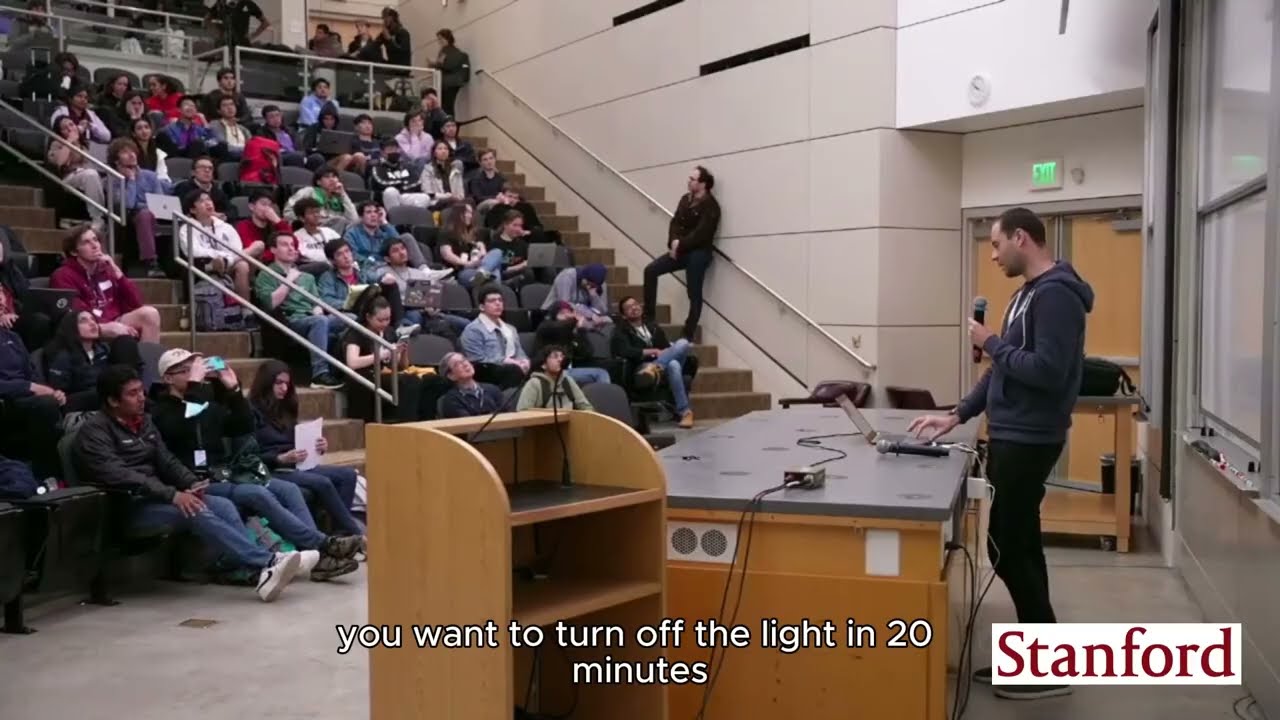
👋 The Hacker & Why Now
Karpathy opens with his trajectory: Stanford PhD student ~7 years ago, then OpenAI, then Tesla (Autopilot), and back to OpenAI "as of one week ago." At Stanford he worked on early neural networks connecting images and language (early CLIP-style models and image captioners); at OpenAI on generative image models and RL; at Tesla on the neural networks behind the Autopilot visualization. 0:00
convnet.js (a JS neural network library — "I did it for the lols"), being the reference human for ImageNet (he personally classified images into 1,000 categories including ~200 dog breeds for a week — "when you see human accuracy quoted on ImageNet, that's me"), activity-tracking apps, arxiv-sanity (paper recommender), blogging, and now YouTube videos + nanoGPT. 1:00
"There has never been a more interesting time to hack than today. Programming is changing very rapidly, and you are all explorers looking at the new vistas." 2:32
🖥️ Software 1.0 — 70 Years of Instructions
What is programming? "Some of you think of writing C++ code, giving instructions to a computer. Maybe Donald Knuth and the Art of Computer Programming. This is programming as it was for the last ~70 years — unchanged on a high level: spelling out instructions and designing an algorithm." 3:09
It got us very far — Linux is a diagram of "a very complicated software engineering project with lots of moving pieces, profilers and debuggers." "But not quite all the way. We started to see the cracks when we got to problems like image recognition." 3:55
🧠 Software 2.0 — The Data Engine
The new programming paradigm is neural networks — "not just another classifier in competition with a random forest. Neural networks are a new programming stack, and you program them slightly differently." 4:48
The data engine cycle (about 5 years of his Tesla life): start with a dataset → train a net → deploy → telemetry/monitoring → collect more data the network finds troubling → label it → some into test sets, some back into training → repeat. "You spin the cycle over and over again." 5:20
Crucially, 2.0 doesn't replace 1.0 — "they layer on top of each other. You still need a ton of 1.0 code to compile your software 2.0." Examples: computer vision became one big convnet; chess became a reinforcement-learning problem (reward 1 for a win, 0 for a draw, -1 for a loss); speech became a big net trained on tons of data (Whisper). 6:06
📚 LLMs — Next-Word Prediction Magic
"Over the last 2–3 years we're again in the middle of another transition." The story begins with large language models: they just predict the next word in a sequence, but with a trillion parameters trained on the whole internet, "something magical starts to happen." 7:04
Generation is just repeated prediction — predict the next thing, plug it back in, repeat — producing poems and arbitrary text. But more interestingly, you can use them to perform tasks: give context, then a few question-answer examples (few-shot, from the GPT-3 paper), and the model "takes on the task of giving the actual answer." 7:58
🎯 Prompt Engineering Is Real
Prompt design goes a long way, and it's now a legitimate job. Karpathy points to Riley Goodside — "one of the first prompt engineers I'm aware of, currently staff prompt engineer at Scale — just extremely good at all these prompts and techniques, and very helpful to me personally." 18:45
The famous framing tweets: "If previous neural nets are special-purpose computers designed for a specific task, GPTs are a general-purpose computer reconfigurable at runtime to run natural-language programs. The programs are specified in prompts, and GPT runs the program by completing the document." And: "The hottest new programming language is English." 19:50
🧪 The Model as Simulator
"GPT is kind of like a simulator — you can condition it into arbitrary universes and get really cool outputs." A series of examples: 11:22
- 🐧 Linux terminal simulation — "Act as a Linux terminal. I'll type commands, you reply with what the terminal should show." It hallucinates an entire filesystem —
ls,cd, creating ajokes.txt, even running Python programs correctly "in the mind of the model." 11:35 - 🌐 Fake network —
ping bbc.comproduces a plausible ping with an IP that doesn't actually exist ("I double-checked, it's totally made up — but it looks like ~24.9 ms latency"). Even acurlPOST to ChatGPT returns plausible JSON. 13:00 - 🏠 The smart-home brain — someone prompted GPT-3 to "pretend to be the sentient brain of a smart home," declaring appliances and rooms in plain English, outputting JSON commands. "We've programmed a smart assistant just by giving it text. That's pretty incredible." 14:10
- ⚙️ GPT-as-backend — the hackathon winner "GPT is all you need for backend": no Python, just an LLM that takes app state as JSON, applies English-described operations ("delete the last two todos"), and returns the new JSON state. 16:20
- 🔍 The Sydney prompt — the (allegedly leaked) prompt behind Bing's Sydney persona: "you can see how engineers at Microsoft programmed Sydney — it identifies as Bing Search, introduces itself a certain way, its output format, limitations, and safety rules, all described in English." 17:50
🇬🇧 Software 3.0 — English as the Language
Bringing the paradigms together: "Software 1.0 was the realm of 'I designed the algorithm' — with us for 70 years. Software 2.0 is dataset iteration — you design the dataset. Software 3.0 is you design the prompt — conditioning a large language model to perform tasks." 20:26
The summary slide: all the programming languages didn't change the paradigm — "what changed the paradigm are neural networks, the data engine, and now the hottest language is English." And the practical tip: "if you want to use any of this in your hacks, the best way to get started is the OpenAI APIs. I don't say that because I work there — I work there because I say that." 21:20
📜 Transformer History
Karpathy traces the transformer's lineage with the framing of an experienced CV researcher who watched the field converge: 33:50
| Year | Milestone |
|---|---|
| 2003 | Bengio et al. — first popular neural language model: a multi-layer perceptron predicting the 4th word from 3 words |
| 2012 | AlexNet — scale a big net on a big dataset, "and the recipe copy-pasted across many areas of AI" |
| 2014 | Sequence-to-sequence — LSTM encoder/decoder for translation, but with the "encoder bottleneck" (whole sentence squeezed into one vector) |
| 2015 | Bahdanau et al. — attention: "soft search" over source words to break the bottleneck |
| 2017 | Attention Is All You Need — "delete everything, keep attention" |
The pre-2012 era: computer vision pipelines were "a zoo of kitchen-sink feature descriptors — sparse histograms, SIFT, color histograms, textons, tiny images, GIST — everyone had their favorite, and you put an SVM on top. It also didn't work. Today you'd be looking for a bug; back then you'd shrug." Worse, every field had its own vocabulary (POS tagging, morphological analysis, syntactic parsing, coreference resolution in NLP) so you couldn't even read papers across areas. 30:30
2012 changed it: neural nets "pop up everywhere — vision, NLP, speech, translation, RL — the same modeling toolkit." Then 2017: "the architectures converge to literally one architecture you copy-paste across everything." What changes is the details of the data and how you chunk and feed it in. 33:00
Attention Is All You Need: "usually papers are incremental, adding one thing. This was a mix of multiple things combined in a unique way, and achieved a very good local minimum in architecture space." It deleted the RNN, kept attention, added positional encoding (attention has no notion of space), adopted the residual structure from ResNet, interspersed attention with MLPs, used layer norms, introduced multi-head attention, and set hyperparameters (4× MLP expansion) "that to this day are used." The only change that stuck since: pre-norm (layer norm moved before attention/MLP). "The GPTs you see today are basically the 2017 architecture." 39:20
🔗 Attention = Message Passing
Karpathy's own interpretation, deliberately different from standard presentations: "To me, attention is the communication phase of the transformer. The transformer interleaves two phases — communication (multi-headed attention) and computation (the MLP)." 44:25
| Term | Meaning |
|---|---|
| Multi-headed attention | Attention applied multiple times in parallel, different Q/K/V weights — "heads = copy-paste in parallel" |
| Layers | "Copy-paste but in series" |
| Self-attention | Keys and values produced from this node itself |
| Cross-attention | Queries from this node, but keys/values from an external source (the encoder) |
"Self-attention and cross-attention only differ in where the keys and values come from — algorithmically it's the same operations." In the encoder-decoder graph, encoder tokens are fully connected to each other; decoder tokens connect to the encoder and to everything before them (triangular structure), because future tokens "give away the answer." 49:00
💻 nanoGPT Walkthrough
Karpathy walks through nanoGPT, his ~300-line minimal GPT-2 reproduction trained on OpenWebText (one node of TPUs for 38 hours). The toy dataset is tiny-Shakespeare — all of Shakespeare concatenated into a 1 MB file. 52:10
Batching: take chunks of the 1-D sequence. Block size = max context length; batch size = how many sequences in parallel (to saturate the GPU). "In a single 4×8 batch, every position is both an input and a target — the real batch size is more like B×T." 54:50
Forward pass: index each token into an embedding table → add positional encodings ("the 'what' and 'where' combined additively") → feed through a series of transformer blocks → layer norm → a linear LM head producing the next-token logits → cross-entropy loss against targets (which are just the inputs offset by one). 55:50
The block: a residual pathway around attention (communication) and the MLP (computation). With block size 8 there are 8 nodes; node 1 attends to itself, node 2 to {1,2}, node 3 to {1,2,3}, and so on — "you apply layer norm, then self-attention so these 8 nodes communicate." The MLP is a 2-layer net with GELU acting per-node. 57:39
The attention code is "the meat": compute Q, K, V from X; matrix-multiply Q·K (the dot product, batched across all queries/keys/heads); masked-fill the forbidden (future) positions with -infinity so softmax drives them to zero ("otherwise the future gives away the answer"); softmax → attention matrix; multiply by V (the weighted sum); linear projection back. 59:30
🏆 Why Transformers Won
The transformer simultaneously optimizes three desirable properties: 43:40
| Property | Why it matters |
|---|---|
| 1. Expressive | Forward pass can implement very interesting functions, potentially even meta-learning |
| 2. Optimizable | Residual connections, layer norms — gradients flow easily, not too many hops from supervision to input |
| 3. Efficient | A shallow-wide graph, perfect for GPU parallelism ("the most under-appreciated — in deep learning, scale matters") |
His renaming: "In hindsight I'd have called the paper 'a general-purpose, efficient, optimizable computer' instead of 'Attention Is All You Need.'" And the closing synthesis: "If you scale up the training set and use a powerful enough neural net like a transformer, the network becomes a kind of general-purpose computer over text. Instead of performing a single fixed sequence, you design the sequence in the prompt." 67:20
✅ Key Takeaways
- Three programming paradigms, stacked. Software 1.0 = design the algorithm (70 years). Software 2.0 = design the dataset (the data engine compiles data into weights). Software 3.0 = design the prompt (condition an LLM). They layer, not replace.
- An LLM is a next-word predictor — and that's the whole trick. All of its task ability comes from narrowing the prediction to the right "slice" (few-shot, step-by-step, IQ-200 conditioning).
- Prompt wording matters measurably. "Let's think step by step" took the juggler problem from 17% → 78.7%; "let's work this out step-by-step to be sure we have the right answer" hit 82%.
- The model is a simulator. Linux terminals, fake ping results, smart-home brains, GPT-as-backend, the Sydney persona — "you can condition it into arbitrary universes" via prompt alone.
- The hottest new programming language is English — and prompting is how you program humans too. The tech is converging toward humans.
- Attention = message passing on a directed graph. Queries look for things, keys say what you have, values are what you communicate. Encoder vs decoder is literally one deleted mask line.
- Transformers won on three axes at once: expressive, optimizable (residuals + layer norms), and efficient (shallow-wide = GPU-friendly). "In deep learning, scale matters" — efficiency is the underrated one.
- The 2017 architecture is still the architecture. The only durable change since has been pre-norm. "The GPTs you see today are basically the 2017 transformer."
🔗 Resources & Links
- 📺 Original video — the full lecture
- 💻 nanoGPT — the ~300-line GPT-2 reproduction