0:00"Does code quality still matter?" Every senior engineer's answer is "it depends" — which is the least helpful answer on Earth, because the whole question is what it depends on. Max Kanat-Alexander — Executive Distinguished Engineer at Capital One and author of Code Simplicity — builds a framework so the answer stops being "it depends" and becomes yes or no.
Understanding + execution
1:14Everything you'll ever accomplish with software reduces to two factors and two alone: understanding, and executing on that understanding — whether that's aligning a model, scaling a system, or driving adoption. Debuggers, observability, evals, even tests: all of them exist to improve your understanding or your ability to execute on it. And everything ever done in the name of code quality exists exclusively for those two things. For a software engineer, the two understandings that matter most are: (1) what is the actual behavior of the system (not what the docs say), and (2) how do I correctly and safely modify that behavior.
Why structure matters
2:42A small system you can describe in one sentence; a real system — the Chromium codebase is the slide's example — has essentially infinite possible behaviors. What makes it understandable is structure: you can describe a component (the URL parser) even when you can't describe the whole. Two programs can both print "Hello World," but one has the identity and structure of Hello World while the other is just a series of instructions. "The whole reason code exists is for structure." Readability and testability were proxies; what always mattered was understandable structure.
The two risks of every change
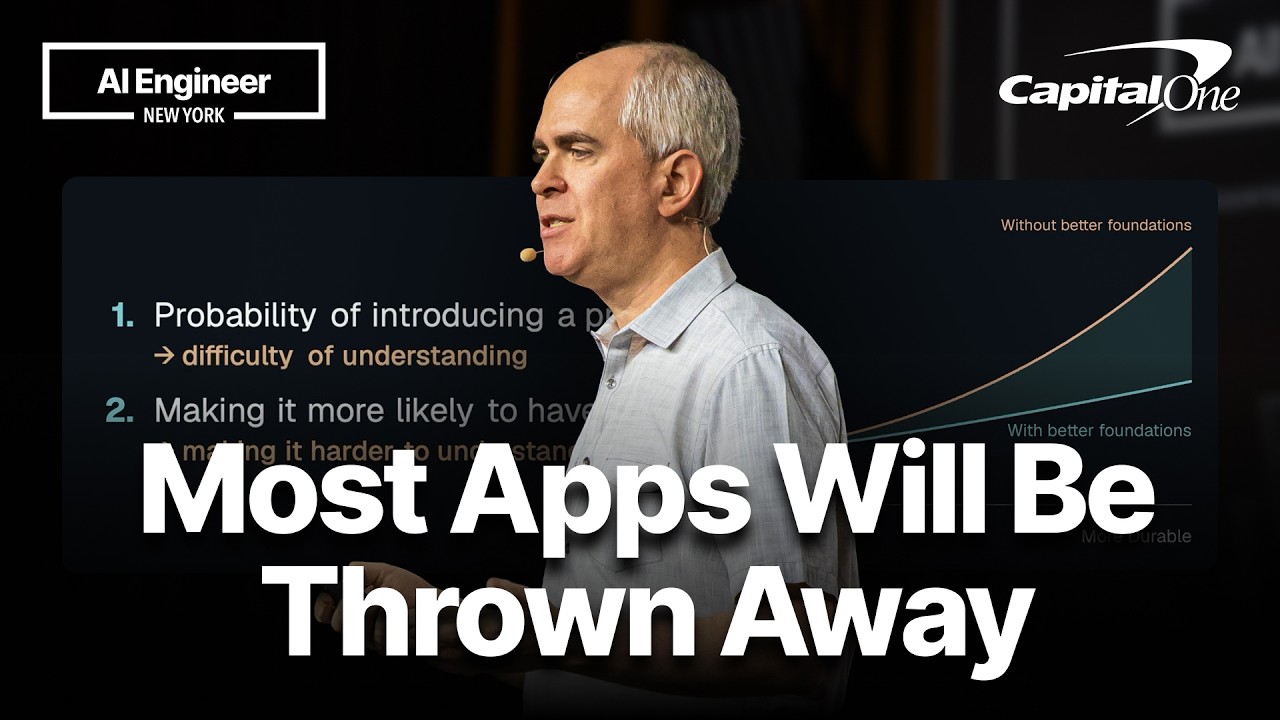
4:47Every modification carries two risks: (1) you introduce a problem — and "problem" isn't just a bug, it's anything bad (schedule slips, budget overruns, project failure); and (2) you make future changes harder, increasing the system's future risk. Both are caused by problems with understanding. His claim: every postmortem he's ever read reduces to one of these two — a config too hard to understand, an emergent property that was impossible to see. And the two feed each other in a vicious cycle that compounds non-linearly — until you reach the point (as every 500-million-line mainframe does) where every change is a problem.
Disposable software
6:56The interesting thing models are doing isn't fixing complexity — it's creating a new category of software that's about to become a hundred thousand times more common: disposable software. It's a world where the consequences of failure are minimal, almost nothing depends on it, replacement costs near zero (rebuild in hours), and maintenance is near-free. In that world, code quality does not matter — the compounding risks it exists to prevent don't exist. Don't like the calculator on your OS? Make your own. Planning one kid's party? Write a party-planner just for that and throw it away.
Durable software
7:59The common confusion: durable software isn't going away. It will probably remain the world's most important systems — and there will be more of it, because AI coding tools make durable software easier to build. But the most numerous systems will be disposable. The two aren't black and white — it's a spectrum set by four factors: consequences of failure, cost of replacement, dependencies, and cost of maintenance. All low = disposable; all high = durable. Long-time engineers know to err on the side of durable (the factors are usually higher than you expect) — but you now have a new option.
Making software more disposable
9:54You can deliberately push software toward the disposable end: isolated environments (deploy only where there's no customer data or PII), enforced independence (no inbound API calls from production systems), redundancy (keep a clunky durable backup so people can vibe-code a better front end that's allowed to fail), and limited scope (a calculator for one person). He frames this as a whole new discipline: not improving the rigor of durable systems, but engineering for disposability — encouraging and allowing things to be thrown away.
Lowering the cost of rigor
12:05The other axis: make rigor cheap, so you don't have to agonize over where you are on the scale (and changing your mind is cheap). Four levers:
- Standardization — it removes possibilities. No PHP in your system means no PHP linters, practices, or security holes to think about. Frameworks and RPC protocols, same reason.
- Inward-flow tooling — tooling that just happens: the programmer doesn't choose to run it or understand it, it's free, fast, and reliable (no false positives). The more true that is, the more it applies even to disposable software.
- Making testing easier — the dream he had as a test owner: in-memory fake versions of every service. "The coding agent can do that now" — but you have to choose to build it and make it available to everyone.
- Maximum strictness — turn lint rules to max and never compromise. It eliminates a ton of conversation; even when the lint is occasionally wrong, a low false-positive rate beats a 100,000-line cleanup later.
The answer
15:50Not "it depends," but three yes-or-no answers: does code quality matter? For disposable software — no. For durable software — yes. And the third, more interesting question: does it have to be expensive? No.
Claims checked
Max Kanat-Alexander is real and this is his actual talk. Executive Distinguished Engineer at Capital One (developer productivity), author of Code Simplicity and Understanding Software, formerly LinkedIn/Google and Bugzilla chief architect. The talk's framing matches his published writing.
The disposable-vs-durable spectrum and the four factors (consequences, replacement cost, dependencies, maintenance) are his conceptual framework, not an empirical result. "Every postmortem reduces to understanding problems" is his stated experience, not a study.
The description promotes AIE CODE (the channel's summit) — not reproduced as a source.