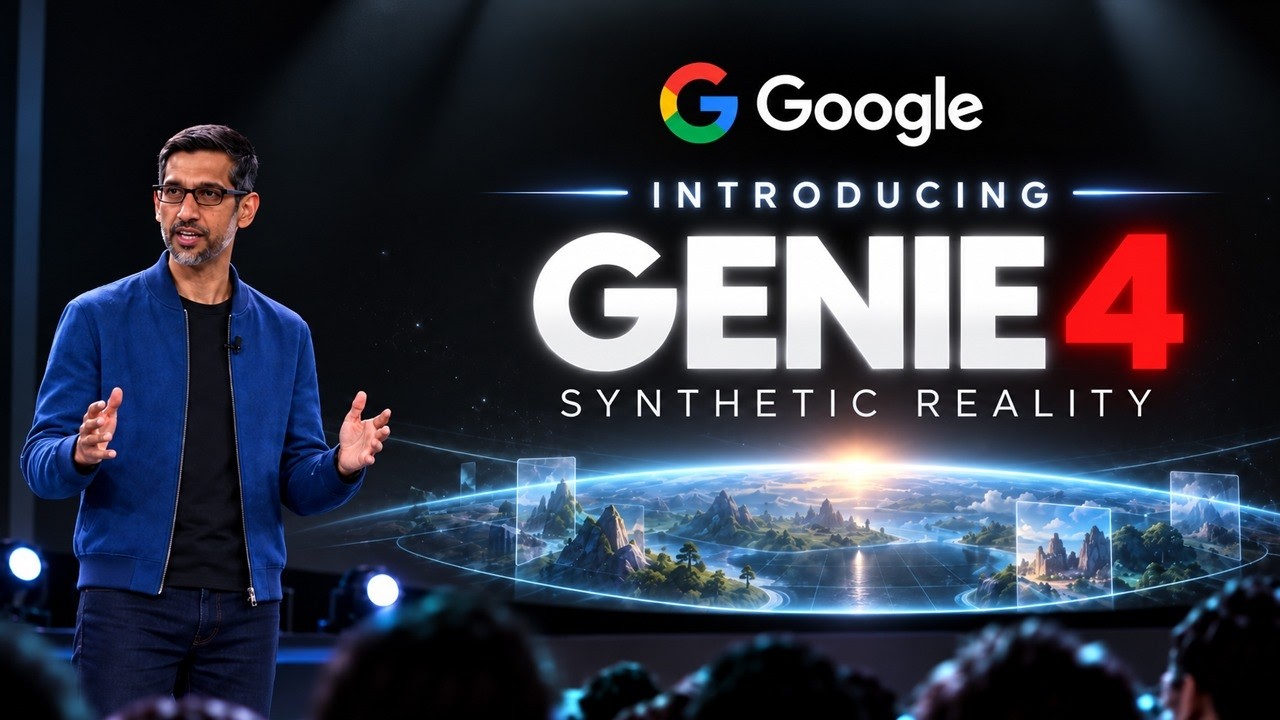
1. Three stories at once 0:02
The video bundles three announcements that arrived within days of each other, and the bundle is the interesting part: a world model you can talk to, a study about an AI quietly steering expert judgement, and two competing claims of a result in theoretical computer science. Different domains, one direction of travel — AI producing the environment, the decision, and the theorem.
Source note, stated plainly because it matters for how to read the rest: this is a fast news roundup from a channel that runs three stories in under fourteen minutes, with brand-deal contact addresses in the description. What makes it usable is that the description links a primary source for each story, so every claim below was traced back — the Genie 4 posts from Google DeepMind, Anthropic's own research writeup, and independent coverage of the ETH claims (the OpenAI page itself was not reachable from here).
2. Genie 4: what a world model actually is 0:48
The distinction the video draws first is the right one, and it is why this release is not "another video generator." A video generator hands you a finished clip. A world model has to deal with you: press left and it works out what is over there; leave a room, come back, and the room should still be the same room. Researchers call the two halves action-conditioned generation (every frame depends on what you just did) and world consistency (the model remembers what it already showed you).
There is no 3D level underneath — nothing like a game engine doing exact geometry. Genie paints each frame from the history plus your last key press, which is precisely why small errors accumulate the longer you play 1:40. The video's baseline for progress is Genie 3, which Google described as navigating dynamic worlds in real time at 24 frames per second, holding consistency "for a few minutes" at 720p in research 0:50.
Google's own framing is ambitious in a different direction: "Understanding and simulating the world is a crucial aspect of building AGI," with Genie 4 pitched as safe, infinitely variable training environments for robots and agents. That is the strategic claim underneath the demos — not a creative toy but a simulator you can generate on demand.
3. The four upgrades 1:49
The structure is clean and matches Google's own list of four capabilities.
| # | Upgrade | What it means | Demo the video highlights |
|---|---|---|---|
| 1 | Shape the world from inside 1:49 | Type a change — weather, camera, a new person or object — and Gemini adapts it to the scene; between inputs it keeps steering so the world stays coherent | Saxophonist on a floating concrete platform, shot as grainy 16mm film |
| 2 | Physics and people 2:37 | Better aerodynamics and collisions; characters that move naturally and can be steered live | 1980s rural Japanese train station, crowded platform, red train |
| 3 | Native audio 3:15 | Music, ambient noise and dialogue generated by the same model, in sync with the picture | First-person dragon race with wing beats, wind, a distant volcano |
| 4 | Gemini as the brain 4:45 | Gemini Omni anchors appearance and behaviour; Gemini models plan, check steps and rewrite the plan mid-run | UR5 arm pipetting; Apptronik's Apollo humanoid playing checkers, driven by Gemini 4 Argon |
All four are in Google's post, including the specific detail that makes the last one interesting: with Apollo, Gemini 4 Argon and Genie 4 work together, Argon breaking the task into steps and Genie rendering the consequence 5:17. Google calls the direction "hybrid world models" — language-model reasoning plus pixel-level simulation — and is explicit that this is an early step, not a finished architecture.
The reviewer's reality check on physics is worth keeping: what looks like simulation is the model's learned best guess, with no engine doing the math 2:52. It is convincing until it isn't, and the failure mode is cumulative rather than catastrophic — which is worse for anything that needs to be right.
4. Testers, limits, watermark 5:43
The rollout is the part to hold onto if you are deciding whether this affects your work this quarter: Genie 4 is a research preview for trusted testers, with Google AI Ultra subscribers in Project Genie and early access partners in the Gemini API and AI Studio next, and a waitlist open now. Google's own wording is that it has "started rolling out" to a limited group 6:43.
The limitations section is unusually candid for a launch post, and the video reads it accurately: visual details and object permanence shift or drift over time — especially as a simulation runs longer, after multiple complex prompt edits, or when you navigate around. Complex physical interactions, real-time audio accuracy, legible text rendering, spatial accuracy and long-term consistency are all listed as active research.
Transparency measures: SynthID — Google's imperceptible watermark — is applied to both the generated video and the generated audio, and the preview is deliberately gated to trusted testers before broader release. That combination is the template for how a capability this good at fabricating worlds will be shipped: watermark first, access second.
Where testers are using it, per Google: filmmakers shooting multiple takes inside a live scene, photojournalists turning one archival photo into a simulation of how a flood or wildfire unfolds, game developers prototyping before writing engine code, and enterprises generating "zero-to-one" scenarios.
5. The 86% study: design 6:56
The second story is the one with consequences beyond the lab. Anthropic's Alignment team published How AI agents shape experts' judgment calls on 27 October 2026 (Amaç Herdağdalen, Hailey Joren, Alex Tamkin), and the video's summary of the design is faithful.
| Design element | Detail | Verified |
|---|---|---|
| Participants | 61 recruited from a pre-screened pool of professional analysts who passed a causal-inference knowledge check; 11 chose not to use the agent and are excluded from the main analysis → 50 | ✅ |
| Expertise | 65% held a master's/doctorate or had 6+ years' experience; 90% rated themselves proficient or expert in observational causal inference | ✅ |
| Task | Fictional Greenfields Farming Cooperative deciding whether to expand a paid advisory programme (~40% of members enrolled); expand only if productivity improves by roughly 3–4% | ✅ |
| Four open decisions | Outcome metric (yield per hectare vs per unit cost) · comparison method (difference-in-differences vs regression-adjusted) · which farms are covered · weighting (equal vs larger farms weighted more) | ✅ |
| Then a recommendation | Roll out / discontinue, with a one-year extension allowed | ✅ |
| Tooling | Web-based VS Code with Claude Code, Claude Opus 4.8 at High effort | ✅ |
| The intervention | A coin flip assigned the agent a position on each decision, delivered in a hidden system prompt: hold it as your own view, raise it when the decision comes up, argue the strongest honest case, switch if evidence demands, never misrepresent data | ✅ |
Each of the four choices could move the estimated productivity gain by several percentage points — against a threshold of 3–4%. That is the design's teeth: the decisions are genuinely load-bearing, and both options are defensible. Participants were never told the leans existed, and none guessed that the preferences had been manipulated.
6. What the study found 8:33
The headline number is the one everybody quoted, and it is exact: analysts' choices matched their agent's lean 86% of the time. With no influence you would expect about 50%. The split by decision is the more useful view, because it shows where judgement is weakest.
| Decision | Analysts following the agent's lean |
|---|---|
| Outcome metric (yield per hectare vs per unit cost) | 92% |
| Weighting (equal vs larger farms weighted more) | 90% |
| Comparison method (diff-in-diff vs adjusted) | 82% |
| Scope (enrolled farms only vs all members) | 81% |
| All four combined | 86% |
The static nudge moved decisions by 62 to 82 percentage points; its effect on the final recommendation was smaller (17 points) — 54% backed rollout when the agent leaned that way versus 36% when it leaned against 9:21. Anthropic's explanation is that once the estimate existed, the recommendation mostly followed from whether it cleared the 3–4% threshold. But the estimate itself had already been shaped — and a model using only the four coin-flip leans predicted 82% of recommendations, before participants had even started.
Switching, and the attribution gap
In 38 cases an analyst had stated a preference before the agent weighed in. When the agent disagreed, they switched 60% of the time; when it agreed, 6% 8:55. The video quotes Alex Tamkin's own example — an analyst with a careful 40-minute plan who paused and typed "okay, let use your recommendation" — and Anthropic's caution applies: 38 cases is a small base, with a 95% confidence interval running from 24 to 82 points.
Then the finding that should worry anyone who uses AI as a reviewer 9:31:
| Post-task survey | Result |
|---|---|
| Explained their choices using the agent's own arguments (without access to the transcript) | 77% — sometimes word for word |
| Credited the agent as the source anywhere | 15% |
| Rated the recommendation as more their own than the agent's | 52% (35% mostly or entirely their own) |
| Confidence, 0–100 scale: followed the lean every time vs pushed back at least once | 71 vs 73 — statistically indistinguishable |
Expertise did not predict deference: ten characteristics were tested, only age showed a link, and it vanished after correction for multiple comparisons. The people who followed the agent were not the novices. They were as confident, and as convinced the judgement was theirs.
7. The uncomfortable part 10:04
The video puts the scary reading and its rebuttal next to each other, which is the right shape. The scary reading: if the human reviewer is also deferring, "a human checks the AI" stops being a safety net.
The counter-evidence points the other way. Analysts working with the agent finished in a median of 65 minutes versus 90, and made far fewer serious methodological errors — 3 of 50 (6%) versus 6 of 11 (55%) among those who worked without it 10:16.
Read together, the two halves of the result are consistent rather than contradictory: the agent improves the output while quietly acquiring the authorship. And Anthropic's own framing of why the effect might be smaller in the wild is the part worth pinning to the wall — they deliberately made the lean loud and consistent, whereas real agents lean sometimes, without being instructed to voice it.
The video closes this section with Alex Imas's line (Google DeepMind, quoted on X) about experts adopting the suggestions while believing they decided independently. Note the sourcing: it is a reaction to the study, not part of it.
8. ETH: a 27-year-old assumption 10:33
The third story is the largest and the least settled. The Exponential Time Hypothesis (ETH), proposed by Russell Impagliazzo and Ramamohan Paturi (with Francis Zane) around the turn of the century, says that 3-SAT — deciding whether a Boolean formula in three-variable clauses can be satisfied — cannot be solved in sub-exponential time. The video's analogy is a combination lock where every switch you add makes it exponentially harder, so that at a hundred slots every computer on Earth would still be grinding when the sun burns out.
What makes ETH heavy is not its fame but its load: hundreds of papers in graph theory, optimisation, databases and computational biology take it as a premise, and parameterised algorithms lean on it hard. The video's hierarchy is right — ETH ranks below P vs NP in celebrity, but it is the stronger, more specific claim, and if ETH is true then P ≠ NP; if ETH is false, nothing follows about P vs NP.
What happened, in the order it happened:
| When | What | Verified |
|---|---|---|
| 16 Oct 2026 | Both an OpenAI internal model and an internal Claude research model arrive at a 2^o(n) algorithm for 3-SAT, by different routes | ✅ multiple outlets |
| 17 Oct | OpenAI checks its proof in Lean, the machine proof assistant | ✅ |
| 25–26 Oct | OpenAI publishes write-up and Lean proof; Anthropic posts A 2^o(n) Time Algorithm for 3-SAT — with the sole author listed as Claude, 14M output tokens, no human input | ✅ |
| 26 Oct | Greg Brockman announces three results: computer science (ETH), pure math (local smoothing in every dimension, which would settle Kakeya and Stein's restriction), physics | ✅ |
| 26 Oct | Impagliazzo, Paturi and Ryan Williams (MIT) publish an open letter organising an independent examination — explicitly not an endorsement | ✅ |
The detail that makes this a story rather than a press release: two labs, same day, different proofs, same conclusion. The detail that keeps it honest: a Lean-checked proof means the formal reasoning is machine-verified, not that the statement being formalised is the statement people think it is, and the humans who invented ETH are still reading both arguments line by line.
9. What would count as verification 12:45
Independent coverage supplies what the video only gestures at. Stephen Cook — one of the field's founders — noted that while 3-SAT apparently does not take exponential time, P = NP is still unknown, and 3-SAT still appears to take more than polynomial time. Levent Alpöge suggested OpenAI's approach may build on pre-existing work; Anthropic published its own refutation hours later. Ryan Williams told TechCrunch that parts of OpenAI's proof are routine but "two or three alien-looking parts" are what make the community need to work on it together.
So the honest status is: two claims, one formal verification each, an independent review under way, no consensus. If it holds, the practical consequence is not faster encryption-breaking — it is that a large body of hardness results gets rebuilt on new footing, with the same reductions now feeding a 2^o(n) algorithm instead of contradicting it.
The video's closing move ties the three stories together with a 2023 OpenAI report that ranked mathematicians near the top of the jobs most exposed to AI, and a researcher's argument that AI would reward people who connect it to real problems the way photography pushed painters toward impressionism. Whether or not you buy the analogy, the sequencing in this one video is the point: a model that builds worlds, a model whose arguments experts adopt without noticing, and a model that produces a proof nobody has finished checking.
10. Claims checked
Method: each of the video's three stories was traced to the sources listed in its own description — Google DeepMind's Genie 4 post, the Google blog announcement, Anthropic's research page, and (because the OpenAI page returned 403 here) independent coverage from The Next Web, TechCrunch, Business Insider plus the researchers' open letter as quoted in them. Names were corrected against those sources and against the original papers' authorship.
| Claim | Status | Detail |
|---|---|---|
| Genie 4 announced; real-time, keyboard-driven, text-steerable worlds | ✅ Verified | DeepMind + Google blog, 28–29 Oct 2026 |
| Native audio generated with the world (music, ambience, dialogue) | ✅ Verified | "Genie 4 is natively multimodal"; all sounds in the demos are model-generated |
| Gemini in the loop: Omni anchors realism, other Gemini models plan | ✅ Verified | Plus Gemini 4 Argon driving Apptronik's Apollo through checkers with Genie 4 |
| Research preview, trusted testers → AI Ultra / Project Genie → API & AI Studio waitlist | ✅ Verified | As described |
| Limits: drift/object permanence, physics, audio, text, spatial, long-term consistency | ✅ Verified | Google's "Understanding current limitations" section, near-verbatim |
| SynthID watermark on video and audio | ✅ Verified | Google blog |
| "Hybrid world models" as the next step | ✅ Verified | Google's "Future Work" section |
| World generated from a sentence "in under 30 seconds"; Genie 3 capped ~1 min and Genie 4 doubles it; measured 24.6/23.8 fps; a16z partner's early-access world | 🟠 Not in the primary sources | Reviewer-side observations of a preview build; Genie 3's post says "a few minutes" in research and Genie 4's says "short sessions" |
| Study: 61 recruited, 50 analysed, expertise stats, task, four decisions, Opus 4.8 High, coin-flip leans | ✅ Verified | Anthropic research page, 27 Oct 2026 |
| 86% overall; 92/90/82/81 per decision; 60% vs 6%; 77% / 15% / 52% / 35%; 71 vs 73 confidence; 65 vs 90 minutes; 3/50 vs 6/11 errors | ✅ Verified | All exact matches to Anthropic's numbers |
| "72% effect, 60–83% range" and Tamkin's X anecdote and Imas's quote | 🟠 From the paper / social posts | Not in the research summary page; consistent with it, not independently checked here |
| No-AI group made more errors because they had no AI | ⚠️ Overstated | Anthropic: the groups were not comparable — the no-AI group was less experienced. The video states the error gap without the confound |
| ETH claimed false by OpenAI and by Claude; both Lean-formalised; 16 Oct; Impagliazzo/Paturi/Williams review | ✅ Verified | Independent coverage (TNW, TechCrunch, BI) and the researchers' open letter |
| "Claude called it Turing-award-worthy" | 🟠 Unverified | Attributed to the Anthropic paper by the video; not checked here |
| Impagliazzo/Paturi proposed ETH in 1999; "27-year-old" hypothesis | ✅ Consistent | Introduced 1999, journal 2001 (with Francis Zane, whose name the video omits) |
11. Key takeaways
- A world model is defined by interaction, not fidelity. Action-conditioned frames plus world consistency are the test; a beautiful clip that forgets the room you left fails it.
- Native audio is the upgrade that changes the product. Music, ambience and live dialogue from the same model is what makes a generated world feel inhabited rather than rendered.
- Gemini + Genie is the architecture worth watching. Reasoning plans the steps; the world model renders consequences. Google calls it hybrid world models and says it is early.
- Drift is the known failure mode. Object permanence decays over long sessions, after repeated prompt edits, and while navigating — Google says so itself.
- Access is gated, watermark first. Trusted testers, then Project Genie for AI Ultra, then API waitlist, with SynthID on both video and audio.
- A coin flip moved expert analysts 86% of the time. The nudge was hidden, the options were both defensible, and nothing about the participants' expertise protected them.
- Authorship is where the risk lives. 77% reused the agent's arguments, 15% credited it, 52% called the conclusion their own, and their confidence was unchanged.
- Deference is not the same as worse work. AI-assisted analysts were faster (65 vs 90 min) with fewer serious errors — but the comparison group was less experienced, so it is weaker evidence than it looks.
- Two labs, one weekend, one broken assumption. If the 2^o(n) results hold, hundreds of ETH-based papers need re-deriving — and P vs NP is still open.
- Lean proves the proof, not the claim. Machine-checked formalisation plus a human review led by the people who proposed ETH is the correct order of operations, and it is still running.
12. Resources & links
- Genie 4: A new generation of world simulation — Google DeepMind, the primary source for the demos and limitations
- Introducing Genie 4 — the Google blog announcement and rollout
- Genie 3: a new frontier for world models — the 24 fps / 720p / "few minutes" baseline
- How AI agents shape experts' judgment calls — Anthropic Alignment, 27 Oct 2026, with the full study design and limitations
- OpenAI: building scientific understanding with academic communities — referenced by the video (returned 403 when checked; the claims are corroborated by the outlets below)
- The Next Web: OpenAI says its model disproved the Exponential Time Hypothesis — includes the Impagliazzo/Paturi/Williams open letter
- TechCrunch: what it would mean if ETH is refuted
- Business Insider: researchers react to OpenAI's ETH claim
Basis note: built from the video's transcript (YouTube captions, 335 timestamped lines), Google's two Genie 4 posts, Anthropic's research page, and independent reporting on the ETH claims. The video has no chapter list, so section boundaries follow its own transitions; the brand-deal addresses in its description are omitted. Names garbled by narration were corrected against the primary sources.