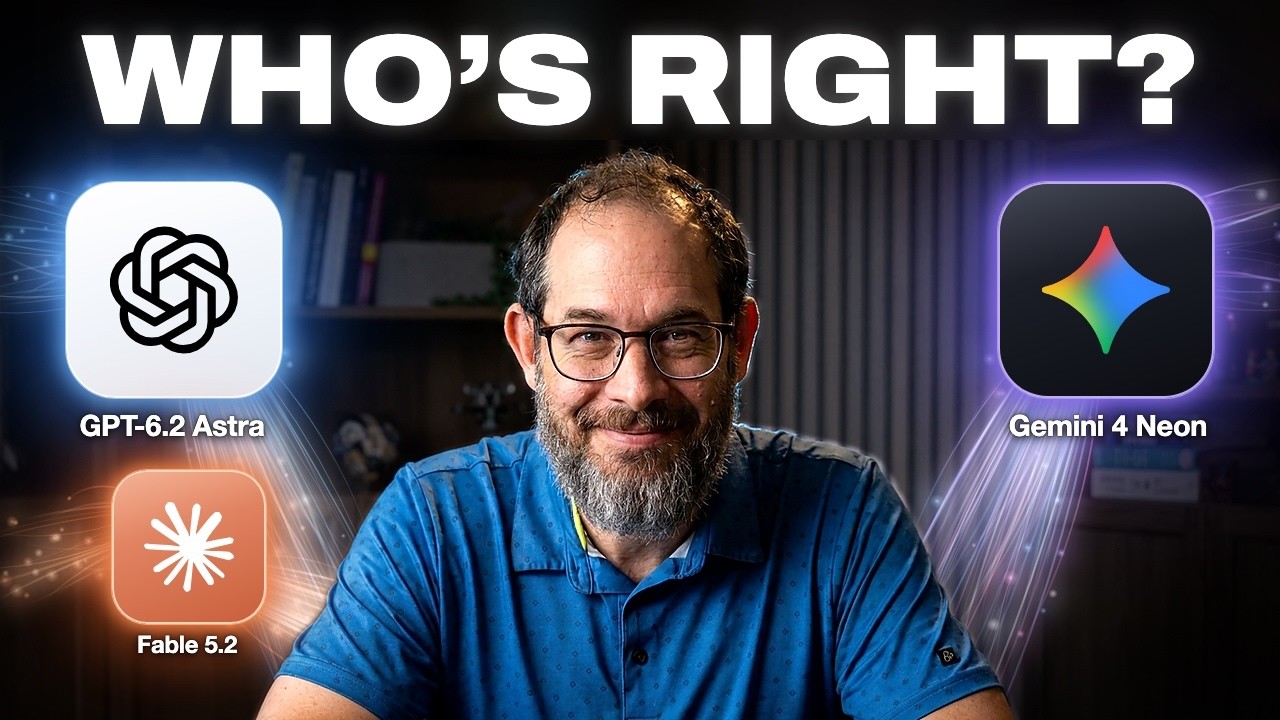
📅 The week, corrected 0:00
| Model | Video says | Actually |
|---|---|---|
| GPT-6.2 Astra | "Tuesday, the 10th of November" | Tuesday, 17 November 2026 — released alongside GPT-6.2 Sol |
| Gemini 4 Neon | "Wednesday" | Wednesday, 18 November 2026 — the next day |
The sequence is exactly right and the calendar is a week off, which makes the story better rather than worse. Two frontier releases on consecutive days is a cleaner illustration of launch-week whiplash than two releases a week apart. The correction matters for one practical reason: anyone reading this in a changelog or a pricing table will find 17 and 18 November, and a one-week discrepancy is how a fact-check gets quietly abandoned.
Also corrected: "Matt Schumer" is Matt Shumer, and at 18:52 the recommendation for a fast, positive-coded writing partner comes out as "Gemini 1.5 Pro" — that model is from 2024. He means Gemini 4 Neon, which he spent six minutes describing. Both are slips rather than errors of substance, but they are the kind of slip that gets quoted back at you.
🪓 The case against Astra 1:08
| Complaint | Source he cites |
|---|---|
| It keeps stopping early on long builds | Every, testing on real builds |
| It obsesses over minor edge cases | Developer reviews and his own use |
| Its explanations are so dense people ask another model to summarise them | His own experience |
| "Unusable", with a review chapter on details that don't matter | Matt Shumer's review |
| Intelligence Index 62, behind Claude Fable 5.2 at 65, with no coding-agent improvement | Artificial Analysis |
The numbers check out. Artificial Analysis does score GPT-6.2 Astra at 62 — at both max and xhigh effort — and its own release write-up calls Astra the #2 model in the Intelligence Index, behind Fable 5.2. So the "62 versus 65" pairing is right, and so is the implication that an overall score near the top can coexist with a bad week among coders.
The "no coding-agent improvement" claim is the one to hold loosely. The video presents it as a flat statement from independent testing; what the published numbers support cleanly is the Intelligence Index figure. A coding-agent index is a separate measurement, and a reader should go to that table rather than take the summary — it is the single most consequential number in his argument and the least evidenced in the video.
🌳 The trees model 2:51
"It's not a forest model. It's not even a forest-and-trees model. It is a trees model. Every single tree must be inspected by this model, every single leaf must be perfect."
| Problem shape | What it demands | Best fit, per the video |
|---|---|---|
| Trees | Every detail checked pedantically against a verifiable goal | Astra — proof-like work, dense analysis, science and math |
| Forest | Narrative arc, tone, knowing what to cut | Neon — writing and thinking out loud |
| Forest and trees | Engineering coherence: which bugs matter now, which rough edges to ship | Fable 5.2 for ambiguity, Opus 5.5 for grinding through |
The forest-versus-trees distinction is genuinely useful vocabulary because it names the failure precisely: a model that cannot let a detail go will stall a build whose real problem is architectural. Most complaints about coding agents are actually complaints about a model answering the wrong kind of question — and "I handed it a forest problem" is a diagnosis a team can act on, unlike "the model is bad".
Where the metaphor starts excusing too much: he is careful to say some models simply come out worse, but the frame tilts toward "different, not better". A regression in the work you actually do is a regression, whatever dimension improved elsewhere, and the vendor chose the trade. The buyer's job is to price it — not to revere the spike. Ask what you lost, and whether anyone asked you.
📊 What the numbers actually say 1:28
| Measurement | GPT-6.2 Astra | Context |
|---|---|---|
| Intelligence Index | 62 (max and xhigh), 60 high, 57 medium, 46 low | #2 overall; Claude Fable 5.2 leads at 65; Gemini 4 Neon is 61 |
| AA-3D | 1,318 Elo — first | Ahead of Fable 5.2 at 1,271 and GPT-6.2 Sol at 1,259, judged by humans |
| AA-Robotics (preview) | 79 — first | Sol 78, Fable 5.2 at 75 |
| AA-AnalystAgent | 62.5% of questions correct on all five attempts — a new high | Real spreadsheets and reports, e.g. a Medicaid expenditure calculation |
| Price | $8 in / $40 out per million; cached input $0.40 | 20% below GPT-6 Astra, with a 60% cut on cached input |
This is the evidence the video's thesis needs, and it was already published when he recorded. The same model that coders called unusable is first on 3D scene building and robotics planning, and set a new high on analyst work — the spreadsheet-and-document territory where a "trees" disposition is exactly right. The spikes are not a metaphor; they have coordinates and numbers.
Which also means the remedy is not a new worldview, it is domain-specific evals. If the shape is measurable — and it is, per-domain — then "your vibe check is unreliable" resolves into something concrete: run the domain index that matches your work, or write your own. He gets to this advice eventually; it would have been stronger stated first.
💡 Neon, and the fleet 6:37
| Model | Position in the Gemini 4 family | Price per million |
|---|---|---|
| Carbon | Hardest, longest-horizon projects | $2 / $10 until 30 November, then $4 / $20 |
| Hydrogen | Fast, cost-efficient everyday coding and agentic work | $1.50 / $7.50, flat across the 1M context |
| Neon | Balances reasoning depth and efficiency for high-frequency complex work | $3 / $15, cached input $0.15 — a 95% discount |
| Argon | Frontier model for most software engineering and knowledge work | $2 / $10 introductory |
His description of Neon's position is exactly Google's own framing: Carbon for long-horizon hardest work, Hydrogen for fast everyday execution, Neon in between. Four Gemini 4 models in under two months is the real story he is pointing at — a repeatable process for scaling and flavouring models rather than a single flagship.
One caution on "the fleet" reading: four models in two months is fast, but it is also how a company recovers from being slow. Reporting through October described Google missing a promised release and shipping its top model through a restricted cyber rollout. A shipping spree is evidence of process, not proof that the process was always there.
💼 Business models as model flavours 8:26
| Lab | His read of the business | What that predicts |
|---|---|---|
| The only frontier lab for which AI can be a side bet, with cash flow from the rest of the business | A fleet of differently flavoured models, tuned for human ergonomics, to pull cloud revenue | |
| Anthropic | Focused allocation toward the work day | Workspace, presentations, visualisation, end-to-end execution — "a workday beast" |
| OpenAI | A dual business: a huge consumer side, and very hard, high-value scientific work | A math-flavoured, detail-obsessed model, with Codex as the enterprise tool alongside |
The observation that these models are "expressions of the business models" is the most durable idea in the video, because it turns launch-week noise into a forecast: if you know what a lab sells, you can predict what it will optimise next — and therefore which of your tasks will get better and which will quietly get worse. That is a strategist's frame rather than a reviewer's.
Unverified in the video: the claim that OpenAI is monetising heavily through ads. It may well be true, but it is offered without a source, and it is doing real work in the argument about incentives. Treat it as a hypothesis about direction, not a fact.
👁 The end of legible intelligence 11:04
"For the last four years we've lived in the era of legible intelligence. You could tell that a model got smarter in a few minutes without needing to be an expert in anything."
This is a real phenomenon and it has a cost structure. When a capability jump shows up as "it can now make a slide deck", every user can see it and adoption follows. When a jump shows up as better constraint satisfaction on a proof, almost nobody notices — and the people who would benefit never try. The four-year habit of judging by feel is now a bias, and he is right that it is invisible precisely because it used to be reliable.
🌊 The sea urchin, and its limit 12:01
| Metaphor | What it explains |
|---|---|
| Thermometer | One number, always up — the benchmark view |
| Flat grid | Two axes, intelligence and taste — better, still too simple |
| Sea urchin in n dimensions | Many spikes; a new spike on a side your light does not reach casts no shadow on your wall |
"You can test it very honestly on real coding work and report that it's frustrating, and still completely miss a huge leap happening ninety degrees away from where you're sitting."
The shadow metaphor does one thing no other framing in this space does: it explains why honest reviewers with real tests can all be right and all be blind at once, without anyone being lazy or captured. That is worth the six minutes he spends on it, and it is a better model of the disagreement than either "the reviews are astroturfed" or "the reviewers are incompetent".
Its limit is that "spiky" is not automatically "not worse". A spike on an axis nobody needs is still a regression on the axes they do need, and the sea urchin picture has no way to distinguish insight from a vendor optimising a metric. Use it to explain disagreement, not to dissolve it: when your work gets harder, the correct response is to re-measure your work, not to assume the shadow is lying.
🔗 The two-model handoff 19:43
| Step | What he does |
|---|---|
| 1 | Give the gnarly mix of raw feedback and constraints to Astra, which chews every connection |
| 2 | Take its output and hand it to Neon to make sense of it and write it readably |
| Result | The spikes you need, chained, instead of waiting for one model that has all of them |
Chaining is the right instinct and it is already standard practice in serious shops: a reasoning model for the hard analysis, a faster model for the write-up, a coding agent for the patch. It also composes with what the industry is converging on — deterministic scaffolding around model calls, with each call routed to the model that suits it.
The failure mode he does not mention: the second model launders the first model's errors. A summariser asked to make dense output readable will smooth contradictions and drop caveats — exactly the things a detail-obsessed model produced and you paid for. If step two is "make this readable", you need a step three that checks the readable version against the raw one, or you have built a machine for losing the analysis while keeping the prose.
🔍 Auditing the shape of your work 18:06
| His advice | How to make it operational |
|---|---|
| Classify your tasks: forest, trees, taste, one-shot, iterative | Write the list down once; it changes less often than the models do |
| Test models on an adjacent function you do not do daily | Pick two tasks from a neighbouring team, with a real acceptance check |
| Evaluate for teams, not individuals | A model that suits one engineer's style can break a shared workflow |
| Ignore the consensus this week | Consensus is a rolling average of other people's task distributions |
The blind-spot-radar idea is the most practical of the three, because it is cheap and it targets the actual failure: your own task distribution is narrow, so your opinion is narrow. Testing one adjacent workflow costs an afternoon and occasionally finds that the model everyone dismissed is the best thing your legal team has ever used.
What all three recommendations share, and what he under-emphasises: none of them work without a written acceptance criterion. "Test it on a neighbouring function" without a defined pass condition produces the same vibe check he is warning against, just in a different room.
✅ Claims checked
| Claim | Verdict | Evidence |
|---|---|---|
| GPT-6.2 Astra dropped Tuesday, 10 November | Wrong date — it was Tuesday, 17 November 2026 | Artificial Analysis release note and OpenAI's own announcement; Sol shipped alongside it |
| Gemini 4 Neon dropped the following day | Correct — Wednesday, 18 November 2026 | Google's announcement post and the model card |
| Artificial Analysis scores Astra at 62, behind Claude Fable 5.2 at 65 | Correct | 62 at max and xhigh effort; Fable 5.2 leads the index at 65; AA itself calls Astra the #2 model |
| Zero improvement in coding agent performance | Plausible but unverified here | The Intelligence Index figure is confirmed; the coding-agent index was not checked |
| Astra stalls on long builds, over-focuses on edge cases, produces unreadable detail | His own testing plus developer reports he cites | Consistent with the model's strengths elsewhere; not independently reproduced here |
| Matt Shumer's review called it unusable | Name misspelled; review not verified | Shumer, not Schumer |
| Neon is not Google's biggest model and sits between Carbon and Hydrogen | Correct, and it is Google's own framing | Carbon for hardest long-horizon work, Hydrogen for fast everyday, Neon balances |
| Google has shipped a large number of models in a few weeks | Correct — four Gemini 4 models in under two months | Carbon from 10 November, Hydrogen from 12 November, Neon 18 November, Argon at introductory pricing |
| Neon is fast, clear and pleasant to write with | His assessment | Not a measurable claim; consistent with its positioning |
| Anthropic is focused on the workday; OpenAI on consumer plus hard science | Interpretation | Supported by what each shipped this year; not a stated strategy from either lab |
| OpenAI monetises heavily through ads | Unverified | No source given; load-bearing for the incentives argument |
| We had four years of legible intelligence since the original ChatGPT | Correct arithmetic | November 2022 to November 2026 |
| Models are grown, not deterministically coded, so improving one property can degrade another | Correct as a general statement | Standard post-training trade-off; the same lab shipped Sol alongside Astra at a third of the price |
| A coding-adjacent model can be first elsewhere while losing on your work | Demonstrated by the published numbers | Astra is first on AA-3D (1,318) and AA-Robotics (79) and set a new high on AA-AnalystAgent at 62.5% |
| A two-model handoff gets you both spikes | Reasonable practice | With the caveat that the second pass can launder the first pass's errors |
| "Gemini 1.5 Pro" as the recommendation for a fast writing partner | Slip — he means Gemini 4 Neon | Gemini 1.5 is a 2024 model |
| Astra pricing | Not discussed; worth knowing | $8/$40 per million, cached input $0.40 — 20% below GPT-6 Astra |
Basis note. Built from the full 22:28 video and checked against Artificial Analysis's release note and model page, OpenAI's announcement, Google's Gemini 4 Neon post and model card, and the published Gemini 4 pricing table. His qualitative judgements about tone and usefulness are reported as his and not scored. The observations that the publishing date of the evidence undercuts his framing of the metaphor, that the second model can launder the first model's errors, and that every recommendation needs a written acceptance criterion are this article's.
🔑 Key takeaways
- Both reviews were right: Astra is #2 in the world on the composite index and a bad fit for messy builds.
- The dates in the video are a week off: Astra 17 November, Neon 18 November — consecutive days, which is the sharper version of the story.
- Forest, trees, and forest-and-trees is vocabulary worth adopting; it turns "the model is bad" into a diagnosis.
- The spikes are measurable, not metaphorical: first on 3D and robotics, new high on analyst work, #2 overall.
- So the remedy is domain evals, not a new worldview — the shape has coordinates.
- "Different, not worse" is only half true: a regression in your work is a regression, and the vendor chose the trade.
- Business model predicts flavour: Google's fleet, Anthropic's workday, OpenAI's consumer-plus-science.
- Four Gemini 4 models in two months is a process story — and also a recovery from being slow.
- Chain models for the spikes you need, and add a check step so the summariser cannot launder the analysis.
- Test one adjacent workflow you do not do daily — that is where your blind spot actually is.
- Ignore launch-week consensus: it is an average of other people's task distributions.
- Your vibe check was reliable for four years and is now a bias — the bias is invisible because it worked.
🔗 Resources
- The video — Nate B Jones, 22:28
- Introducing GPT-6.2 Astra and Sol — pricing, AA-AnalystAgent, AA-3D
- AA: GPT-6.2 Astra — the 62 at each effort level, and the release date
- Introducing Gemini 4 Neon and its model card
- This site's earlier deep dive on Gemini 4 Neon — the third-place 61, the Carbon comparison, and the pricing trap until 30 November
- The deep dive on Claude Fable 5.2, the model both of these are being measured against
Basis note. No sponsor content. The video promotes the author's Substack post and newsletter; that is disclosed rather than treated as bias. Every number here was re-read from the primary source, which is how the one-week date error and the "Gemini 1.5 Pro" slip were caught.
⏱ Timestamp index
0:00Astra called unusable, Neon loved
0:20He has used both
0:27Both reactions are right
0:44The labs are not building the same intelligence
1:08The split around Astra
1:176 versus 6.2 is a different flavour
1:27Not a good general writer or coder
1:3462 on the index, behind 65
1:47Every's findings: stops early
1:56"Details that don't matter"
2:07Stalls, edge cases, dense explanations
2:28Good writing is a different problem
2:51It is a trees model
3:10Hand a trees model a messy build
3:17Where it earns its keep
3:44Messy product data across dimensions
4:10Most models want to smooth contradictions
4:26It refuses to wave its hands
4:48Math-flavoured
5:05One missed condition collapses a proof
5:19Scientists finding it useful
5:39Builders who write long explicit instructions
6:04"Build exactly this" work
6:18Turning to Fable and Opus 5.5
6:37Google rolls out Neon
6:53Between Carbon and Hydrogen
7:04A lighter pre-train
7:20Work put into communication style
7:29Chipper and easy to read
7:57Doing one job well
8:06Look past Neon at the fleet
8:26Models as expressions of business models
8:40Google's freedom to experiment
8:57Anthropic allocates to the workday
9:20Claude as a workday beast
9:37Fable feels intuitive
9:58Randomisation read as serendipity
10:15OpenAI's dual business
10:40Codex as the enterprise tool
11:04Three labs, three directions
11:17The era of legible intelligence
11:31When Claude figured out PowerPoint
11:41Neon as peak legible intelligence
12:01The bias this hid
12:10Intelligence is not a thermometer
12:40Not a flat grid either
12:57Fifty axes, like a sea urchin
13:11Spiky in a hypersphere
13:23Every spike is a capability
13:43The flashlight and the shadow
14:20A spike the light misses
14:41Trade-offs cannot be avoided
14:59The shape of your work changes
15:27Nobody has to review unfairly
15:51Underneath: custom post-training everywhere
16:11Model proliferation, not convergence
16:21The team problem
16:396 versus 6.2 as an example
17:06Evals must work for teams
17:31Some models really are worse
18:06Audit the shape of your tasks first
18:34Forest, trees, taste, one-shot
18:45A fast writing partner
18:58Workday taste and execution
19:13Astra's token efficiency and fast mode
19:30Did I hand it the wrong problem?
19:43Build a two-model handoff
20:07Astra chews, Neon makes sense of it
20:27Set up blind-spot radar
21:00Ignore positive and negative vibes
21:29Launch weeks met by "I don't care"
21:53A bad review can hide a real spike
22:08Mental habits of evaluation