📋 Overview
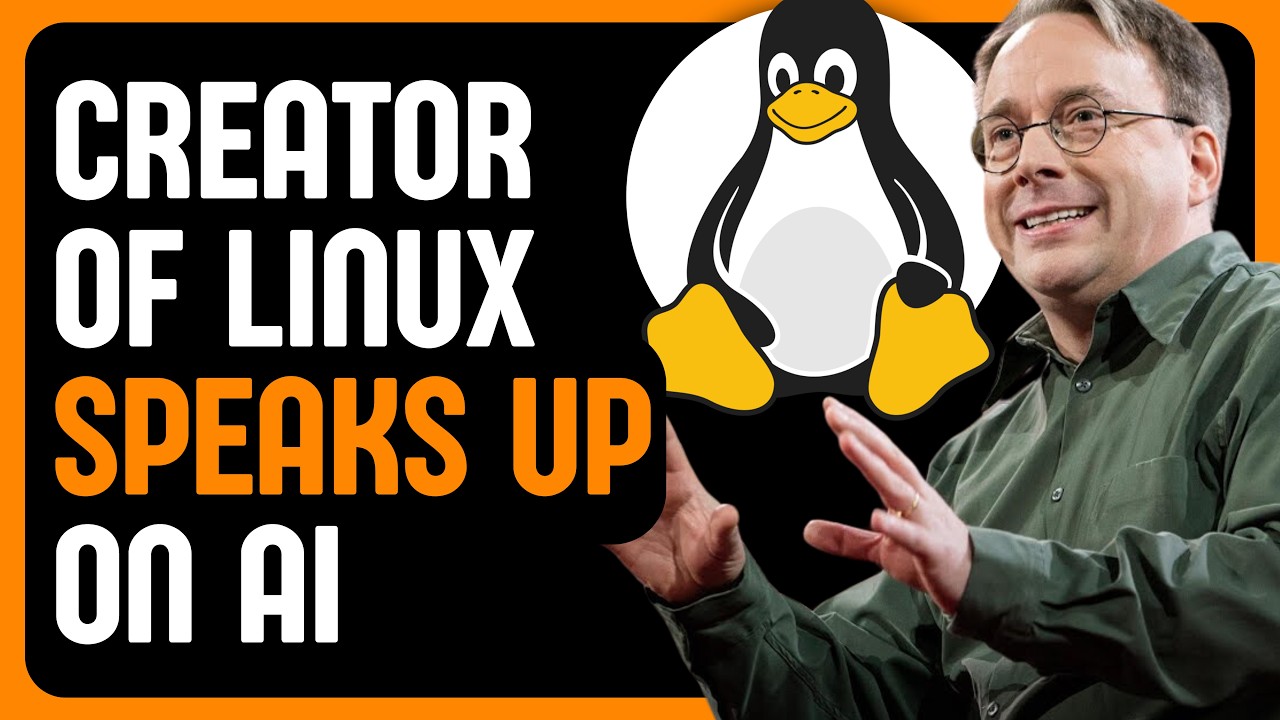
In a fireside chat at the Linux Foundation Open Source Summit, Linus Torvalds and Dirk Hohndel (Head of Verizon's Open Source Program Office) discuss how AI tools are reshaping Linux kernel development. Torvalds reveals that AI-assisted coding has driven a 20% spike in commits over the past six months, while simultaneously flooding the kernel's security mailing list with duplicate AI-generated bug reports. He outlines a new policy declaring that any bug found by AI should be treated as public, explains why security through obscurity is now dead, and argues that despite the short-term social pain, AI bug-finding is ultimately a net positive for open source.
1 The 20% Commit Surge
Torvalds opens by reflecting on 35 years of Linux development and 20 years of the modern Git-based release process. For two decades, things were "smooth sailing" — steady, predictable progress. Then, about six months ago, everything changed.
The last two kernel releases saw approximately 20% more commits than the historical average. Torvalds initially attributed this to excitement around the Linux 7.0 major version bump, similar to what happened with 6.0. However, he quickly realized the real cause:
Dirk Hohndel adds that they had discussed this trend six months earlier in Tokyo — AI tooling has lowered the barrier of entry to writing Linux kernel patches. The tools handle a "big chunk of the work," which has had both positive and negative impacts on the community.
2 Love-Hate Relationship with AI
When asked about AI in coding — with a show of hands revealing nearly the entire audience uses AI tools — Torvalds describes his relationship with AI as a "love-hate" one:
- The love: He genuinely enjoys the technology from a technical angle, finds the tools "very useful and interesting"
- The hate: AI is causing significant pain points — but not because the technology itself is bad
The core issue, Torvalds explains, is social, not technical. The biggest historical pain points in Linux have never been about code itself, but about being forced to change how people work. He draws a parallel to the year 2000, when he personally had to change his workflow because he no longer scaled for the growing project — a transition he still remembers as "one of the more painful episodes in kernel development." Now, 25 years later, the same dynamic is playing out, but at a community scale:
3 Security Mailing List Overwhelmed
Torvalds zeros in on one of the most concrete pain points: the kernel security mailing list has been flooded with AI-generated bug reports. The dynamic works like this:
- AI tools find bugs that may have security implications
- People's first reaction is to send them to the security list because "this may have security implications"
- Hundreds of people run the same (or similar) AI tools, often finding the same underlying issue
- The security list receives duplicate reports — tens, sometimes hundreds — all pointing to the same root cause with slightly different presentations
- The list has very few people on it (because it's "all supposed to be super secret"), and those few spent all their time just forwarding reports to the developers who knew the relevant code
4 New Policy: AI-Found Bugs Are Public
In the announcement of Linux 7.1-rc4, Torvalds introduced new security disclosure guidelines with a specific AI provision:
- Any bug found with AI should be considered public — not because it isn't a real bug, but because if one person found it with AI, a hundred others already did too
- The report should go to the regular bug tracker, not the secret security list
- Exception: Don't publicly share the exploit itself. Report the problem, but don't tell the world "this is how you bring down a big company on a Friday afternoon"
Torvalds emphasizes this isn't Linux-specific advice:
5 The Branded Bug Problem
Dirk Hohndel brings up a troubling trend that predates AI but has been amplified by it — the "branded bug" culture. Companies that find vulnerabilities:
- Brand the bug — give it a catchy name, create a domain, design a logo
- Release it publicly for maximum fame — before ever notifying the maintainers who need to fix it
- Never submit a patch — even though the code is open source
Hohndel points to the example of Heartbleed as an early instance, but notes the problem has intensified. He describes four recent local privilege escalation bugs in the Linux kernel, two of which were disclosed in exactly this irresponsible way. Torvalds' response is blunt:
6 The Zero-Minute Disclosure Gap
Hohndel frames the challenge starkly: with these four recent privilege escalation bugs, the time between the Linux kernel developers learning about the vulnerability and the world learning about it was zero minutes. There was:
- No opportunity to fix the bug before it became public
- No opportunity to get patches ready for distributions
- No opportunity to help the people who actually run the code
He challenges Torvalds: if all AI-found bugs are public, doesn't that put maintainers permanently on the back foot? Torvalds' response is pragmatic resignation:
7 AI Kills Security Through Obscurity
Torvalds explains why the old model no longer works. The Linux kernel has ~35 million lines of code and bugs are "daily occurrences." The traditional approach was:
- Fix the bug in the public repository
- Tell distributions to upgrade, but don't describe the specific security implications
- Rely on subtlety: security fixes were often subtle enough that nobody would figure out the implications from the patch alone
This worked for years — until AI. Torvalds shares a concrete example: last week they fixed a bug, and within 3 hours a blog post appeared detailing the security implications. Security researchers used AI to automate the "figuring it out" part — analyzing public patches to reverse-engineer exploits.
The incentive structure makes this inevitable: security researchers build their careers by being the first to publicize vulnerabilities. Being first means more eyes on your blog, more clout, more business. AI tools make that race almost instant.
8 The Open Source Advantage
Torvalds preempts the obvious objection: if AI makes open source code transparent to attack, should we switch to closed source? His answer is decisive: absolutely not.
- AI can reverse-engineer closed-source software too — "if you think that AI can't do reverse engineering of closed source, you're in for a surprise"
- Closed source is worse: AI can find the bugs in closed-source code, but it can't help you fix them. In open source, AI enables both attack and defense
Hohndel reinforces this point with an observation about the recent security firms: they spent enormous resources (money and compute tokens) using AI to find bugs in open-source code, but strangely none of them submitted a patch. He argues this is a social responsibility failure — journalists should give more attention to bug fixers than bug finders.
Torvalds acknowledges that finding is sometimes easier than fixing, showing his characteristic pragmatism even when he's clearly frustrated.
9 Finding Bugs Is Good
Despite the frustration evident throughout the conversation, Torvalds ends on a genuinely optimistic note. His final framing recenters the entire discussion:
- Short-term pain, long-term gain: When AI finds a bug, it hurts in the moment, but the code gets fixed and the end result is better
- The conflict isn't with AI itself: "The conflict is that there are some social choke points and social pain points that come with this new tool"
- 35 years of code is being audited: AI is finding issues in decades-old code that humans never caught
- The real danger is unfound bugs: "Finding bugs is great because the real problem is all the bugs you didn't find"
🎯 Key Takeaways
🔑 Key Takeaways
- AI drove a 20% commit increase — The last two Linux kernel releases saw ~20% more commits than the historical average, driven by AI-assisted development tools lowering the barrier to entry
- Security mailing list was overwhelmed — Hundreds of people running the same AI tools flooded the kernel's secret security list with duplicate bug reports, paralyzing the small team
- New policy: AI-found bugs are public — Torvalds decreed that any bug found with AI should be treated as public, since if one person found it, hundreds already did
- Don't publish exploits, do publish bugs — Report the problem but don't share the exact exploit details that would help attackers
- Security through obscurity is dead — AI can analyze a public patch and produce a blog post about its security implications within 3 hours
- Branded vulnerability culture is toxic — Companies that name bugs, create logos, and publicize before notifying maintainers are burning bridges with the kernel community
- Zero-minute disclosure gap — Recent privilege escalation bugs became public simultaneously with the kernel team learning about them, leaving no time to prepare patches
- Closed source isn't safer — AI can reverse-engineer closed-source code too, and unlike open source, it can't help fix the problems it finds
- Bug finders should also be bug fixers — Security firms spend tokens finding bugs in open-source code but submit zero patches — a social responsibility failure
- The real problem is social, not technical — AI tools are good; the challenge is learning to use them responsibly within community norms and not overwhelming maintainers
- Long-term optimism — Despite short-term pain, finding bugs in 35 years of code and fixing them makes the kernel objectively better
🔗 Resources & Links
- Full Open Source Summit Conversation — The complete fireside chat between Linus Torvalds and Dirk Hohndel hosted by the Linux Foundation
- Linux Kernel Archives — Official Linux kernel release page with changelogs and source