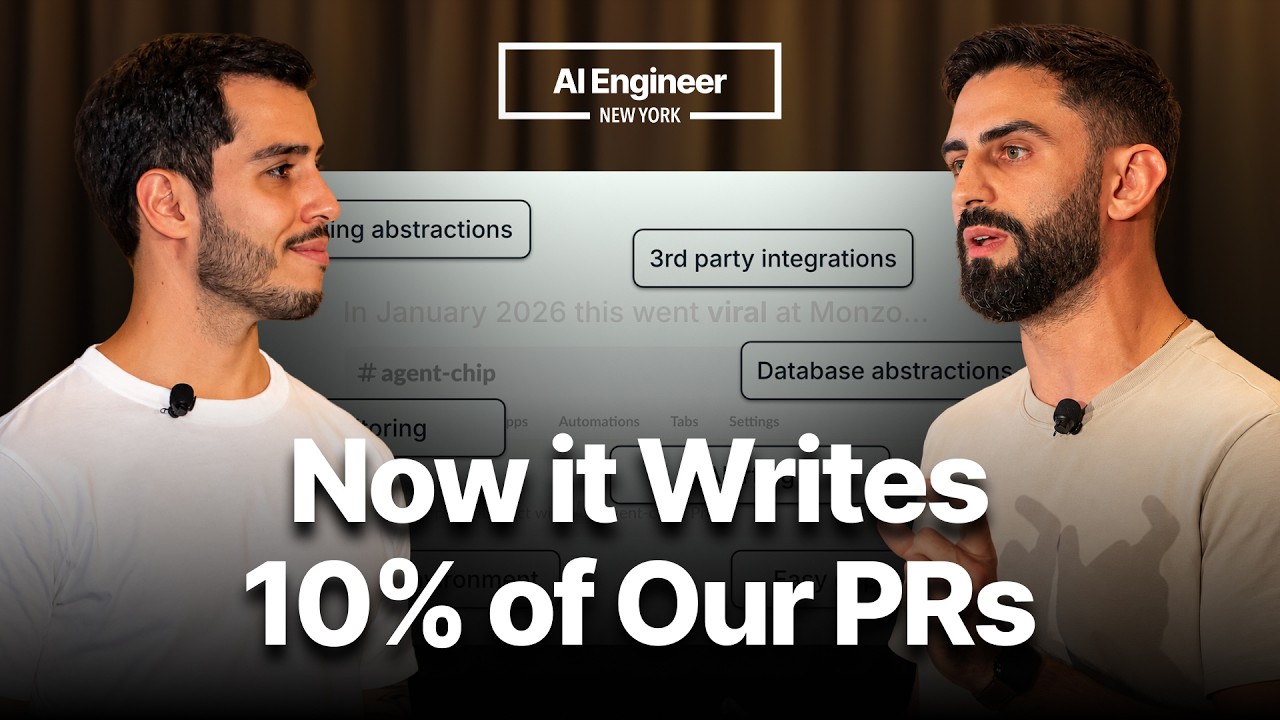
0:00Monzo — the UK digital bank — built its own in-house coding agent, Agent Chip, and it took off: it now authors over 10% of all merged pull requests across the company's tech teams. Felipe Felisola Caso and Francesco Galletta walk through why it worked so fast, and the answer isn't a model — it's the platform already underneath it.
Monzo by the numbers
0:28The scale of the problem the agent has to work against: engineers maintaining 3,000+ backend services, about 13,000 data warehouse models, and dozens of ML predictors — covering credit decisions, financial-crime detection, and complex app/backend/data use cases. The backdrop is the running joke from X quoted in the talk: "if you're not building your own AI coding harness, are you even a serious tech company?"
The Slack agent that went viral
1:37In January 2026, a Slack channel went viral inside Monzo: react to any message with a little chip emoji 🍟 and Agent Chip picks that message up as a prompt. That simple entry point evolved into an always-available teammate: @Agent Chip to answer a question, dig up architecture details, do code reviews ("looks good to me"), or pick up Linear tickets and just get on with them.
10% of PRs, 1,800 tasks/day
2:51The outcome today: Agent Chip authors over 10% of all merged PRs across tech (data, ML, backend, app), runs more than 1,800 tasks per day, and is starting to be adopted by business users — answering business questions and writing queries, not just coding. The talk's honest framing: lots of companies have agent success stories; what they're sharing is the why.
The secret sauce: "LLMs = lots of little multipliers"
3:51The core thesis: Agent Chip didn't take off because of a great model — it took off because Monzo already had a strong platform. When the Slack agent "went viral," the viral part was thin — the underlying capabilities (alerting, monitoring, third-party integrations, a staging environment, queueing abstractions, easy deployment, database abstractions) already existed. The reframe they want you to take away: LLMs = "lots of little multipliers" — the value compounds from the building blocks you already have, not from the model itself.
The architecture
5:04Two layers. First, an MCP gateway — internal services and knowledge sources sit behind an MCP server that gives deterministic behavior, choosing what's exposed to agents and managing authentication and authorization. Second, an agent orchestration system that powers Agent Chip: 5:59remote agents run inside a sandbox in an isolated namespace, with strict tools and permissions. The visual they use is a "box inside a box inside a box": the agent image defines the exact tools and CLIs, the proxy controls egress to the outside world (repos, code), and the innermost box is where the non-determinism happens — deliberately separated from production infrastructure, because this is a regulated bank and non-determinism has to be contained while still letting the agent "run loose and develop."
Incident mode & on-call
10:07Because Agent Chip became a building block, whole new use cases fell out of it:
- Incident mode — when an incident triggers, Agent Chip joins the channel and investigates logs, traces, the exact service, and the code, giving the human high-signal help (deliberately not flooding the channel with hypotheses).
- Ask channels — squad-to-squad interaction; Agent Chip drafts responses from knowledge sources, solves ask-tickets itself, or tags a human when it needs more context.
- Agent Chip on Call — the reactive version triages data-quality alerts and back-end changes automatically; the proactive version monitors back-end changes and predicts which outcomes they'll have on data before the next batch runs.
- Non-engineers shipping changes — 12:12a product person calls Agent Chip, gets a draft that's already tested in staging, and then involves an engineer to review and deploy. It doesn't lower Monzo's engineering rigor — it lowers the barrier to entry.
Why keep it in-house
12:57Why Agent Chip stays valuable in a fast-moving market: it's composable (a building block that quickly enables new agentic use cases); the platform is provider-agnostic (the agent "box" can be swapped for any model, chosen dynamically per purpose); and it covers a broadening development window — drafting backend and app changes, testing in staging, data tests, maybe predictors end-to-end. They're not "married to Agent Chip forever," but these properties make it a strong, permanent part of Monzo's internal platform.
Claims checked
Monzo is real, and the talk is real. Monzo is a well-known UK digital bank; the speakers (Felipe Felisola Caso, Francesco Galletta) are Monzo engineers on AI Engineer. The story is independently covered by multiple outlets, and Monzo's own engineering blog has "Building Agent Chip".
The headline numbers are self-reported by Monzo — 10% of merged PRs, 1,800 tasks/day, 3,000+ services, 13,000 data models. These are the speakers' own figures (no independent audit), but the substance and the "Agent Chip" name are confirmed across independent coverage.
The auto-captions flip between "Agent Chip" and "Agent Ship"; the correct name is Agent Chip (the chip emoji 🍟), confirmed by Monzo's own blog and independent reporting.
The description promotes AIE CODE (the channel's own summit) — not reproduced as a source.