🚫 What we excluded, and what it means
This is a sponsored video, and the sponsor is the product. The sponsor is WorkBuddy — Tencent's own desktop agent app — and both main demos run inside it, with Hy4 selected in its model picker. That does not make the tests worthless, because he uses answer keys and shows the failures, but it does mean the video is a demonstration of a vendor's two products working together rather than an independent comparison. It is also, awkwardly, a review of a model whose own vendor calls it open while the weights are not out.
📦 What shipped 0:04
| Property | Value |
|---|---|
| Name | Hy4 — spelled Hy, pronounced "hi", from Tencent's Hy team |
| Released | 4 November 2026, the full release rather than a preview |
| New in this version | Vision for the first time: charts, screenshots and documents |
| Also new | Computer use across command-line and graphical interfaces |
| Context and output | 1 million tokens of context, up to 65,536 output tokens |
| Availability | Tencent Cloud TokenHub, WorkBuddy, CodeBuddy, Yuanbao, WeCom, ima, plus OpenRouter and other third parties |
The two capability claims are the whole release, and they are worth separating: seeing an image is a perception problem, driving a computer is an agency problem. Text models could do neither well a year earlier, and doing both means a model can now be handed a screenshot and a desktop and asked to act — which is the difference between a chat assistant and a colleague who can use your tools.
🌳 The lineage and the licences 0:28
| Version | Date | Licence | Note |
|---|---|---|---|
| Hy3 | 6 July 2026 | Apache-2.0 | 256k context |
| Hy4 preview | 28 August 2026 | Apache-2.0 — weights on Hugging Face | 770B total parameters, 49B active, MoE with 256 routed plus one shared expert, top-8 routing, 78 layers, 1M context |
| Hy4 (full) | 4 November 2026 | Proprietary — API only | Vision and computer use added; weights promised later |
| Hy4 Flash | 16 November 2026 | Proprietary — API only | The cheaper variant |
The video says only that "the weights weren't out at launch", which is true and incomplete. What actually exists is an open-weight preview from August under Apache-2.0 that anyone can download and run, and a closed full release from November that has vision. Tencent is therefore shipping its best model behind an API while its open-weight model is a quarter behind — a pattern worth recognising, because "open" in a press release now describes a family's history rather than the artefact you can obtain today.
📜 The open claim 0:22
"Tencent says it now ranks among the leading open models, but they also say it still trails the top closed models, and the weights weren't out at launch."
| Statement | Status |
|---|---|
| "Among the strongest open-source models" — the release post's own words | Said about a model distributed as a hosted API with weights promised later |
| Still trails top closed models | Admitted by Tencent, which is to its credit |
| A comprehensive system card will accompany the weights | A future tense, which is where most release caveats live |
| An open-weight Apache-2.0 Hy4 preview exists | Aug 28, on Hugging Face, with architecture details published |
The reviewer's instinct — "take the claims with a grain of salt and let's actually use it" — is correct, and the sharper question is simpler: open weights mean you can run it, audit it, fine-tune it and keep it after the vendor changes its mind. None of that is true of the model in this video. The August preview is the open artefact; the November release is a hosted service.
🧩 Model versus app 0:35
| Component | What it does |
|---|---|
| Hy4 | Reads the input — text, screenshots, documents — and writes the answer |
| WorkBuddy | Plans the steps, opens files, produces a finished artefact; the model is swappable inside it |
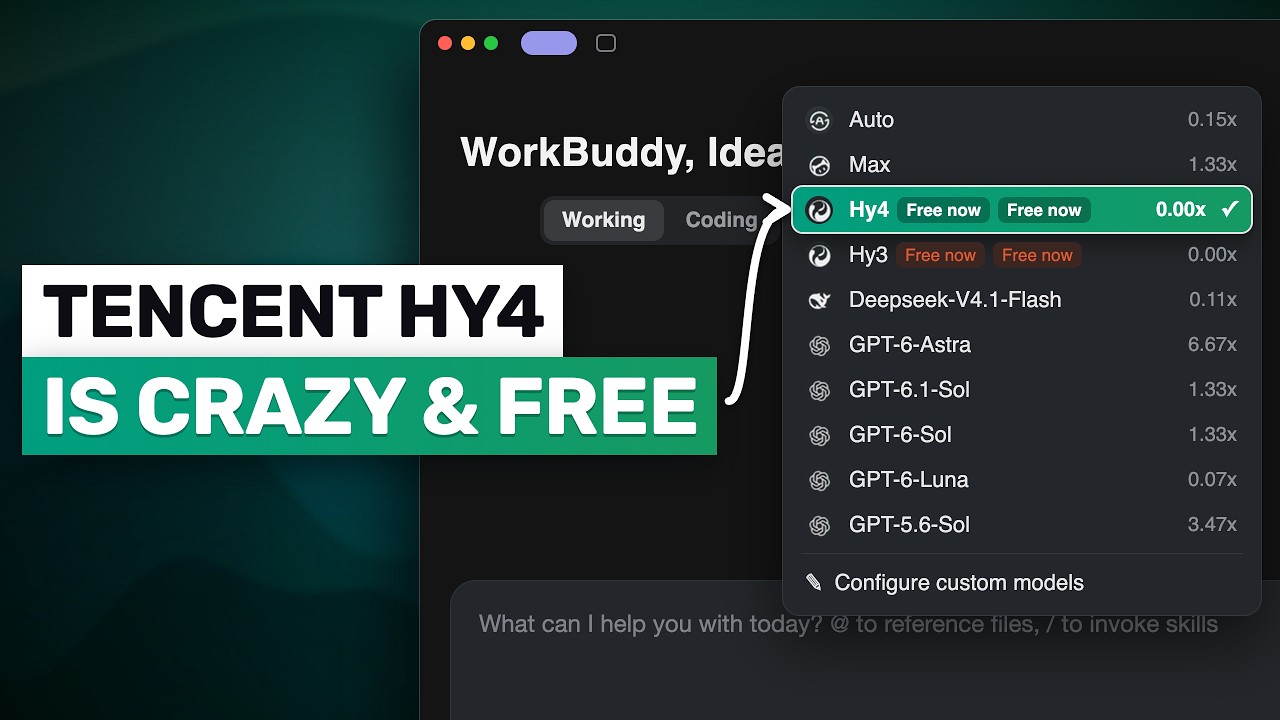
This distinction is the most useful teaching in the video, and it is one most release coverage gets wrong. Almost every "the model did X" claim on the internet is really "the app did X with a model", and the difference matters because you can change one and not the other. Setting up is exactly three steps: download the app, open the model picker at the bottom right of the input box, choose Hy4 — then paste a screenshot or attach files.
📉 Demo one: the planted error 1:06
| Input | Detail |
|---|---|
| A sales dashboard | Screenshot of a fictional shop's numbers |
| A written commentary | With an error deliberately planted |
| The raw CSV | So the reviewer knows the correct answer independently |
| The task | Find what does not match, redo the September-to-October maths, write a one-page note for leadership |
| The planted error | What Hy4 said |
|---|---|
| "Revenue rose 20% because average order value rose" | Revenue rose 20% because orders rose 20%; average order value stayed flat at $50 |
| Implicit false conclusion | Average spend per order did not rise, and the numbers cannot tell you why orders grew |
Catching a wrong causal explanation — rather than a wrong digit — is a harder task than it looks, because every number in the commentary can be correct while the sentence is still false. The test is also well-built in the way that matters: he has the CSV, so the answer key is not his memory of what he intended. Total time: about twelve minutes on one prompt, and it fixed its own page layout along the way.
🧱 Demo two: the task board 1:48
| Requirement | Result |
|---|---|
| Rebuild a three-column board from a screenshot | Done — to do, in progress, done |
| Add a task | Works |
| Move between columns | Works |
| Search | Works |
| Survive a reload | Works — after one round of feedback to fix two bugs |
| Because it kept working after delivery, he stopped it, and the run shows as cancelled | Not a failure of output, a failure of stopping |
He says plainly "this isn't a first try", which is the sentence that makes the rest of the review trustworthy. And the reload test is the right one: a board that looks correct but forgets everything is a mock, not an application. The detail worth flagging for anyone evaluating agentic coding is the persistence requirement — it is the cheap way to tell whether the app has state or just rendered state once.
The cancelled run is a small but real signal about agent harnesses: a model that continues working after the deliverable is complete is burning tokens on your behalf. Knowing how to stop it — and having a UI that records the stop as cancelled rather than as a failure — matters more as runs get longer.
🧾 Demo three: the receipts folder 2:40
| Input | Seven files: receipt photos, PDFs, an email receipt, a CSV, a personal note |
|---|---|
| Task | Keep only real October expenses, fill a spreadsheet, export a one-page report |
| Time | About seven minutes |
| Total reported | $4,623 — meals $51.90, supplies $64.18, printing $318.75, travel $27.40 |
| Excluded, with reasons | A September taxi receipt, a quote that is not an invoice, a shopping list |
The interesting part is the exclusions, not the total. A model that sums a folder is doing arithmetic; a model that declines three files and explains why is doing classification with justification, which is the actual difficulty in document work. Rejecting a quote because it is not an invoice is exactly the judgement a bookkeeper applies, and getting it right with reasons is what makes the output auditable.
One caveat the video states honestly: WorkBuddy has no tool for clicking around the desktop, so this was file work in a folder rather than GUI automation. "Computer use" in the model's announcement therefore does not mean the app you are testing can drive arbitrary windows — that capability belongs to the model's API, not to this harness.
✏️ Demo four: the sketch 3:22
| Input | A pencil sketch — striped lighthouse, cottage, sailing boat — with handwritten notes |
|---|---|
| Task | A single-file 3D scene in three.js |
| Time | About nine minutes |
| Result | One HTML file: drag to look around, the beam spins, clicking the lamp toggles the light, the boat bobs on the waves |
| Why it is impressive | It read the handwriting, not only the drawing |
A 3D scene from a 2D sketch is a decent proxy for spatial reasoning, and the testable details are the interactive ones: does dragging rotate the view, does the toggle work, does the boat animate independently. Those are cheap to check by hand and hard to fake — which is why "make it interactive" is a better evaluation prompt than "make it look like the sketch".
⚡ Demo five: the energy report 3:49
| The trap | Note three said the gym's August reading includes 1,800 kWh that is not real use — so the chart makes August look like the biggest month |
|---|---|
| Gym's August, corrected | 390 kWh |
| Q3 total | 37,580 → 35,780 |
| Highest month after correction | September |
| Highest consumer in September | Main hall, 3,960 |
| Library | Up 12.2% |
| Estimated cost | $5,335.76 |
| Most per square metre / corrections due | Workshop / 15 November |
| Time | Under two minutes, all seven answers matched |
This is the best test in the video and the one to copy. A footnote that invalidates a chart requires reading the text, understanding that a meter reading is not consumption, and then recomputing every downstream number including rankings. It is the difference between OCR and comprehension — and the corrected ranking (September becomes the highest month) is the proof that the model actually applied it rather than acknowledging it.
🧪 How to test a vision model 4:33
| Rule | Why it works |
|---|---|
| Use your own files | Benchmarks measure benchmarks; your documents measure your work |
| Keep the prompt and settings identical, change only the model | Otherwise you are measuring your own prompt tuning |
| Plant mistakes and keep an answer key | Turns "looks right" into a pass/fail |
| Remember image input ≠ image output | It reads images; it does not generate them |
| Report whether it was the first attempt | A fix after feedback is a different product than a first-try success |
"Change only the model" is the discipline that most comparisons lack, and it is why this five-minute video is more useful than a leaderboard: same harness, same files, same prompt, swap the model. The caveat he states — that image input is not image generation — sounds trivial and is not, because a great deal of confused evaluation comes from expecting a vision model to produce pictures.
💸 Pricing, and a window that closed 4:43
| Item | Value |
|---|---|
| Input, standard | $0.83 per million tokens |
| Output, standard | $2.50 per million tokens |
| Cached input | $0.042 per million — roughly twenty times cheaper than fresh input, and unmentioned in the video |
| TokenHub promotion | 50% off standard through 31 December 2026, so about $0.42 / $1.25 in practice |
| Free tier in WorkBuddy and CodeBuddy | 4–15 November 2026 — already over by the time the video published on the 20th |
The price is the same as the preview's, which is the interesting part: Tencent kept list pricing flat while adding vision and computer use, and then halved it through its own channel until the end of the year. Note the cached-input line — for document work, where the same PDF or codebase is repeatedly attached, the cache price is the number that decides whether the workflow is affordable.
Practical timing problem: the video was published five days after the free window closed. Anyone watching it and expecting to try Hy4 for free in WorkBuddy cannot, and the video does not say so. The 50% TokenHub discount does still stand until 31 December.
🚧 Caveats 5:00
| Caveat | Detail |
|---|---|
| The full model is not open | API-only, proprietary, weights promised; the Apache-2.0 artefact is the August preview |
| The demos are inside the sponsor's app | What you see is Hy4 plus WorkBuddy, not Hy4 alone |
| Five demos is not a benchmark | All five passed his keys, which is encouraging and statistically meaningless |
| Long-running by default | 12 minutes for one prompt, 9 for another; and one run kept working after delivery |
| Computer use is a model claim, not an app feature | WorkBuddy has no desktop-clicking tool |
| No independent quality data | Tencent says it trails top closed models, which is the only comparative statement available |
The honest summary is that this is a very good document-and-screenshot model inside a vendor's own harness, demonstrated on five hand-built tasks with answer keys, by a reviewer being paid by that vendor. That is enough to justify trying it on your own files and not enough to justify believing any ranking — which is exactly what the video says, to its credit.
✅ Claims checked
| Claim | Verdict | Evidence |
|---|---|---|
| Hy4 is the official release, launched 4 November 2026 | Correct | Tencent's release post and the Hy team's announcement, ten weeks after the August preview |
| It is the first Hy model with vision | Correct | Both vision and computer use are described as firsts for the family |
| It can use a computer in the terminal and in desktop apps | Correct as a model capability | Announced across CLI and GUI; not exposed by the app in these demos |
| Tencent says it ranks among the leading open models | Correct, and it is their phrase | "Among the strongest open-source models" appears in the release |
| Tencent says it still trails top closed models | Correct | Stated in the coverage he is paraphrasing |
| The weights were not out at launch | Correct — and incomplete | Full Hy4 is API-only; the Apache-2.0 Hy4 preview from 28 August is downloadable |
| WorkBuddy is Tencent's desktop agent app, separate from the model | Correct | Model picker inside the app; model is swappable |
| Sales demo: Hy4 caught the wrong explanation | Demonstrated | Orders up 20%, average order value flat at $50 — arithmetic he could verify from the CSV |
| That run took about 12 minutes | His measurement | Single prompt, including fixing its own layout |
| Task board passed add, move, search and reload | After one round of feedback | Two bugs; he says it was not a first try |
| Receipts folder total was $4,623 | Matched his answer key | Three files correctly excluded with reasons |
| Pencil sketch became an interactive three.js scene | Demonstrated | About nine minutes, one HTML file, handwriting read |
| Energy report: all seven answers matched | Matched his key | Including the corrected August figure, Q3 total and the new highest month |
| Image input means it reads images, not generates them | Correct | Worth stating; a common confusion |
| API is about $0.83 in / $2.50 out per million tokens | Correct as list price | The same as the preview's published pricing |
| TokenHub at half price through 31 December 2026 | Correct | Confirmed in Tencent's release post |
| Hy4 free in WorkBuddy and CodeBuddy from 4 to 15 November | Correct — and already expired when the video published | Same release post |
| Hy4 is fully open source | Not as shipped | Proprietary API for the full model; open weights for the earlier preview |
Basis note. Built from the full 5:27 video and checked against Tencent's release announcement, the Hy4 preview's model card and architecture details, and independent coverage of the release. The video is sponsored by WorkBuddy, the app used for every demo, which is disclosed above rather than treated as neutral. The demo numbers are his, verified against the answer keys he built; the licence status is the main correction.
🔑 Key takeaways
- Vision plus computer use is the release, and they are different problems: seeing an image, and acting on a screen.
- "Open" now often describes a family's history, not the artefact. Hy4's open weights are the August preview; the November model is a hosted API.
- Separate the model from the app. Most "the model did X" claims are really "the app did X with a model", and only one of them is swappable.
- Keep an answer key. A planted error plus the raw data turns a demo into a pass/fail test.
- Change only the model when comparing, or you are measuring your prompt tuning.
- Catching a false causal explanation is the hard task, because every digit can be right while the sentence is wrong.
- Test state, not appearance: a task board that forgets on reload is a mock, not an app.
- Exclusions with reasons are the real document skill — rejecting a quote because it is not an invoice is bookkeeping judgement.
- A footnote that invalidates a chart is the best vision test: read the note, understand the meter reading, recompute the ranking.
- Report whether it was the first attempt. A fix after feedback is a different result from a first-try success.
- Cached input pricing is the number that matters for repeated documents — about twenty times cheaper than fresh input.
- Check the clock on promotions: this video published five days after the free window it describes had closed.
- A run that keeps working after delivery is a cost, and knowing how to stop it is part of using long-running agents.
- Five good demos justify trying it on your files, not believing a ranking — which is what the reviewer concludes anyway.
🔗 Resources
- The video — AICodeKing, 5:27, sponsored by WorkBuddy
- Tencent's Hy4 announcement — capabilities, availability and the promotion dates
- Hy4 preview on Hugging Face — the Apache-2.0 weights, 770B total and 49B active parameters
- This site's deep dive on Gemini 4 Neon, for how the same week's other release compared on cost per task rather than on features
Basis note. The sponsor is the product under test, which is disclosed rather than glossed over. List prices, promotion windows and licence status were checked against Tencent's own announcement; demo outcomes are the reviewer's measurements against his own answer keys.
⏱ Timestamp index
0:04Hy4, the official release
0:12Launched 4 November
0:16The first Hy model with vision
0:22Computer use in CLI and desktop apps
0:28Leading open models, still behind closed
0:31Weights not out at launch
0:35Model versus app
0:52Installing and choosing the model
1:00Attaching a screenshot
1:06The sales dashboard demo
1:21The answer key
1:36Twelve minutes, one prompt
1:48The task board demo
2:06"This isn't a first try"
2:14Add, move, search, reload
2:27It kept working, so he stopped it
2:40The receipts folder
3:03Total $4,623
3:16Three files excluded, with reasons
3:22The pencil sketch
3:33A 3D scene in one HTML file
3:49The energy report
3:56The 1,800 kWh note
4:05Q3 total corrected
4:16Library up 12.2%
4:33How he would test it
4:39Image input is not image output
4:43Pricing
4:52TokenHub at half price to 31 December
5:00What he would try first