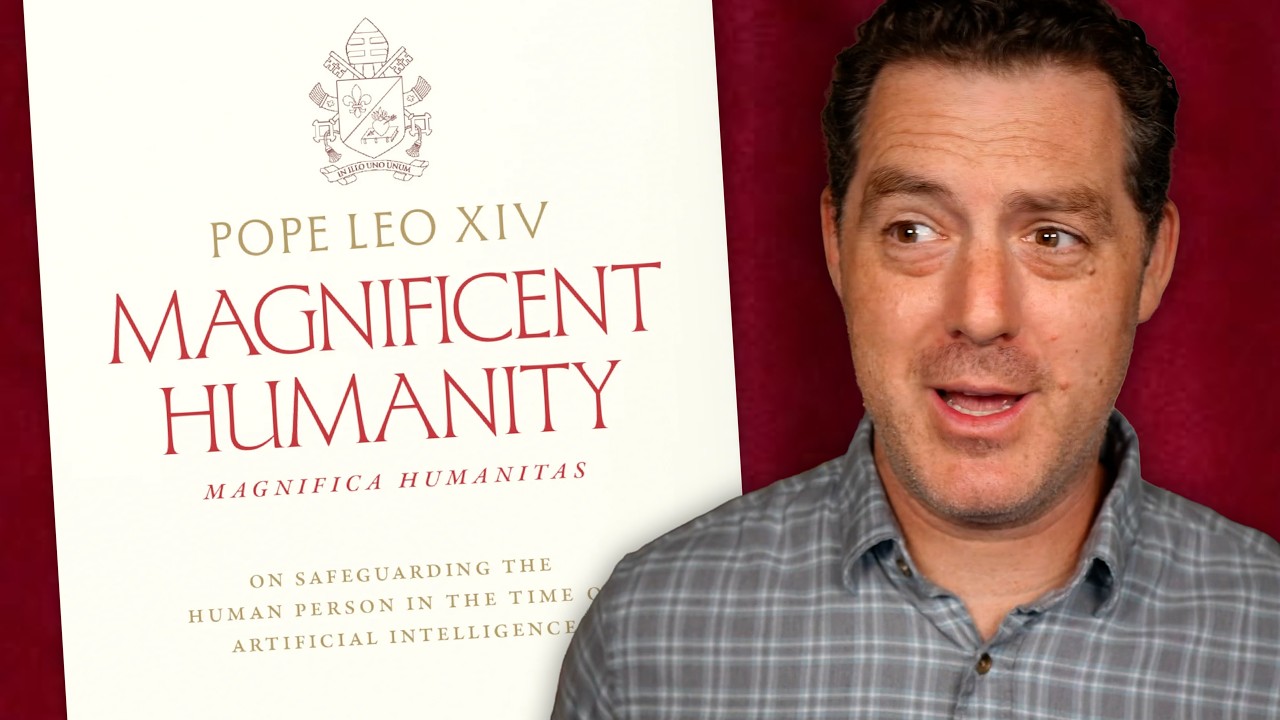
The Pope Is Into AI
Matthew Berman breaks down Pope Leo XIV's 40,000-word encyclical on artificial intelligence — what it says about open source, human dignity, AI arms races, and why Anthropic showed up at the Vatican.
Pope Leo XIV has released "Magnifica Humanitas" — a sprawling, 40,000-word encyclical dedicated entirely to artificial intelligence. It is the first papal document ever focused solely on AI, and Matthew Berman calls it "genuinely thoughtful."
The core thesis: humanity is magnificent — and the AI age must not make us forget that. The Pope frames AI not as inherently evil, but as a tool whose trajectory depends on human choices. The document's length and depth signal the Vatican's seriousness about engaging with technology at a philosophical level.
Berman notes that while the encyclical has religious framing, many of its arguments are "surprisingly secular" and pragmatic — touching on market power, open-source software, labor displacement, and geopolitics.
The Pope argues that concentrated private tech power is one of the greatest risks of the AI era. A handful of corporations controlling access to foundational AI capabilities creates a dangerous asymmetry.
Berman connects this directly to the open-source vs. closed-source debate. He draws a pointed parallel to Anthropic's lobbying for AI regulations that would effectively erect barriers to entry — and to the "Mythos" model access-control system that gates who can use powerful models.
The Pope's position, paraphrased: if AI is going to reshape society, its tools should not be locked behind the gates of a few private entities. Berman notes the irony that the Vatican sounds more pro-open-source than some Silicon Valley companies.
The encyclical devotes significant space to how AI threatens human identity through work. When people derive purpose and dignity from labor — and AI replaces that labor — what happens to the person?
Pope Leo XIV warns against new forms of dehumanization:
- Treating humans as data points or optimization targets
- Algorithmic decision-making that strips context and compassion
- A growing "uselessness class" of people economically displaced by automation
Berman emphasizes this isn't a Luddite argument — the Pope acknowledges AI's potential benefits — but rather a call to center human dignity in every design and policy decision.
The Pope warns that emotional AI relationships are a threat to authentic human connection. As AI companions become more convincing, they risk replacing the messy, vulnerable reality of human bonds with frictionless simulation.
This resonates with current trends: Character.ai's massive user base, AI girlfriend apps, and growing reports of people preferring chatbot interactions to human ones. The encyclical calls this a form of "spiritual impoverishment."
Berman agrees this is underappreciated: "When the AI always agrees with you, never challenges you, and is available 24/7, that's not companionship — that's a mirror."
Pope Leo XIV frames AI development as an arms race — between nations, between corporations — and calls for de-escalation. The analogy to nuclear weapons is explicit in the encyclical.
Key arguments:
- The race to AGI is driven by fear of being second, not by humanitarian purpose
- Autonomous weapons systems represent a moral red line
- International cooperation is preferable to competitive acceleration
Berman notes this is the most politically charged section — it implicitly challenges U.S., Chinese, and European postures. The Pope's call for a "pause" or "treaty" echoes (but goes further than) earlier open letters from AI researchers.
Berman unpacks a subtle but critical point: regulatory capture. Large incumbents actively lobby for AI regulations — not to protect the public, but to build moats that block smaller competitors and open-source alternatives.
He singles out Anthropic's Dario Amodei, who has publicly advocated for licensing regimes that would, in practice, require the kind of compliance infrastructure only well-funded companies can afford.
The paradox: the companies calling loudest for "responsible AI regulation" are the ones who would benefit most from it. The Pope's encyclical, perhaps unwittingly, aligns with this concern — warning that regulation must serve people, not consolidate power.
Anthropic's co-founder spoke at the Vatican event unveiling the encyclical. Berman calls this "Pope-based marketing" — a strategic play for moral authority and public trust.
By aligning with the Vatican, Anthropic positions itself as the "ethical" AI company — the one that cares about safety, that engages with moral institutions, that takes existential risk seriously.
Berman is skeptical: "You can't claim the moral high ground while simultaneously lobbying to crush open-source competitors." He sees a tension between Anthropic's public positioning (safety-first, human-values-aligned) and its business strategy (regulatory moats, gated access).
Reactions from AI industry leaders have been mixed but notably respectful. Even those who disagree with specific policy prescriptions acknowledge the encyclical's depth and seriousness.
- Open-source advocates — enthusiastic about the Pope's stance on distributed access and opposition to concentrated power
- Safety researchers — welcomed the arms-race framing and calls for international cooperation
- Industry executives — polite but cautious; few want to publicly disagree with the Pope
- Skeptics — question whether the Vatican has the technical literacy to meaningfully contribute to AI governance
Berman's take: regardless of one's religious views, having a major global institution with over a billion followers weigh in on AI governance is significant — and the document is better-informed than most government white papers on the topic.
🔑 Key Takeaways
- First-ever AI encyclical: Pope Leo XIV's "Magnifica Humanitas" is a 40,000-word document dedicated entirely to artificial intelligence — signaling the Vatican treats AI as a civilizational issue.
- Pro-open-source stance: The Pope argues against concentrated private tech power, inadvertently aligning with open-source advocates and challenging closed-model gatekeeping.
- Human dignity at the center: AI threatens identity through work displacement — the encyclical calls for keeping human dignity as the design constraint, not an afterthought.
- AI companionship warning: Emotional AI relationships risk replacing authentic human connection with frictionless simulation — a "spiritual impoverishment."
- Arms race framing: AI development is compared to nuclear proliferation; the Pope calls for de-escalation, international cooperation, and a ban on autonomous weapons.
- Regulatory capture alert: Incumbents like Anthropic lobby for regulations that serve as competitive moats — the Pope's call for people-serving regulation cuts against this.
- Anthropic's Vatican play: Appearing at the encyclical's unveiling is strategic "Pope-based marketing" — seeking moral authority while maintaining business-driven gated access.
- Unlikely authority: Regardless of religious views, a global institution with a billion+ followers engaging seriously with AI policy is significant — and the document is better than most government white papers.