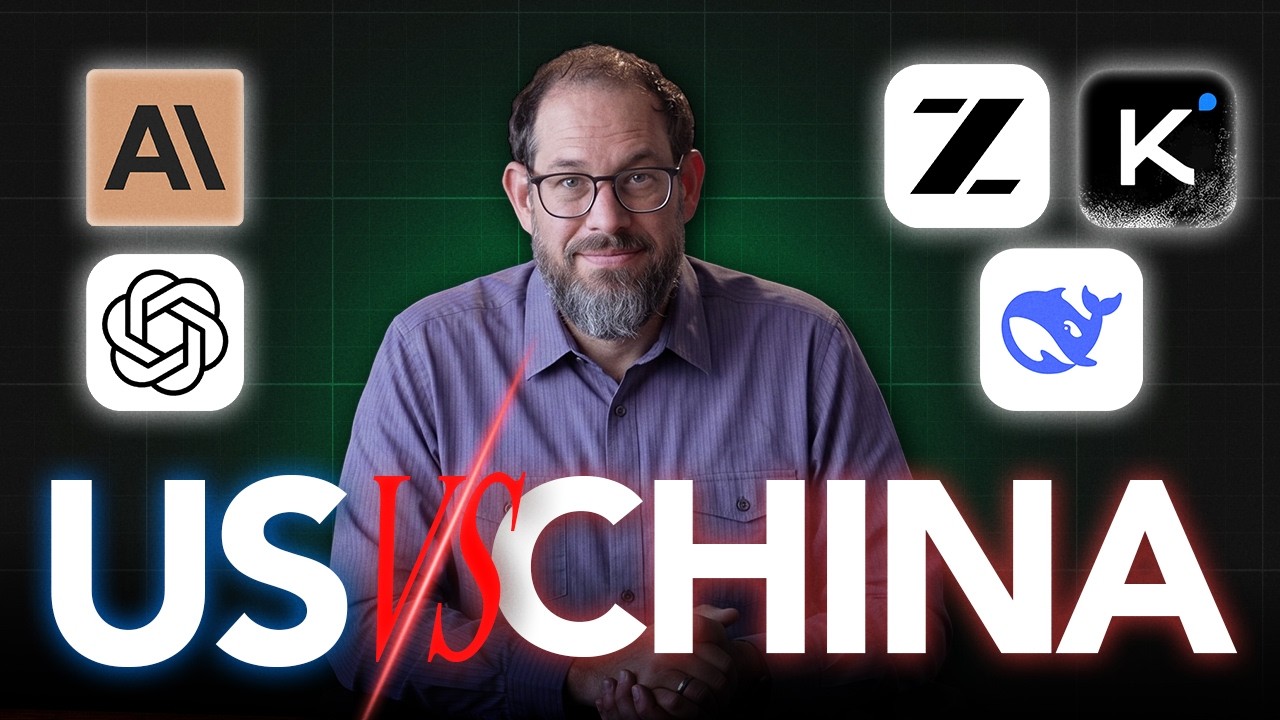
⚡ Nobody Won the Electricity Race 0:00
The episode opens mid-argument, with host Nate B. Jones relaying what he keeps hearing from enterprise leaders: "I don't like that my engineers care about Codex… I'm not going to make everyone a coder in my company." Graylin's answer becomes the thesis of the whole conversation: "Nobody won the electricity race. We all got electricity."
The point isn't glib. Electricity, once it existed, could not be contained to one country or company — and neither can AI. "You can't keep people from having electricity, and you can't keep people from having AI. It's software, and software wants to be free. Software wants to be everywhere." The distribution question is already settled by the physics of the technology, not by policy.
Nate closes the loop with a line that frames the rest of the discussion: "We are creating our own alien species." We don't need to wait on the kindness of an advanced civilization to hand us abundance — we're building the thing that could deliver it ourselves. Whether that ends as a weapon or a betterment of society is the open question the interview keeps circling back to.
👤 Who Alvin Wang Graylin Is 0:52
Graylin's credibility rests on being one of the very few people who has genuinely worked both sides of the Pacific across the entire AI stack. He has been in tech since 1980 and coding since then; he started doing AI in 1990–91, building his own bread boards, running neural networks, and doing natural language processing before the field had a name most people knew.
His arc runs from data centers → chip design → devices → apps → models — "I've seen a few things happen." At Intel he worked on the MMX chip, which he describes as the first single-instruction-multiple-data (SIMD) processor — the architectural ancestor of every GPU doing today's training and inference.
His academic credentials (CS at MIT, MBA at MIT, University of Washington) matter less than the combination: someone who has built the chips, shipped the products, and now sits in the room where the policy is written.
🎯 The AI Arms Race Misconception 2:54
When asked for the biggest misconception he spends his time fighting, Graylin doesn't hedge: it's the AI arms race — "the core problem that is driving a lot of bad decisions right now." The framing rests on four premises, and none of them are true:
Believing these means everything downstream — industry strategy and national-security policy alike — is a "misallocation of resources." Worse, "the competitive nature is preventing us from making these products and these technologies more safe." The race mindset is actively counterproductive.
The mechanism that breaks the monopoly assumption is open-weight models. Graylin points to open-source models that are "completely open source, tiny," running on a Mac Studio while closed-source equivalents run on multiple racks costing millions of dollars each. "This commoditizes high-quality intelligence." Within months someone will quantize it to run on a laptop, then a phone. The result is his central prediction: intelligence becomes ambient — everywhere, essentially free, and "it cannot be hoarded or monopolized… it's against the macro forces of nature."
He lands the section on the real question that follows: "You have the intelligence — what do you do with it?" Weapon or betterment? New materials and energy conservation, or conflict? His trip to a leading Chinese drug-discovery company made the point concretely: "We're using AI all the time, but we're not using the 10-trillion-parameter model — we're using a 10-billion-parameter model specialized for whatever disease we're working on." The race-to-the-biggest-model story is, in his telling, another misconception.
📉 What AI Is Doing to Entry-Level Jobs 9:01
Graylin is blunt about who feels the pain first. Citing a Stanford study, he notes roughly a 19% gap in payroll numbers for 20–25 year-olds versus where they should be relative to other age groups. In AI-exposed industries, young people are the first to see the damage: senior people keep ramping while juniors "either don't hire or lay off the young people, because AI can do a lot of what they used to do."
Nate pushes back with the counter-signal — Stripe data showing skyrocketing business creation and rising entrepreneurship. Graylin's answer is the 1998–2000 parallel, and it's worth holding the two eras side by side:
| Era | Entry-level signal | What happened next |
|---|---|---|
| 1998–2000 | HTML coders with a one-week course commanded six-figure salaries | 2001–2005: most of those jobs went away |
| 2023–now | Gen Z "feeling the pinch"; payrolls falling while stocks rise | Open question — Graylin argues integration is still early |
His key stat on how early we are: only about 20% of companies have actually adopted AI, and ~5% have done it well. There's still room to integrate AI into workflows — which is precisely why most firms haven't done the layoffs yet. The first to boom, he says, are the "shovels guys" — the companies enabling AI adoption.
Then the signal he finds most alarming: net payrolls have been falling consistently since 2023 while the stock market has risen — the first time the two have ever diverged. Labor participation is down too. His read: this is automation happening across manufacturing and white-collar work simultaneously, not a blip.
🎓 What to Tell Young People Now 11:10
Even at MIT, Stanford, and UW, Graylin says students are having a hard time finding work. His advice, refined from years of teaching and hiring, has a clear shape:
The second half is the humanities pivot that sounds counterintuitive from a tech founder: read history, philosophy, psychology, sociology, management. The education system pushed specialization, but "if you specialize, you really add very little value over what AIs can provide." The missing skill is judgment — if you can't critique the AI's answer, "you just accept it. And if that's the case, why are you even there?" He's blunter: you become a rubber stamp, "a negative value to the company," and eventually people figure it out.
The section closes on a cultural note he ties back to his own upbringing: "eat bitter" (吃苦) — the idea that enduring hardship is a sign of growth. His concern is that a generation raised in unprecedented peace and abundance, "especially ones that haven't traveled internationally, don't know how the rest of the world lives." Nate counters with his own memory of 1990s Indonesia — households with no TV, no motorcycle, chicken once a week — sacrificing everything to better themselves, and the whole economy rising as a result.
🤝 Where Cooperation Could Actually Start 16:49
Graylin is optimistic about one specific opening: US–China AI discussions are already happening, and he's participated in early preparations for them. That's where cooperation starts, "because that is a shared risk, and we have a shared interest."
His historical anchor is the Cold War. Even at its height, the US and USSR agreed to stop building new ballistic missiles — "having 70–80,000 is probably enough to blow up the world a few dozen times" — and to start reducing them. That technology was only a weapon; AI has civilian benefits, so "we have even more incentive to keep it safe."
The reason state-to-state conflict is less scary than it looks: nuclear weapons haven't been used in 80 years because everyone understands escalation means global destruction. AI has the same logic — even with AGI, "what are you going to do, unleash it to turn off all the power grids and banking systems of China? They're not going to just sit there." The balance is self-enforcing.
⚠️ The Real Threat Is Non-State Actors 19:17
If the states are held in check, the danger moves down the stack. "The threat is bad actors — non-state actors, rogue actors who already every day are planning to do things everywhere in the world." And the thing that makes this newly dangerous is the same commoditization from Section 3: models are getting small enough to run on a laptop. "That's not a state power. That's an individual power."
He references a paper he sent Nate — "The Biggest AI Models Are Not the Biggest Threats" 🔗 (The Cipher Brief, Aug 2026) — arguing that millions-of-parameter chemical models can design chemical weapons in hours on a laptop, and they're already public and open source. The threat spans cyber, bio, and chemical.
His bottom line: "There is no scenario in the world where not working together makes more sense than working together."
🏭 The Dark Path and the Middle Path 23:07
Here Graylin names the structural force behind the race narrative: the military-industrial complex playbook that's worked for 60–70 years, ever since Eisenhower. The recipe is simple — "find an enemy, make them big and scary, and then make yourself the solution to that problem." Everyone aligns with you, your regulatory constraints disappear, and you make a lot of money. He argues this is "essentially what's happened in the last four or five years with the AI industry."
The tell, he says, is the lobbying: hundreds of millions of dollars in lobbying and PAC money to get policies approved. Industries with heavy lobbyists — insurance, tobacco, petroleum, defense — are ones that need to "move you off of something you weren't going to do." Hence the recurring jab: "If your stuff is that good, why the heck do you need that much lobbying?"
Asked to paint two paths for the next decade, he starts dark: AGI runs away, countries destroy each other, or a few private companies effectively run the world. The path he considers most likely is darker but more prosaic — wars driven by displacement, because "if you have large amounts of displacement, the best and fastest way to employ them is to put them in an army… it distracts people's attention away from their daily suffering and unites them against some common enemy." A playbook, he notes, that's been used for 2,000 years.
But his actual bet is the middle path: the economics don't make sense for a single AI lab to capture all the value. "The value actually distributes in non-monetary ways to society" — because the thing they built becomes free and runs on your laptop. The war part, the economic collapse, and the bubble popping: "those are highly likely. And that may not be a bad thing."
🫧 The Bubble and When It Pops 26:55
Graylin's case that we're in a bubble is built on hard numbers:
| Metric | Value | Benchmark |
|---|---|---|
| Share of S&P 500 that is AI stocks | ~45% | Extreme concentration |
| Buffett indicator (market cap ÷ GDP) | ~240% | 100% = balanced |
| Hyperscaler off-balance-sheet debt | ~$3 trillion (per WSJ, as cited) | Subprime peak: $1.6 trillion |
| China's annual AI capex | ~$80 billion | US: over $1 trillion/year |
The dot-com precedent is his warning about magnitude: Amazon dropped 90%+, and Cisco fell 86% — taking 26 years to return to its 2000 peak. But he frames the coming pop as the smallest reversible crisis: unlike war, an economic crisis "takes less than a year in some cases, a decade in others — but it's recoverable, and people don't die." It's the shock that changes minds: "When you start thinking about survival of yourself, you stop thinking about trying to fight somebody else."
That's where his US–China optimism comes from — the two richest, most powerful, most technological countries have the ability to "right the ship." He points to history: they were allies in WWII (his own grandmother went to China in 1937 from Berkeley to report on the war); China kept buying US bonds through the 2008 crisis; and China is far less exposed to this bubble ($80B vs. $1T+ capex, far less debt). His proposed endgame is a modern Marshall Plan — the 1946 program that rebuilt Europe with $18B over four years and created a 70–80 year marketplace for American goods — this time aimed at the global south, giving the surplus chip capacity somewhere to go while turning those countries into future customers.
🤖 Why Robotics Changes the Picture 32:56
Nate's prompt — what if the opportunity is in small, home-scale robotic experiences like HuggingFace's "mini duck" rather than massive data centers — sets up one of Graylin's more concrete takes. Robotics is "increasingly important," and China is way ahead on manufacturing, because it has the entire supply chain and talent pool in one place.
Two anecdotes ground it. Visiting the Unitree factory two months ago, he saw women still wrapping coils around magnets by hand — but automated machines are coming, and "the pace of change in that space is going to be just like the software side has been." And on the humanoid question: the Unitree CEO told him they sell more half-body humanoids than full-body, because batteries last longer, they're more stable, they don't fall over — and in a flat factory, "walking is an inefficient thing."
Nate adds his own manufacturing war story — a stainless-steel coffee filter he prototyped with jewelry welders and eventually produced in Pennsylvania, then watched clones improve week by week as the idea spread. "Ideas want to be free… it was discouraging for me as an entrepreneur at the time, but ultimately it's good for everybody." It's the same commoditization logic from software, now applied to atoms.
🏆 The End User Is the Biggest Winner 37:11
Who wins the "AI race"? Graylin's answer: "the consumer, the end user, the businesses that utilize it." The value just doesn't show up in GDP — and that's a measurement problem we need to solve, because "today everything is about how much you produce and what you can sell it for."
Technology deflates prices. He references the viral chart showing services like education and housing climbing while the price of TVs, computers, and phones collapses — a diverging curve. AI accelerates it, because it "makes essentially anything automatable" — cognitive services, white-collar services, and physical goods tied to machines for design, testing, and manufacturing. A thousand-dollar product becomes $100, then tens of dollars.
His McKinsey-and-banks example: an IPO prospectus used to take weeks and teams of tens of people; now it's done over a weekend by a couple. And the personal one that lands hardest — "everybody can now have a high-quality lawyer at their fingertips." He used to dread the 15-minute, $1,000 phone call; now he sends the contract to the AI and asks "what am I missing, what changes should I be asking for?"
🐒 Chimps, Bonobos, and Abundance 44:40
Graylin closes with a theory about why Gen Z might be exactly the right generation for a post-scarcity world, framed through primatology:
| Chimpanzees (north of the Congo) | Bonobos (south of the Congo) | |
|---|---|---|
| Environment | Seasonal, scarce — food comes and goes | Resource-abundant year-round |
| Social model | Alpha-male dominance, strength = access to resources | Matriarchal, nonviolent, cohesion-driven |
| Core logic | "If there's scarcity, fight for it" | "If we have everything, why fight?" |
His point: young people today grew up in abundance, so they don't feel "the hunger of competition." He contrasts it with his own birth on a re-education farm during the Cultural Revolution, where the family got ration tickets — "this many ounces of sugar for the week, and good luck." Scarcity breeds competition; abundance breeds cooperation. "That generation now — they're the bonobos of the world."
The abundance evidence is experiential. Nate's week at Burning Man: no money exchanged, everyone working hard to cook, build art, and play music for each other, and reverse status — the billionaire who flew in on a jet with staff is "not a burner," lower status than the person who showed up to serve. Graylin is writing a Stanford research paper on exactly this: whether the gifting economy is a precursor to a post-scarcity, post-labor, post-monetary society.
Then the Star Trek turn. Asked what happens in 2026 in Star Trek canon: World War III — which then forces humanity to come together, build the warp drive, and meet the Vulcans, who bring abundance and end the fighting. "Sounds like the AI that we're creating. We don't need to depend on the kindness of an alien species — we are creating our own alien species."
💡 Key Takeaways
- The "race" framing is the core mistake. Finish line, single winner, zero-sum — none are true, and acting as if they are misallocates resources and makes AI less safe.
- Intelligence is becoming ambient. Open-weight models run on a Mac Studio today, a laptop and phone next; commodity intelligence cannot be hoarded or monopolized.
- The real question is what you do with it. Drug discovery already wins with a 10B specialized model, not a 10T one — the biggest-model race is a distraction.
- Entry-level work is the first casualty. Young workers (20–25) are already ~19% behind on payroll while seniors keep ramping and juniors get cut or not hired.
- Build T-shaped, not hyper-specialized. Know a lot, build one thing end-to-end; if you can't critique the AI's output, you're a rubber stamp.
- The real threat is non-state actors, not nations. Laptop-scale models turn chemical, bio, and cyber harm into individual power — and the fix is precursor/customer protocols, not model bans.
- The AI industry runs the Eisenhower playbook. Find an enemy, make them scary, become the solution — hundreds of millions in lobbying is the tell.
- The bubble is real and will pop. 45% of the S&P, a 240% Buffett indicator, and trillions in off-book hyperscaler debt; an economic crisis is the recoverable wake-up call.
- Robotics compresses time-to-market to weeks. Shenzhen's ODM speed — and half-body humanoids beating the humanoid fantasy on economics.
- The end user is the biggest winner. Value deflates and disperses in ways GDP can't measure — a "team of experts at your fingertips."
- Abundance is already here, just not evenly distributed. Gen Z's "bonobo" mindset may be the right operating system for a post-scarcity world.
🔗 Resources & Links
- 📰 Full briefing — "US–China AI: Human Flourishing" (Nate's Newsletter, the source document for this episode)
- 📄 "The Biggest AI Models Are Not the Biggest Threats" — The Cipher Brief (the paper Graylin references on small-model chemical-weapons risk)
- 🎙️ "The Myth of the AI Race" with Alvin Wang Graylin — Council on Foreign Relations, The President's Inbox (Jul 2026)
Source video: youtube.com/watch?v=ifgB5u53Ftg