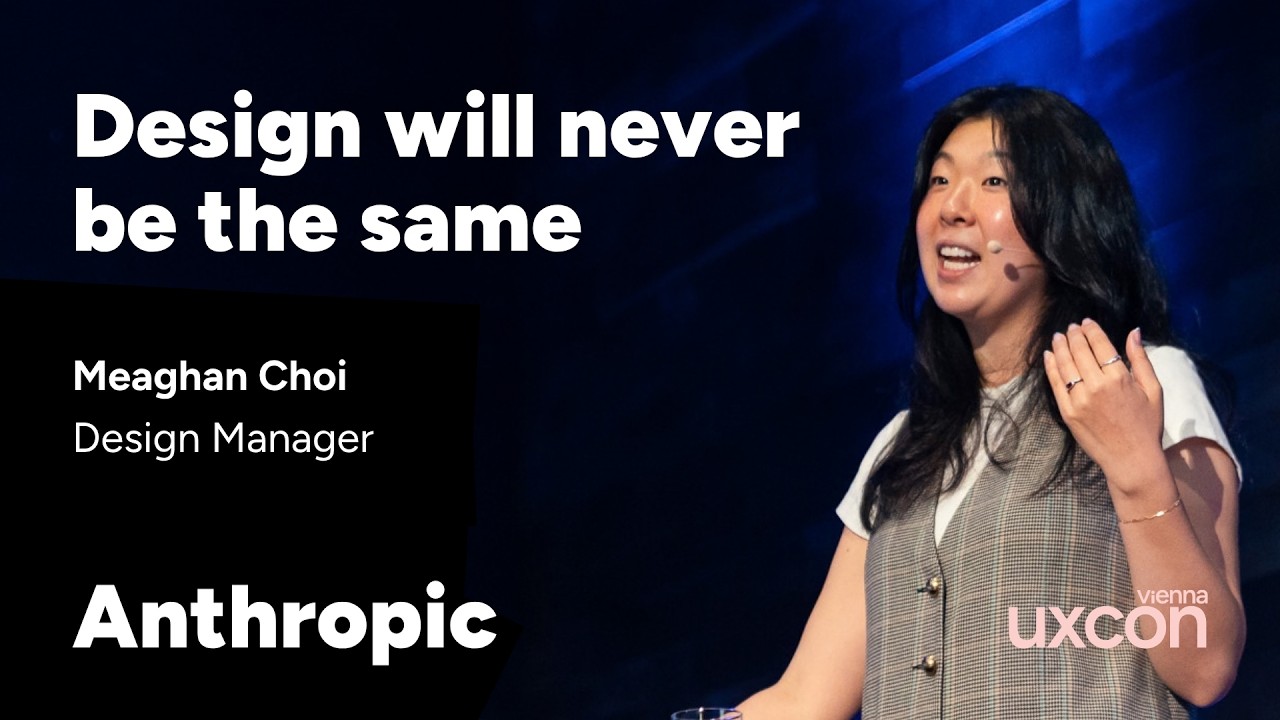
0:00Meaghan Choi leads design for Claude Code at Anthropic. A year ago, she says, much of her job was convincing designers to try AI coding — and then convincing engineering orgs to give designers access to the codebase. "Nobody really needs convincing anymore. The problem is quite the opposite." A Designer Fund study put it bluntly: ~65% of designers now say their job is so much more than design — overlapping product and engineering.
Stressful and fun at once
2:42The core tension she names: implementation sped up, but design didn't — and quality bars haven't moved, even as everyone ships faster. "Design has never been so difficult, and so hard, and so stressful." Yet at the same moment, designers are building things like Flip Book (auto-generated explanatory worlds) and Backyard Designers (a whimsical roster tool) — "design has both never been so stressful and also never been so fun." Her diagnosis: the pain comes from change we talk about amorphously — "things are changing around us and happening to us" — instead of pinpointing exactly what's shifting. So she maps it.
Three fundamental shifts
6:14The old design process had a concrete deliverable and a handoff at every step, over weeks or months. The new one is fluid and blended. Three shifts drive it: (1) anyone can code — AI coding is, after search, the second major use case, and every role now has an undercurrent of "use AI," which increasingly means "code." Her tailored version: designers can code, and designers should be coding — we're no longer having that debate. 7:10(2) trying an idea is essentially free — an abundance of idea generation, not necessarily a good thing. (3) The result: a huge expectation of increased velocity — what took months "can technically be done in a few days," and the environment pressures everyone to feel they should be moving faster.
Idea slop
8:24With infinite ideas and free prototyping, the real challenge flips: deciding what's actually worth building, and when it's ready. 10:25She asks the room how often someone dumped a weekend prototype on their plate — then keeps hands raised for "more than 50% were good ideas" (almost none). Her bar: a 10–20% hit rate is genius-level innovation. Demos used to signal effort and therefore plausibility; now building is cheap, so "it's not necessarily a good idea just because you can build it." She calls what lands on her desk "idea slop," and spends her time on the strategy questions: Should this exist? Who are you solving for — does that person really exist, or is it just you? Is it a real problem? Do they want us to solve it? Does it make sense in this product? Deciding product strategy "is a bigger part of the design role than ever before."
Claude Imagine → Design
12:38The origin story of Claude Design, told from inside: Claude Imagine launched alongside Sonnet 3.5/3.7 as a temporary demo — the first model generation that could generate front-end UI, but only "a little play space." 13:26A designer on the team, Nate, pushed it further: Claude was great at generating HTML, so he prototyped it as a design tool — and discovered Claude generates much better front-end UI when it has access to the design system. He built a skill giving Claude that access, which became the foundation of Claude Design. Then a step further: access to the design system → access to the brand system → Claude could also make slides — unlocking brand, marketing, sales and account teams "almost accidentally." The pattern she highlights isn't the tool; it's the process — a demo, then an identified audience and use case, then a functional prototype iterated with product/engineering, then emerging use cases, then a strategy and roadmap. Each product decision was made one step at a time, by design.
Claude Code desktop
18:55Three launches of the Claude Code desktop app, as design and engineering "working in lockstep." Late 2025: a one-week sprint to make the core dev flow functional, borrowing patterns from the chat app — the launch bar was just "functional," testing whether a GUI beats a CLI (they weren't sure it would). Early 2026: the launch bar flipped to design-driven — every feature started and finished by design, redesigned to feel developer-forward, "like a power tool." Mid-2026: a performance/reliability spike — work that used to be pure engineering, but hover states, loading animations and click behaviors meant the launch bar (speed + reliability) was still a joint decision. The through-line: design now owns "done." She contrasts it with her last job, where she had to beg for codebase access and get an engineer to push her PRs — "now we're all shipping to the app."
The new skillset
22:12Designers now ship the last mile, so the skills they're flexing are the ones engineers built over years: offering timelines and scoping implementation, defining a concrete "done" state ("we can't hand-wave quality anymore"), and knowing when to push a deadline or make something a fast-follow. 24:07And the next frontier: designing automations for your workflow — the way DevEx teams automate engineering, design teams are now automating design-system adherence, content guidelines, accessibility, and AI PR review. "Designers are coding; we need the same machinery engineers have."
What only design does
24:34With everything blended and timelines compressed, you can't do it all — so decide what only you as a designer can do. Not "taste" (too hand-wavy); specifically: creative solutions (few functions explore as much variety and iterate on the variance); simplifying complexity (technical understanding + user empathy — "a bridge between the function we're building and the people using it"); product cohesion (the end-to-end experience, not just the launched feature); and fit and finish (details that add up to delight, not just function).
The joyless-slop warning
27:30The failure mode she's worried about: if designers start believing "design is dead" and that the skill is automatable, "we're going to end up in a world of joyless slop" — apps that aren't useful, aren't delightful, don't bring joy. It's not where she thinks we're headed, but it's a call to action. The close: design won't be the same because it will be more than it ever was — and designers who lean into the chaos, play, and learn the new skills won't just help themselves; they'll be defining the role the whole industry expects designers to play.
Q&A highlights
30:15Four exchanges worth noting. UX research: Anthropic relies on it more than ever — tactical/reactive research is increasingly automated (and badly done when a designer or engineer runs it without a researcher), freeing researchers for bigger strategic synthesis. 31:04Org structure: "pods" of two-to-three people (designer + engineer, or +PM) that shift fluidly through a feature's lifecycle; headcount planning is "very organic" — did we lack designers or engineers last half? 33:47Tool choice: there is no single right tool or workflow — and her counterintuitive advice is don't be on the frontier; unless you're personally passionate, wait a few months for the dust to settle. 35:42Security: that's your DevEx/DevOps team's job (CI checks, testing, PR review tiers) — designers review PRs for UX, engineers for safety; and "you're not coding enough if you haven't caused an incident."
Claims checked
The speaker and her role are real. Meaghan Choi is Head of Design for Claude Code and Cowork at Anthropic (previously Meta and Cloudflare), confirmed by the uxcon speaker page and independent listings. The talk is from uxcon vienna.
The Claude Imagine → Claude Design origin story (Nate's design-system skill), the three Claude Code desktop launches, and the "~65% of designers" Designer Fund figure are the speaker's own account and cited survey — not independently re-verified here.
Auto-captions render the speaker as "Megan" and "Cloud Code" for Claude Code; both corrected. Flip Book, Backyard Designers, and the Designer Fund study are named as described.