🐝 What it actually is 0:00
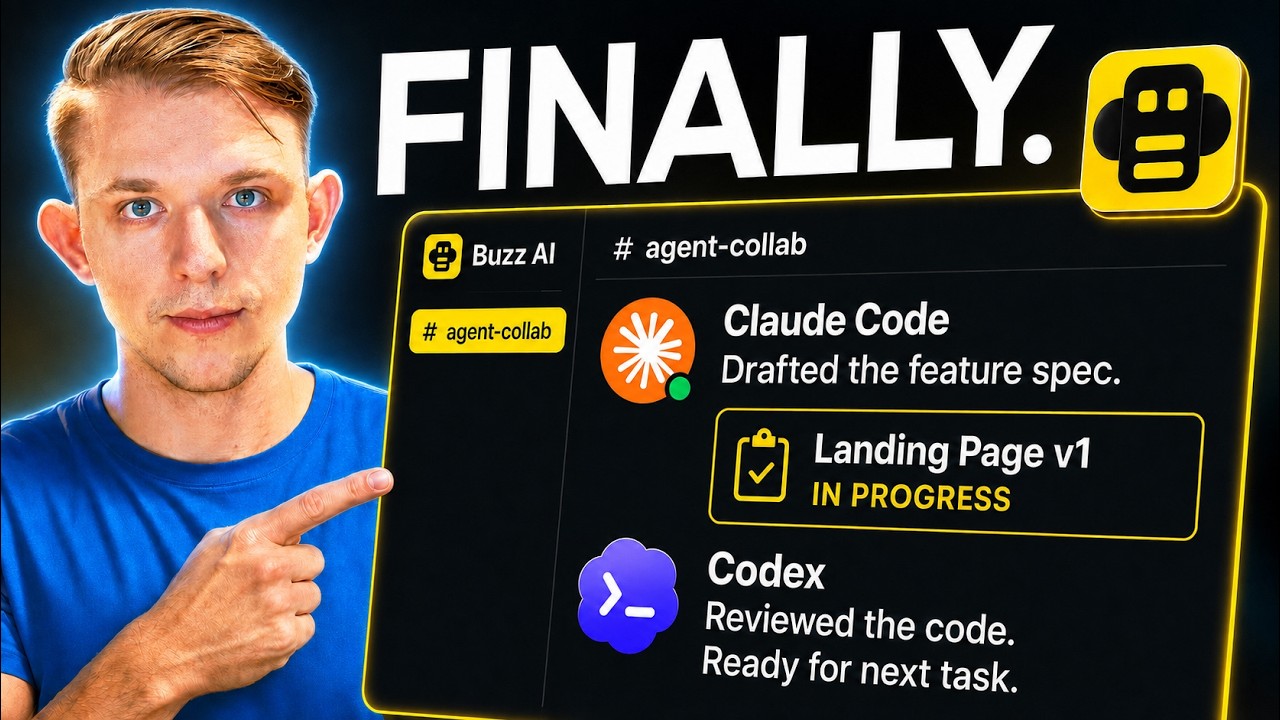
The opening demo is the clearest statement of the product: one message typed into a channel, and Claude Code, Grok running on Cursor, Kimi running on Devin and Codex all read it and respond in the same thread. Grok answers first because it is fast. They are all in one room.
block/buzz — verified. 17,010 stars, 1,600 forks, Rust, Apache-2.0, created 6 March 2026. That is roughly 117 stars a day for 145 days, which is genuinely exceptional traction. Free and open source, as claimed.🔀 Slack is the wrong analogy 3:01
Both speakers lean on "a free Slack clone", and the guest is candid that this framing is shallow — "people want to replace Slack, but that is like a very superficial reason". His better description is that Buzz is "a giant context harvester" where all your context lives in one place, shared between teammates and agents.
But the README goes further than either of them, and this is the part the video never explains:
🔌 Why ACP is the real story 4:49
The presenter gets close to the key mechanism but stops short: "it uses something under the hood called agent client or agent connect protocol. I'm not sure exactly what the acronym stands for."
The observable consequence is the detail that makes the product credible: when you message Codex through Buzz, the session shows up in your ChatGPT app's recent chats. Buzz is not reimplementing these agents — it is driving the real CLI tools in your terminal, with your existing subscriptions, skills and memory intact.
👑 The lead agent pattern 46:00
The most practical advice in the tutorial half, and the reason it works is unglamorous:
His answer is to designate a lead agent — Codex, in his case — because that is where his roughly thirty skills, his memory and his strongest computer-use capability live. Other agents get pulled in for review and second opinions, but the work that needs his accumulated context starts with the lead.
🎨 The demo that works 47:00
The thumbnail exercise is the best demonstration in the video because it is a complete loop with a visible result:
- Codex takes the lead, using his existing thumbnail skill, and generates five options
- It tags Claude Code and Grok and asks them to rank them one to five
- Both critique independently
- Codex generates five revised versions using both critiques
He leaves to fill a glass of water and comes back to round two, which is visibly better than round one — he calls the first batch "very mid" himself.
A smaller detail that impressed him and is worth noting: in the voice huddle, he sent four messages and the agents only responded to the one that required a response. Knowing when not to speak is not trivial behaviour in a shared channel.
⚠️ The honest failure 36:20
The most valuable stretch of the video is the one where the product does not work, and both speakers say so plainly.
The guest is equally direct elsewhere — "workflows I haven't gotten to work very well for me… there's probably some bugs", and on external triggers, "I haven't found a way to get it working reliably yet".
And the presenter's framing of the underlying problem is the single best line in the fifty-five minutes:
💰 Shared compute 23:02
The most forward-looking feature, and one that is already shipped rather than speculative. Under Settings → Compute there is a "share this machine with your relay" option: Buzz inspects your hardware, selects the strongest local model it can run, and lets other members of your community invoke agents that execute on your machine.
The guest extends this to a per-task payment model and, eventually, agents paying other agents — a weaker model buying work from a stronger one.
📖 What the README says 30:00
Two things in the project's own documentation deserve more attention than the video gives them.
The identity model
This is a genuinely different security posture from bolting an agent onto your account. Every action is a signed event attributable to a specific keypair, which makes "which agent did that, and when" answerable rather than guessable — the kind of property that matters in a regulated environment.
The GitHub-adjacent ambitions
The "GitHub killer" framing in the conversation is overstated, but the underlying feature is real: Git events as NIP-34 signed events, a Git hosting backend, and the "branch as room" pattern where a feature branch becomes a channel and the merge decision lands alongside the evidence that justified it.
🧭 Before you install it 52:00
A fair summary of where this actually stands:
| Capability | Status |
|---|---|
| Multiple harnesses answering in one channel | Works — demonstrated repeatedly on camera |
| Cross-model critique loops | Works — the thumbnail demo is a complete loop |
| Uses existing Codex / Claude Code subscriptions via ACP | Works — sessions appear in the ChatGPT app |
| Self-hosted, signed event log, per-agent identity | Core architecture, documented |
| Shared local compute across a community | Shipped feature |
| Scheduled workflows / recurring tasks | Unreliable — both speakers report silent no-ops |
| External triggers and webhooks | Guest: "haven't found a way to get it working reliably" |
| Mobile apps | Demoed and working for him; README lists them as still being wired up |
| Agent-to-agent payments | Speculation — the compute sharing it would build on is real |
🔍 Claims checked
| Claim | Result |
|---|---|
| Free and open source | Apache-2.0, public repo |
| Written in Rust | Confirmed |
| Very popular / viral | 17,010 stars, 1,600 forks in 145 days (~117/day) |
| Works with existing Codex and Claude Code subs | ACP harness named in the README |
| "Agent client or agent connect protocol" | It is the Agent Client Protocol — an open standard, 3,807 stars |
| Shared compute across a community | Documented, shipped |
| Created by Jack Dorsey | It is a Block project; Dorsey appears 0 times in the README |
| "A free version of Slack" | Understated — it is a self-hostable Nostr relay; "relay" appears 25 times |
| iOS app works great | Works for him; README lists mobile under "being wired up" |
| Workflows / scheduled tasks | Both speakers report failures; README confirms "glue still drying" |
| "A GitHub killer" | Overstated — Git features exist (NIP-34, hosting backend) but this is early |
Repository metadata, licence, README and the Agent Client Protocol verified 30 July 2026.
💡 Key takeaways
- 17,010 stars in 145 days — roughly 117 a day. Rust, Apache-2.0, and free as claimed. The traction is real.
- "Free Slack clone" undersells it. The README describes a self-hostable Nostr relay where every message, reaction, workflow step and git event is a signed event in one log. That is infrastructure, not a chat app.
- ACP is the Agent Client Protocol — an open standard with its own ecosystem, not Buzz-specific plumbing. The presenter wasn't sure; it's worth knowing.
- It drives the real CLI tools, not clones. Messaging Codex through Buzz makes the session appear in your ChatGPT app — which is why it can be free: you bring the compute via subscriptions you already pay for.
- Context reportedly survives a harness switch. Change an agent from Opus to Codex in preferences and the conversation carries over. If that holds, the harness becomes a swappable backend rather than a lock-in point.
- Designate a lead agent. Your skills and memory are not portable between harnesses, so one is genuinely more capable for you. His lead is Codex — ~30 skills, memory, best computer use. The others review.
- Cross-model critique falls out of the architecture. Generator and critics are different models by default, so the independent-verification property you normally have to engineer comes for free.
- The scheduler is not trustworthy yet. A 9am task announced what it was about to do and then did not do it. The guest hit the same failure. The README's own table calls workflow glue "still drying".
- "I just don't have trust in my AI agent team." The best line in the video, and the real bottleneck: unverified delegation costs more attention than it saves.
- Their fix is a supervisor agent that pings every recurring job and nudges on silent no-ops. Reasonable — but recognise it as building a watchdog because the scheduler cannot be relied on.
- Shared compute is already shipped. Buzz picks the strongest local model your hardware supports and lets community members run agents on your machine. The agent-to-agent payment economy on top of it is still speculation.
- Agents get their own keypairs and audit trails — scoped by identity, not permission flags. That is a genuinely better security posture than attaching an agent to your own account.
- It is a Block project, not a Dorsey side project. Dorsey leads Block so the claim isn't false, but the framing matters when you assess longevity and support.
- The unexamined risk is the management channel. An agent with email, Slack and SMS access running unattended every three hours, on a product whose scheduler is admittedly unreliable, deserves a deliberate decision.
- Read the README's maturity table before adopting. Three columns — works today, being wired up, pending code — plus an explicit warning not to plan a compliance programme around the third.
🔗 Resources & links
- Claude Code + Codex Can FINALLY Work Together (Buzz AI)Source video — Riley Brown with Vinny (@hot_town), 55:15
- block/buzzThe repository — 17,010 stars, Rust, Apache-2.0. Read the maturity table
- Agent Client ProtocolThe open standard that makes the multi-harness setup possible
- Buzz architectureHow the relay and event log actually work
- Packaged buildsmacOS .dmg, Linux .AppImage/.deb, Windows .exe