ChatGPT Dots vs GrokBot vs Hermes Agent: A Head-to-Head on Real Jobs
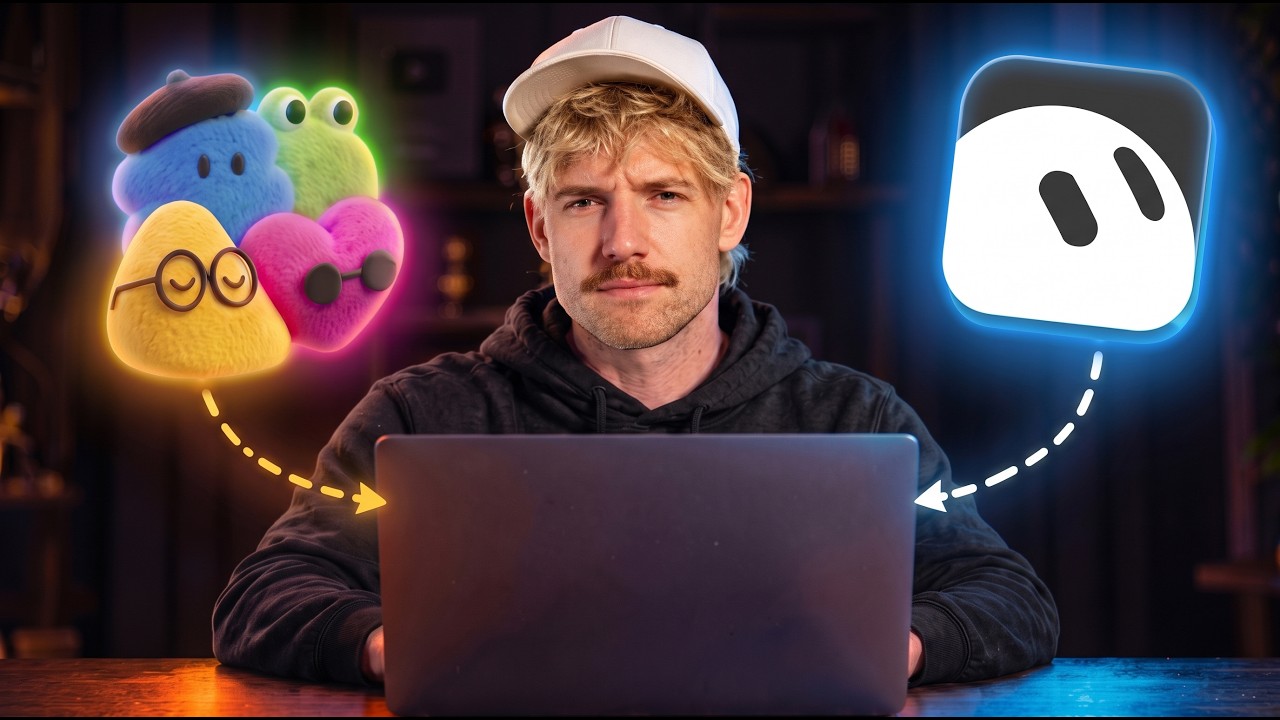
1.The Setup: Three Assistants, One Benchmark0:00
Jack Roberts opens by framing the three players as the same species — "AI personal assistants" — and sets a deliberately tough benchmark: give each one as little instruction as possible and see what it delivers. "I judge the skill of an assistant based on how little instructions can I give you and you still deliver something of high quality." The test is four real jobs — generate an image and video, edit a podcast episode, connect tools to draft an email, and build a competitor strategy — followed by cost, learning, control, and limitations.
The trio: ChatGPT Dots (OpenAI's new personal assistant, just released), GrokBot (xAI's), and Hermes Agent (Nous Research's self-hosted assistant). His opening quip is that he's "getting a bit crazy of triangles and squares smiling at me everywhere I go" — every assistant is converging on the same soft-geometric-face design language.
2.Architecture & Access: Cloud vs Your Own Machine0:51
Where they live is the first real difference. Dots runs on OpenAI's cloud computer — you open it in the ChatGPT app or browser (it comes with ChatGPT Pro), and it keeps working between chats, pinging your phone. GrokBot is one shared cloud computer running 24/7 in the background, $20/month to start. Hermes Agent is the outlier: "you run it yourself on your computer or in the terminal" — or on a VPS — and it works in Telegram, WhatsApp, or the terminal.
Under the hood the model story mirrors the hosting story. Dots is powered by GPT-6 Astra, GrokBot by the latest Grok model, and Hermes — "you can power it with anything you want." That single fact drives most of the rest of the comparison. He also flags the practical wrinkle: Dots eventually works on your computer "only if you allow it," whereas Hermes is on your machine by default.
3.Job 1: Image + Video, Near-Zero Instructions2:28
The first job: "create an image and a video for my Skool community, AI Automations with Jack, using the Higgsfield API — complete creative autonomy." The catch none of them can clear alone: none of the three generate images or video natively, so he gives each the same Higgsfield API key (one key, unlimited image/video generation) — a detail he stresses because "any personal assistant you're using, you need to give it the ability to create images and videos."
All three delivered in one shot, but the differences show. Dots (on GPT-6.1 Astra) produced an image and animated it into a short video. GrokBot generated a clean "beautiful coffee with a laptop, slow zoom in" clip. Hermes, on the same GPT-6.1 model, did something the others didn't: it pulled in his personal brand — the "little brain" logo and blueprints from his own community — and baked it into the image, then built a 15-second explainer video. The tell is the assistant that already knows your context produces output that's actually yours.
4.Jobs 2–4: Podcast, Email, and Competitor Strategy8:03
Podcast edit (grab an episode of his "Stacked" podcast and produce a usable asset): all three produced something workable but none blew him away — Dots nailed the logo but had slightly off formatting ("one or two prompts would have fixed it"), GrokBot was "a little more traditional" with some text missing, and Hermes got the logo and a decent edit. His honest caveat: none are using top-tier video models here, "it's not the harness's fault, it's just the prompt."
Email draft (via Zapier): "unsurprisingly, they all did a fine job" — every one connected to his inbox and drafted a response. His recommendation is Zapier as the authentication layer: connect a tool once and expose it as a single MCP point to Dots, GrokBot, or Hermes alike, so you don't re-authenticate everywhere. Competitor strategy (the most interesting split): Dots browsed each competitor in its own browser and returned a five-page text document; GrokBot gave a "slightly visual overview"; Hermes "went a little more into detail" with different ideas — and did it from the app, Telegram, or anywhere, on the same model as Dots.
5.What They Actually Cost11:03
| Dots | GrokBot | Hermes Agent | |
|---|---|---|---|
| Price | ChatGPT Pro $100/mo ($200, $500 tiers) | from $20/mo | $0 software — pay only for models used |
| Model | GPT-6 Astra (locked) | latest Grok (locked) | any model (Opus, GPT, local Qwen…) |
| Runs on | OpenAI cloud | shared Grok cloud | your machine / VPS |
| Interface | ChatGPT app/browser, Slack, Teams | GrokBot app | Telegram, WhatsApp, terminal |
| Privacy | cloud; "safe passwords not shown to model" | privacy mode, encrypt, opt out of training | lives on your own machine; can run offline |
The headline economic fact is the model-lock: "with Dots, guys, you are model locked. Just like with GrokBot, you're essentially model locked. There are ways to hack it, but Hermes is truly model agnostic." The free tier of Hermes is real — run open-source models on your own hardware for $0 — but he's honest that it's "not really economically viable unless you've got the hardware. Remember, you pay in time as well." You can also point Hermes at your ChatGPT subscription and reuse it, which he calls "very impressive."
6.Learning, Control, and the Model-Lock Question13:10
How each gets better: Dots learns from your feedback and carries it across ChatGPT, Slack, and Teams. GrokBot follows you around — you can even record your screen and teach it a skill — and remembers things. Hermes writes tasks after you use it, keeps persistent memory you can amend and build on, and is "for the builders who want full creative control."
On control, all three message proactively — his GrokBot weight-loss bot nags him every morning about the chocolate cake — and Hermes can do the same via a recurring task ("ask me my weight every day at 10am"). The deeper control axis is the model itself: Dots and GrokBot pick for you, while "with Hermes, you actually get to pick any model that you want — run this with Opus, run this with flavor of the day." That's the whole thesis in one line: the managed assistants remove choice in exchange for zero setup; Hermes gives you the choice back and charges you the setup.
7.Limitations and the Privacy Angle15:02
Each has honest gaps. Dots is still rolling out — not yet on Pro in some regions — and you get one Dot per plan ("I would have loved multiple Dots"). GrokBot's main pain point is the usage allowance, though it's "unbelievably easy to set up." Hermes is the technical one: "you've got to install it, update it, you run into things around tokens" — it's an open-source project that moves fast.
Privacy splits along the same hosting line. Dots runs on OpenAI's servers ("the stuff that happens with Dots isn't running locally on your computer"); GrokBot offers privacy mode, encryption, and training opt-out; Hermes lives on your own machine — you could run it fully offline or virtualized. The one structural caveat: "they all work when your laptop is off except for Hermes — unless you host it virtually or have a Mac Mini at home running 24/7." Self-hosting buys you control and privacy and charges you uptime.
8.Who Should Pick Which19:20
His verdict is segmented, not a single winner. Beginners should start with GrokBot (cheap at $20, effortless) or Dots (if you already live in ChatGPT). He's transparent that Dots is "a couple of weeks behind GrokBot in terms of maturation," but "OpenAI is a giant and I'd expect the capabilities and power of Dots to grow exponentially." Hands-off, plugin-and-go → Dots or GrokBot.
And then the other camp: "if you like tinkering, if you're a bit of a nerd, you want to build your own systems… Hermes Agent gives you the full control." If you want control, customizability, any model, running locally — "a Qwen model on your own Mac Mini" — Hermes is the one. His framing that lands the whole comparison: separate building software at a laptop (ChatGPT/Claude) from the personal assistant on-the-go — and for that assistant, pick by whether you want zero-setup managed (Dots/GrokBot) or full-control self-hosted (Hermes).
Key Takeaways
- All three are AI personal assistants converging on the same design — but they split on one axis: whose computer they live on (OpenAI cloud, Grok cloud, or your machine).
- Dots = ChatGPT Pro ($100/mo), GPT-6 Astra, model-locked, runs on OpenAI's cloud, works across ChatGPT/Slack/Teams.
- GrokBot = $20/mo, latest Grok, model-locked, shared cloud, screen-recording to teach skills, multiple agents that talk to each other.
- Hermes Agent = $0 software, model-agnostic (any model), self-hosted, persistent memory, Telegram/WhatsApp/terminal.
- On the image/video job, Hermes was the only one that pulled in personal brand context — with identical model power, context becomes the differentiator.
- All three need an external API (Higgsfield) for image/video and Zapier as the authentication layer for tools.
- The trade-offs are symmetric: Dots/GrokBot = zero setup but model-locked and cloud-hosted; Hermes = full control and privacy but install, tokens, and self-hosted uptime ("works when your laptop is off — except Hermes").
- Verdict is segmented: beginners → GrokBot or Dots; tinkerers/builders who want any model and local control → Hermes Agent.
Timestamp Index
- 0:00 Intro — three assistants, one benchmark
- 0:51 Where to get each + architecture
- 2:28 Job 1: image + video via Higgsfield
- 6:23 Job 1 results — Hermes brings brand context
- 8:03 Job 2: podcast edit
- 9:10 Job 3: Zapier + email draft
- 10:24 Job 4: competitor strategy
- 11:03 Cost + the model-lock question
- 13:10 How they learn
- 13:49 Who's in control / proactivity
- 15:02 What they can't do yet
- 16:10 Safety, privacy, and common questions
- 18:23 Do you actually need one?
- 19:20 Which one should you pick