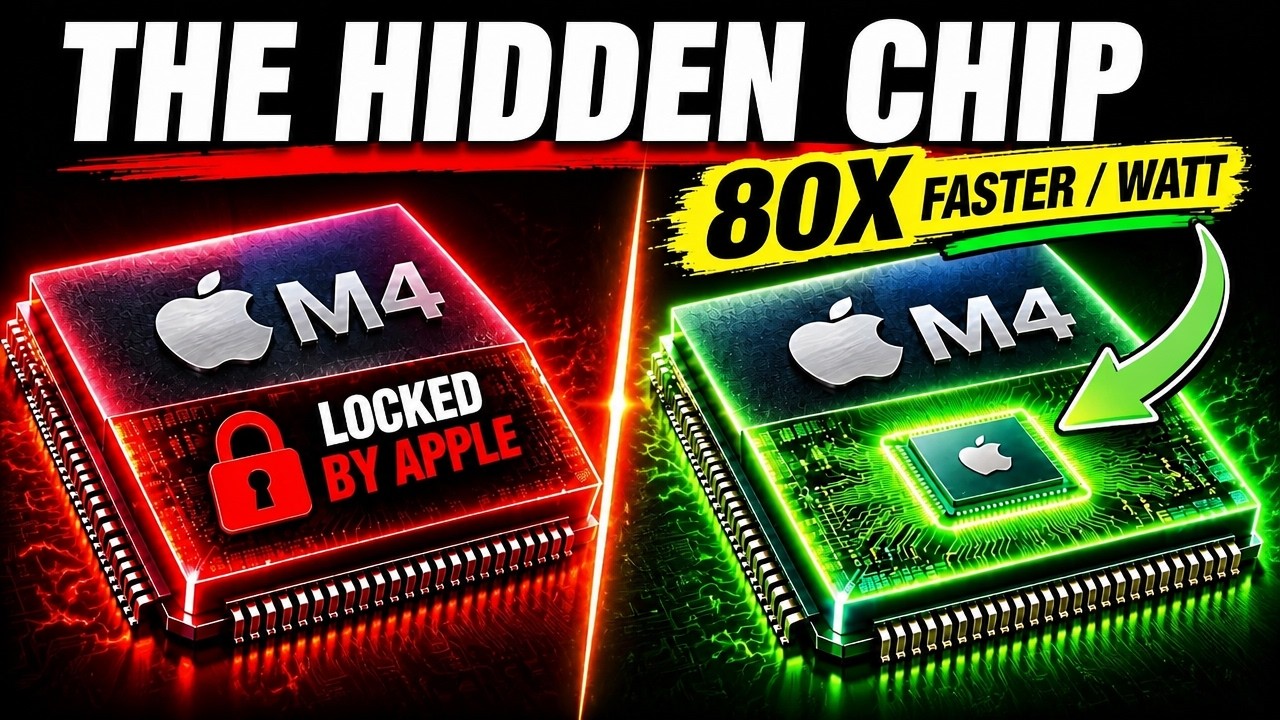
🎬 What the video claims 0:00
| Claim | Status |
|---|---|
| Every Apple Silicon Mac contains a 16-core Neural Engine | True |
| Apple exposes it for inference only, through Core ML | True |
| An independent researcher bypassed Core ML in pure userspace and trained transformers on it | True — and it is on GitHub under an MIT licence |
| One training step takes 9.3 milliseconds | That is a single-layer microbenchmark; the real pipeline is 91 ms and 412 ms per step |
| 11.2% of peak utilisation | That is the microbenchmark figure; the repository now states roughly 5–9% |
| 38 TOPS of AI compute is sitting unused | Marketing number, not attainable: the engine dequantises 8-bit input to 16-bit before computing |
| Apple hid a secret chip | Apple advertises the ANE. What is undocumented is the programming interface |
The substance is real and verifiable, which makes the inflated parts unnecessary. A researcher did open the ANE for training in userspace without touching system integrity protection, did publish it, and two academic papers now build on the work. That is the story. The numbers added for drama are the only weak part — and they came from a microbenchmark that the original blog presented as a microbenchmark.
🔧 The hardware, honestly stated 0:18
| Metric | Apple's claim | What is measurable |
|---|---|---|
| Throughput | 38 TOPS (8-bit), about 16 TFLOPS in 16-bit | Roughly 15.8–19 TFLOPS FP16 in practice — the 38 TOPS figure assumes 8-bit arithmetic that the hardware dequantises before computing |
| Power at load | — | Single-digit watts; Apple's own published ANE research quotes an iPhone 13 running a transformer at 0.454 W |
| Efficiency | — | About 6.6 TFLOPS per watt at peak, which is the basis of the efficiency comparison |
| Usable for training | None | Zero through public APIs; the whole point of the project |
The gap between 38 TOPS and roughly 19 TFLOPS is the most useful correction in this article, because it explains why every subsequent number in the video feels slightly too good: the ceiling it computes percentages against does not exist. Independent characterisation found that 8-bit input is dequantised to 16-bit before any computation happens, so the honest peak is about half the marketing figure.
🔒 What is actually locked 4:55
| Open door | Closed door |
|---|---|
| Inference: convert a model, hand it to Core ML, and Core ML decides where it runs | Training: no backpropagation, no optimiser step, no direct memory access |
| The GPU via Metal, or the CPU via MLX and Accelerate | Direct dispatch to the ANE, or any visibility into where a computation ran |
"You were allowed to look at the finished results, but you were never allowed to see the gears turning behind the glass."
The description of the restriction is accurate, and the important part is the asymmetry: Core ML does not merely decline to train — it also declines to tell you what it ran where. A developer cannot even benchmark the ANE through the public path, because placement is opaque. That is a stranger situation than "inference only", and it explains why the work needed a private interface rather than a clever Core ML trick.
Where the video oversteps: it presents the restriction as a business decision, asserted rather than argued — Apple keeps it closed to avoid drivers, registers and bug reports. That is a plausible reading and it is not evidence. The engineering explanation is at least as likely: a fixed-function accelerator with a tight memory layout is expensive to expose safely, and Apple's own published ANE research is entirely about inference optimisation.
🔓 How it was opened 8:10
| Piece | Role |
|---|---|
| A private framework in the system's private directory | The driver Apple's own teams use; no headers, no documentation, and importing it into a normal project fails |
| Objective-C runtime metadata | Class names and method signatures survive in the compiled binary, so a runtime probe can reconstruct the API surface |
| Three private classes | A client for dispatching work, a compiler for turning a graph into hardware code, and a descriptor for building a model entirely in memory |
| Model Intermediate Language (MIL) | Apple's internal representation for compute graphs, usable directly once the compiler is reachable |
The in-memory descriptor is the load-bearing discovery, and the video explains why well: Core ML compiles a model to disk and caches it, which takes hundreds of milliseconds. Training changes weights every step, so a disk round-trip per step would be both impossibly slow and fatal to the SSD. Compiling a graph in RAM and dispatching it directly is what turns a single inference engine into something that can run a loop.
It matters constitutionally that this ran in userspace. No jailbreak, no disabled integrity protection, no kernel extension, no modified system binaries — the researcher's own stated ground rule, and the reason the result is reproducible on a stock Mac by anyone who clones the repository.
➗ The mathematics that made it possible 11:28
"A mathematical dot product does not know whether it is calculating a forward prediction or a backward error gradient. The numbers are just numbers."
| Obstacle | Workaround |
|---|---|
| No native backward operations | Express the gradient computation as forward operations: transposed multiplications and element-wise additions |
| Small on-chip memory | Store activations in 8-bit while computing in 16-bit |
| Strict alignment and stride requirements | Hand-mapped memory layouts, verified with test harnesses |
| Weights change every step, forcing recompilation | Pack activations and weights into one tensor and slice them inside the kernel, so weights move without a recompile |
The observation at the centre of this is genuinely elegant and worth carrying away: backpropagation is not a hardware feature, it is a sequence of matrix operations. Any accelerator that can multiply matrices can compute gradients, provided the software expresses them in the instruction set it has. The "inference-only" label was a statement about the software stack, not the silicon.
📉 The numbers, corrected 13:20
| The video's figure | What the repository reports |
|---|---|
| "An entire training step in just 9.3 milliseconds" | 9.3 ms is one transformer layer at dimension 768 and sequence 512 — a microbenchmark, not a training step |
| 1.78 TFLOPS sustained | Correct for that microbenchmark |
| Six hardware kernel passes per step | Correct for that microbenchmark |
| 11.2% hardware utilisation | The repository now states roughly 5–9% of peak |
| Trained a 600-million-parameter model natively | Correct — Qwen3-0.6B, 596M parameters, grouped-query attention |
| Model | Parameters | Milliseconds per step |
|---|---|---|
| Stories110M, 12 layers, dimension 768 | 109M | 91 |
| Qwen3-0.6B, 28 layers, dimension 1024, GQA | 596M | 412 |
So the pipeline exists and works — it is just ten to forty times slower per step than the video implies. Nine milliseconds is the cost of moving one layer's worth of data through the engine; a full step involves every layer, the optimiser, and the parts that still run on the CPU. Both numbers are in the same repository, and the microbenchmark was never presented as the whole story.
And the division of labour is not quite as described either: forward passes and input gradients run on the ANE, but weight gradients are computed on the CPU through Accelerate's BLAS. "Full backpropagation inside the silicon" is the aspiration; the working implementation puts the largest remaining piece on the processor.
⚡ Is the 80× claim right? 3:12
| Accelerator | Peak throughput | Terflops per watt |
|---|---|---|
| M4 Neural Engine | About 19 TFLOPS in 16-bit | ≈ 6.6 |
| M4 GPU | About 3.5 TFLOPS | ≈ 1.0 |
| A100 | 312 TFLOPS | ≈ 0.08 |
| H100 | 990 TFLOPS | ≈ 0.13 |
The comparison is arithmetically fair and rhetorically misleading, and both halves matter. Per watt of peak arithmetic, the ANE really is roughly eighty times an A100. But the A100 has about sixteen times the raw throughput and a memory system built for training, and nobody runs a training cluster for its efficiency per flop — they run it because the model finishes. The video says as much at the end, then lets the headline stand.
A more useful comparison is the same chip's own GPU, which is what a developer would actually choose between. Published measurements on an M1 Max found the ANE about 3.8× faster and roughly 9× more energy-efficient than that chip's GPU for a specific convolution — a large, defensible win that needs no A100 in the sentence.
🚧 The limitations the author states himself 14:20
| Limitation | Detail |
|---|---|
| Low utilisation | Roughly 5–9% of peak, with substantial engineering work remaining |
| Element-wise operations fall back to the CPU | Which is where a large share of the time goes |
| Not a production framework | The author calls it research code he updates when he finds something interesting |
| Does not replace GPU training | His words: not for anything beyond small research models today |
| Compilation leak | Early iterations failed after roughly 119 compiles in one process, from an unresolved leak of memory, file descriptors or kernel handles |
| Numerical fragility | Gradients are products of small numbers; 16-bit loses them, so loss scaling is mandatory |
| Newer silicon | Apple reportedly blocks in-memory loading on later chips, which is a question the video does not raise |
The repository opens with a section titled "On The Hype", which is the most important thing to read before the video: the author states plainly that some coverage has overstated his work's implications. When the person who did the work publishes a paragraph asking people to calm down, quoting the excited version of his results is a choice.
📚 What happened next 14:40
| Development | Why it matters |
|---|---|
| The project is MIT licensed on GitHub | About 7,300 stars and 960 forks, created February 2026 — anyone can reproduce it |
| Academic work built on it | A characterisation and programming paper on the ANE for training and inference, which measures the 32 MB memory cliff and a dispatch overhead of about 0.095 ms |
| A second paper and a demo project | An architecture-and-performance guide whose companion trains a transformer from scratch and then completes a prompt |
| The author moved on deliberately | He says he will not grow it into a community framework; feature requests will go unanswered and forks are encouraged |
This is the real significance, and the video understates it by chasing a conspiracy: a weekend project became the empirical foundation for peer-reviewed work on how Apple's accelerator actually behaves. The 38 TOPS figure was corrected by that follow-on work, not by Apple. That is what a healthy reverse-engineering ecosystem produces — numbers that survive contact with independent measurement.
🎭 The framing problem 15:25
"Your hardware does not belong to the corporation that stamped their logo onto the aluminum chassis. It belongs to you."
The sentiment is defensible and the video's version of it is not. There is a real argument that an accelerator you paid for should be programmable, and the researcher's insistence on userspace-only, no-jailbreak execution is the responsible version of that argument — it demonstrates capability without breaking anyone's security model. What the video adds on top is motive: that Apple locked the chip to protect profit margins, stated as fact, alongside "secret AI chip" and "hidden" in the title.
Two things worth separating: the ANE is not secret — it is in every keynote and on every spec page, and Apple publishes research about it. And "locked" is not the same as "concealed": the interface is undocumented, which is a normal state for hardware a vendor does not support for third-party programming. You can hold both that this should change and that the situation is not a conspiracy.
One practical caution the video omits entirely: depending on a private framework is a maintenance commitment with no contract. Apple can change class names, behaviour or availability in any macOS update, and reportedly has already restricted in-memory loading on newer silicon. Nothing about this project is safe to build a product on — which the author says, and the video does not.
✅ Claims checked
| Claim | Verdict | Evidence |
|---|---|---|
| Apple Silicon Macs contain a 16-core Neural Engine, exposed for inference through Core ML | Correct | Public documentation and Apple's own ANE research |
| The researcher is Manjeet Singh, known as maderix | Correct name, and the video mangles it | GitHub profile "Manjeet Singh"; the video says "Manjit Singh" and "Matterix" |
| He trained transformers on the ANE via reverse-engineered private APIs | Correct | maderix/ANE, MIT, about 7,300 stars, created February 2026 |
| The work ran in userspace on stock macOS with no jailbreak or disabled protections | Correct — the author's stated ground rule | And the reason it is reproducible |
| Three private classes unlock it | Correct in substance | A client, a compiler and an in-memory model descriptor; MIL is the graph representation |
| Apple's 38 TOPS figure describes usable compute | No — 8-bit input is dequantised to 16-bit, giving roughly 19 TFLOPS of real throughput | Independent characterisation of the ANE; the repository itself quotes 15.8 TFLOPS |
| The Neural Engine consumes single-digit watts while the GPU pulls 30–50 W under load | Consistent with published measurements | Apple's own research reports an iPhone 13 ANE running a transformer at 0.454 W |
| About 6.6 TFLOPS per watt, so roughly 80× an A100 per watt | Arithmetically correct, and needs the caveat he skips | A100 has ~16× the raw throughput; the comparison is efficiency at peak, not speed |
| An entire training step takes 9.3 ms | It is one transformer layer at dim 768, seq 512 | The repository's full pipelines run 91 ms/step for 109M and 412 ms/step for 596M |
| 1.78 TFLOPS sustained and six kernel dispatches per step | Correct for the microbenchmark | Same source |
| 11.2% of peak utilisation | The repository states roughly 5–9% | The 11.2% figure belongs to the single-layer benchmark |
| He trained a 600-million-parameter model natively | Correct — Qwen3-0.6B at 596M parameters | Grouped-query attention supported |
| Full forward and backward passes inside the ANE | Partly: input gradients run on the ANE, weight gradients on the CPU via BLAS | Repository pipeline description |
| Element-wise operations still fall back to the CPU; utilisation is low | Correct, and stated by the author first | "On The Hype" section of the README |
| The technique is a production option | No — the author says it is research, not a framework, and does not replace GPU training | And he declines to maintain it as a community project |
| Apple's motive was protecting margins | Interpretation presented as fact | No evidence offered; an engineering explanation is equally available |
| The Neural Engine was secret | No — it is advertised; the programming interface is what is undocumented | Apple keynotes, spec pages and published research |
| Follow-on academic work exists | Correct, and the video omits it | A characterisation paper measuring the 32 MB memory cliff and ~0.095 ms dispatch overhead, plus an architecture and performance guide |
Basis note. Built from the full 16:05 video and checked against the maderix/ANE repository and README, the author's three-part write-up, two follow-on academic papers, Apple's published ANE research, and an independent technical commentary that tabulates the efficiency comparison. Every performance figure here comes from the repository, which is why the microbenchmark-versus-pipeline distinction was findable. The observations about the 38-TOPS ceiling explaining the inflated percentages, and about private-framework dependence as an unsupported maintenance commitment, are this article's.
🔑 Key takeaways
- The achievement is real: backpropagation on the ANE, in userspace, on stock macOS, published under MIT.
- Backprop is matrix maths, not a hardware feature. Any engine that multiplies matrices can compute gradients if the software says so.
- Compiling in memory is the load-bearing trick — a disk round-trip per weight update would be both slow and destructive.
- Packing weights into the activation tensor avoids recompiling every step, which is what makes a training loop possible at all.
- 38 TOPS is not usable compute. 8-bit input is dequantised to 16-bit, so real peak is about 19 TFLOPS.
- The 9.3 ms figure is one layer, not a training step: the full pipeline runs 91 ms and 412 ms per step.
- Utilisation is 5–9%, not 11.2%, and weight gradients still run on the CPU.
- 80× per watt is arithmetically true — and the A100 still has sixteen times the raw throughput.
- The author asked people to stop overstating his work. That is the strongest evidence against the video's framing.
- Follow-on papers corrected Apple's spec sheet — that is what the project's real legacy looks like.
- Private frameworks are an unsupported dependency: class names, behaviour and loading rights can change with any OS update.
- "Undocumented" is not "hidden". The chip is advertised; the interface is not published.
🔗 Resources
- The video — DieLevel, 16:05
- maderix/ANE — the code, the benchmarks and the "On The Hype" section
- The author's write-up in three parts: reverse engineering, benchmarks, and training
- The characterisation and programming paper — 38 TOPS debunked, the 32 MB memory cliff, dispatch overhead
- Apple's own ANE transformer research — latency and power figures from the vendor
- This site's deep dive on local model efficiency, for why watts per useful answer is the metric that decides whether on-device training is sane
Basis note. No sponsor content; the channel asks for subscriptions and memberships, which is disclosed in the video. This article deliberately describes the architecture rather than any procedure for reproducing the private-API calls — the repository is public for anyone who wants the implementation. The three-number correction (step time, utilisation, TOPS) is the substantive reason this piece exists.
⏱ Timestamp index
0:00Half the chip's brain
0:18TSMC silicon beside the CPU
0:28The 16-core Neural Engine
0:4238 trillion operations per second
0:53Face ID, Live Text, dictation
1:03Stepping outside the playground
1:18Inference only, by policy
1:34Send it to the GPU instead
2:01The truck to the grocery store
2:1630 to 50 watts on the GPU
2:404 to 8 watts at peak
2:596.6 teraflops per watt
3:12The A100 comparison
3:30Business constraint dressed as physics
3:53Why Apple keeps it closed
4:25Core ML decides where it runs
4:55The one-way mirror
5:02Early 2026, an independent engineer
5:2015.8 teraflops off-limits
5:44Weekends with a disassembler
6:11What he found inside
6:31The userspace ground rule
7:10The bank vault analogy
7:30The private frameworks directory
7:54No headers, no documentation
8:10Objective-C metadata in the binary
8:32Reconstructing the API surface
8:45Three private classes
9:05The restaurant-kitchen analogy
9:29Hundreds of milliseconds to compile
9:45Weights change every step
10:05Building the graph in RAM
10:27Compiling to hardware code in a fraction of a millisecond
10:41No native backprop instructions
11:03What training normally does
11:28The maths of a backward pass
11:50Reformulating as forward operations
12:25The L2 cache problem
12:438-bit storage, 16-bit maths
12:56Alignment and stride failures
13:15Test harnesses for every layout
13:20Hitting enter
13:38No kernel panic
13:51The performance numbers
13:589.3 milliseconds
14:081.78 teraflops
14:15Scaling to 600 million parameters
14:26Will we throw away our clusters
14:4411.2% utilisation
15:00Never about replacing supercomputers
15:13Your hardware belongs to you
15:31Protecting margins, not complexity
15:45One developer in a bedroom