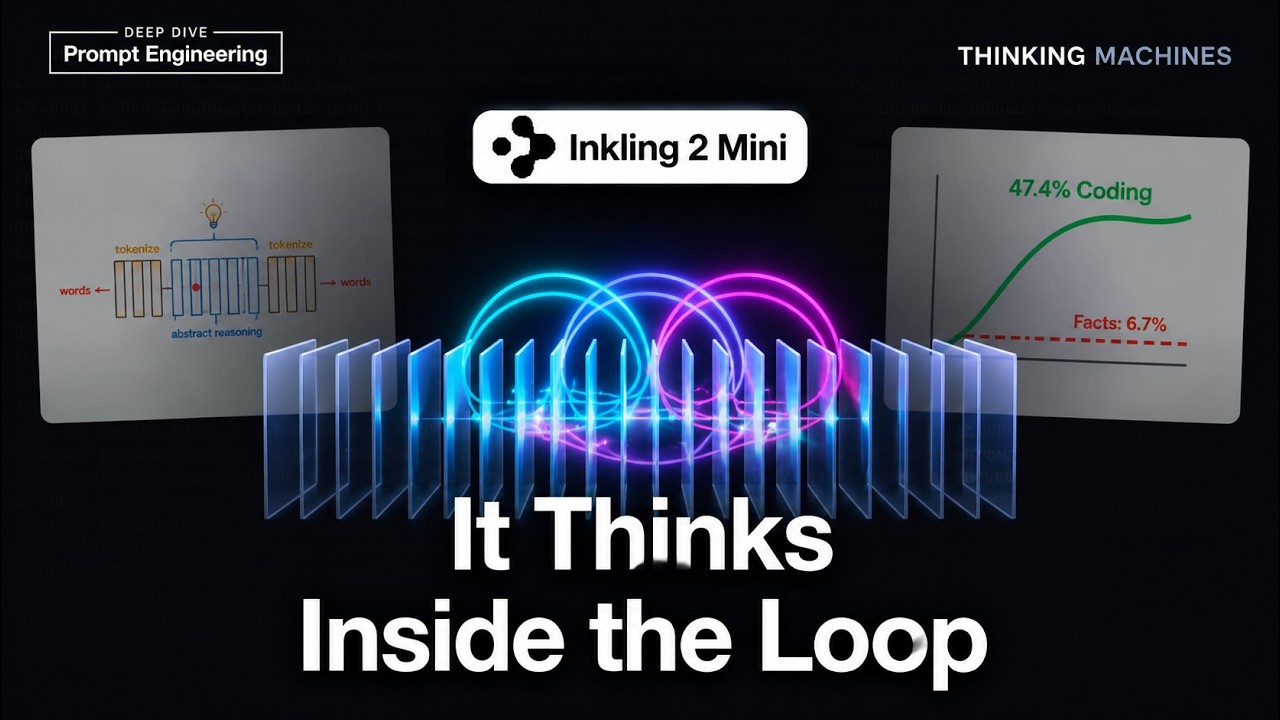
📦 What was released 0:00
| Property | Detail |
|---|
| Model | Inkling 2 Mini, from Thinking Machines Lab, released 20 November 2026 |
| Architecture | 24-layer looped transformer, mixture of experts |
| Size | 26.4B total parameters, 3.4B active per pass |
| Footprint | About 20 GB, thanks to native low-bit weights |
| Runs on | Apple silicon with 32 GB or more, or roughly 32 GB of VRAM |
| Licence | Apache-2.0, open weights |
| Context | Up to 1M tokens, text and image input |
| Headline claims | Leads every open-weights model under 100B total parameters on DeepSWE v1.1 (48.2%) and Vals Index v2.2 (46.5%) |
The reason this release matters more than its benchmarks is that it makes the architecture inspectable. Looped transformers were rumoured to be behind at least one frontier lab's gains, and until now there was nothing open to study. A 20 GB Apache-2.0 model that fits on a laptop and has a companion variable-loop research checkpoint is the kind of artefact that turns speculation into engineering.
🧩 The problem looping solves 2:03
"A model cannot fit a chain like that into one trip through its layers. So it needs another way to get more steps."
| Way to get more computation | What it costs |
|---|
| Add more layers | More weights, more memory, bigger GPUs |
| Write more thinking tokens | Slower and more expensive per answer; every token costs a full trip through the stack |
| Loop the layers you already have | More compute per token, same weights — and the reasoning is never written out |
The framing is precise and worth keeping: thinking tokens are doing arithmetic on paper, and the loop is doing it in your head. Paper is transparent and slow; your head is opaque and faster. Every design question about this model is a consequence of that trade, including the interpretability worry that the video correctly anticipates from the first minute.
One addition to his account of the paper's lineage: Universal Transformers (Dehghani et al., 2018) is the right citation, and two open models preceded this one — ByteDance's Ouro, whose config declares 48 layers with four universal-transformer steps, and NVIDIA's Dory 1.0, a 72-layer dense model with no experts at all. The difference here is scale plus design, exactly as he says.
🔁 How the loop is built 5:10
| Block | Layers | Runs | Job |
|---|
| Prelude | 1–6 | Once | Turns incoming tokens into the internal representation |
| Core (looped) | 7–18 | Three times | Where the abstract reasoning happens |
| Final | 19–24 | Once | Turns the representation back into the next token |
The arithmetic in the video is exactly right: 6 + 6 + (12 × 3) = 48 layer applications per token, from 24 stored layers. And the mechanism that makes repeated passes useful rather than circular is the message — the second and third passes read the middle blocks' output from the previous pass, merged with the prelude's output through a learned gate.
The gate detail is the one to remember, because it explains why training works at all: it initially blocks the entire message, so the model starts as a plain single-pass network and learns to open the channel. Without that, three passes through the same weights with a live feedback path is a good way to produce instability on the first gradient step.
🎯 Why the middle, not the end 6:05
| What they looped | Won on | Compute-equivalent gain |
|---|
| Middle 12 layers (7–18) | 27 of 28 evaluations | 1.51–1.91× — the no-loop baseline would need this much more compute to match the loss |
| Last 12 layers (13–24) | 1 of 28 | 1.24–1.36× |
"27 of 28 evaluations" is not rhetoric; it is in the release post, along with the compute-equivalence estimate. The explanation is intuitive and checkable: the first and last layers spend their capacity translating between tokens and internal representations, while the middle layers are where abstract reasoning lives — so that is where an extra pass is worth paying for.
Note what this comparison actually measured: it is a claim about where to spend a fixed amount of extra compute, not a claim that middle-looping is inherently better than a deeper model. The 1.51–1.91× number is the interesting part — it is the honest size of the architectural win, and it is smaller than the headline benchmarks suggest on their own.
🧱 MoE plus loop 6:58
| Passes | Effective active parameters per token | Total stored |
|---|
| 1 | 3.4B | 26.4B |
| 3 (shipped) | 5.4B | 26.4B |
| 5 | 7.4B | 26.4B |
"Combining the loop with experts is what makes this implementation stand out."
That is the correct conclusion, and the model card gives the exact accounting: each extra pass through the looped layers adds about 1.0B effective active parameters. So "3.4B active" understates the compute by 60% — the number to plan against is 5.4B at three passes. Anyone benchmarking this against a 3.4B dense model is comparing against something that does a third of the work per token.
On his hedge about NVIDIA's Dory: he says "as far as I can tell" it does not use experts, which is the right level of confidence for a video — and it happens to be correct. Dory 1.0's config declares 72 layers and no expert fields, so it is dense. Ouro declares 48 layers with four universal-transformer steps.
📈 The pass-count experiment 7:57
Alongside the model, Thinking Machines released a research checkpoint where you choose the number of passes from one to five, with identical weights. The video's key figure checks out exactly.
| Passes | DeepSWE v1.1 | SWE-bench Pro v2 (Hard) |
|---|
| 1 | 0.7% | 39.7% |
| 2 | 28.3% | 69.1% |
| 3 | 47.4% | 78.9% |
| 4 | 46.9% | 76.0% |
| 5 | 48.2% | 78.4% |
| Shipped model (always 3) | 48.2% | 77.9% |
"Less than 1% at one pass, 47% at three" is right on the numbers, and it is a remarkable result: the same weights, the same task, and the model goes from essentially incapable to competent. What the extra passes buy is not knowledge or skill in the usual sense — it is enough sequential computation for the task to be tractable at all. His line, that the extra passes "decide whether it can do the work at all", is the correct reading.
One caution the model card itself raises: the research checkpoint and the released model had different training stages, so Thinking Machines explicitly warn against comparing them directly. The pass-count curve is a clean within-model experiment; the comparison to Inkling 2 Mini is not.
🧮 What passes buy: reasoning, with less written down 8:59
| Metric, on GPQA Diamond questions answered correctly at every pass count | 1 pass | 3 passes | 5 passes |
|---|
| Mean reasoning tokens | 3,703 | 1,731 | 1,661 |
| Mean words per sentence | 8.9 | 8.7 | 8.7 |
| Fraction of words in an English dictionary | — | — | Unchanged |
The mechanism behind the savings is the one the video describes: with more passes the model is more direct and backtracks less. It reaches the same answer in under half the visible tokens, and those tokens remain as readable as before — same sentence length, same plain-English vocabulary. That is a much stronger claim than "it got shorter", because short output is easy to produce by omitting things.
Which is exactly the question to ask of any "fewer tokens" result: fewer tokens is a win only if quality is held fixed on the same items. Here it is measured on questions the model answered correctly at all five pass counts, which controls for that — and it is also why the result cannot be read as "5 passes makes it smarter". It is a measurement of efficiency on tasks it could already solve.
🚫 What they do not buy: knowledge 9:16
| Improves with more passes | Does not improve with more passes |
|---|
| Long-context benchmarks such as GraphWalks BFS and MRCR v2 | AA-Omniscience, SimpleQA Verified, SimpleVQA, WorldVQA — all knowledge-intensive |
"A fact has to be stored somewhere in the weights, and looping does not add any weights."
This is the single most useful sentence in the video, and it has an immediate practical consequence: a looped model is a reasoning engine with a small library, so pair it with retrieval rather than expecting it to remember. The release post says the same thing more diplomatically — knowledge is mostly a function of total parameter count, and Mini's factuality score is in line with other models of its size.
✏️ Two numbers to correct 9:49
| His claim | What the release says |
|---|
| "Gains flat out at three passes" — presented as general | True on the agentic-coding charts, where 4 and 5 passes add nothing. But the post explicitly reports a serial-reasoning benchmark that kept improving out to ten loops — twice what the model was trained with |
| "A version without the loop needed more than twice the compute to reach the same quality" | Overstated. The published figures are 1.51–1.91× for middle-looping, and the scaling-law comparison says the non-looping version would need "over 1.5×" the compute to match held-out loss |
Both corrections point in the same direction and they matter for adoption. "Flat at three" is a benchmark-specific observation being generalised into a rule; the ten-loop result on serial reasoning is the more interesting finding, because it means the model extrapolates past its training configuration on tasks where depth is the bottleneck. And "more than twice the compute" inflates a real 1.5–1.9× architectural advantage into a headline — a smaller number that is easier to defend and still decisive at scale.
💸 The cost accounting that matters 10:07
| Budget | Effect of looping |
|---|
| Memory | Saved — 24 layers stored, 48 applications |
| Compute per token | Higher — three passes are three passes |
| Latency per token | Slower |
| Total tokens | Much lower when there is thinking to save |
"On a short chat question, there is very little thinking to cut. So we're going to be paying for extra passes and in return we don't really get anything back."
That is the correct conclusion and it should be the first line of any deployment note. The architecture pays off exactly where the workload is long and reasoning-heavy — agentic coding, analysis, serial problems — and loses on short exchanges. The video's rule is sound: choose it when memory is the binding constraint and the tasks are long.
Two efficiency numbers the video leaves out, both from the sources it links. The released model was over 50% more compute-efficient to train than the non-looping version its scaling law predicts. And on intelligence-per-joule measured by Stanford's Hazy Research Lab on an NVIDIA DGX Spark, Inkling 2 Mini scored 0.703 against 0.430 for Qwen3.6-35B-A3B, 0.159 for Gemma-4-26B-A4B and 0.036 for Qwen3.5-27B. Energy per useful answer is the metric that decides whether local deployment is sane.
🛡 Monitorability, and the safety result he skips 11:23
| Concern | What the release reports |
|---|
| Reasoning moves inside the loop, so there is less chain of thought to read | CoT got shorter but stayed legible: unchanged sentence length and dictionary-word fraction |
| Covert side tasks become easier to hide | The model did not trend higher on agentic-sabotage tests as loops were added, and was unable to perform covert side tasks in realistic agentic environments |
| Steering or suppressing the visible reasoning | The card states the model has very little controllability over its chain of thought |
| Capability without visible reasoning | The research variant's no-CoT time horizon rose from 16 seconds at one pass to 37 seconds at three |
The safety data is the part of this release that gets least attention and should get more, because it addresses the obvious objection directly: if you put the reasoning where nobody can read it, does oversight break? The answer so far is that visible reasoning shrank without becoming less readable, sabotage scores did not rise, and the model could not run covert side tasks in realistic environments. Those are results from the lab building the model, about a model they chose to release — good evidence, not independent evidence.
"Very little controllability over its chain of thought" deserves care, because it cuts both ways. It helps monitoring — the model cannot easily steer its own visible reasoning to look innocent. It also means you cannot make it reason in a prescribed style. Both are consequences of the same property, and neither is a safety guarantee about the loop itself.
🔬 Inside the loop 12:10
| Goodfire's finding | Detail |
|---|
| One activation dimension | An outlier neuron-like direction that carries coordination information between loops |
| Loop 1 and 2 | A massive positive spike at layer 18, the last layer of each loop |
| Loop 3 | A large negative spike — read as the model not expecting any further loop |
| Interpretation | It appears to tell future loops which block to read from |
"I would take this with a grain of salt because these are early results on one model."
His caveat is right, and the finding is still the most interesting thing in the release. A single direction that flips sign on the final pass is a mechanism, not a metaphor: it is a learned signal saying "there is another pass coming, read from block 3" — and its absence in loop 3 is the model knowing the loop is over. Goodfire also decomposed which layers write into which readers, inspecting 3,538,944 weight vectors across 24 layers to find the ones aimed at those coordination directions.
Why "one model, early results" is the correct hedge: an outlier dimension that coordinates loops could be a universal property of looped architectures or a quirk of this training run at this depth. The variable-loop checkpoint is what makes the question testable — run the same analysis at one, three and five passes and see whether the signal scales or saturates.
🖥 How to run it, and its limits 12:36
| Practicality | Detail |
|---|
| Hardware | Apple silicon with 32 GB or more, or about 32 GB of VRAM |
| Weights | Most weights trained and deployed natively in NVFP4, with the last four layers in MXFP8 |
| Formats | GGUF builds available for llama.cpp and similar local runtimes; Ollama publishes it |
| Demo | On a MacBook Pro in airplane mode, it built a playable flight simulator in a few minutes |
| Limit | What to do about it |
|---|
| No new knowledge from looping | Pair with search or your own documents |
| Not the strongest small model for multi-turn chat or many constraints | 50.0% on MultiChallenge and 33.4% on ComplexConstraints v1.1 — behind Qwen3.8-27B on both |
| Gets stuck re-checking its own work, especially while debugging code | Cap output tokens and agent turns, as the release recommends |
| Minimum reasoning effort does not switch reasoning off | The middle layers still run three times, so compute stays higher than the active-parameter count implies |
| Loop support in local runtimes is new | Speed varies by runtime and hardware |
The limitation list is unusually honest for a launch, and the two benchmark losses it contains are the ones to weigh: 50.0% on MultiChallenge and 33.4% on ComplexConstraints, both behind a 27B model from a competitor. If your workload is long constraint-heavy instructions, this is not your model — however impressive the loop is.
✅ Claims checked
| Claim | Verdict | Evidence |
|---|
| Inkling 2 Mini is a looped transformer small enough to run on a laptop | Correct | Released 20 November 2026, 26.4B total / 3.4B active, about 20 GB, Apple silicon 32 GB+ |
| It is open weight | Correct — Apache-2.0 | Model card |
| A looped transformer runs part of itself more than once per token | Correct | 24 layers, middle blocks run three times |
| 24 layers arranged as four blocks of six | Correct | Prelude 1–6, core 7–18, final 19–24 |
| 48 layer applications per token from 24 stored layers | Correct | 6 + 36 + 6 |
| Looping the middle beat looping the end on 27 of 28 evaluations | Correct, verbatim | With compute-equivalent gains of 1.51–1.91× versus 1.24–1.36× |
| Each pass reads the previous pass's output, called the message | Correct | Merged with the prelude output through a learned gate that starts fully closed |
| It is a mixture of experts storing about 26B weights | Correct — 26.4B total | Each extra pass adds about 1.0B effective active parameters |
| NVIDIA's Dory does not use experts | Correct | Dory 1.0 config: 72 layers, no expert fields |
| ByteDance's Ouro used the same concept earlier | Correct | 48 layers with four universal-transformer steps |
| The idea traces to Universal Transformers, 2018 | Correct | arXiv 1807.03819 |
| One pass solves under 1% of agentic coding tasks; three passes about 47% | Correct — 0.7% to 47.4% on DeepSWE v1.1 | Research checkpoint at 1–5 passes |
| Five passes reach the same answers with under half the thinking tokens | Correct — 1,661 versus 3,703 mean reasoning tokens | On GPQA Diamond questions answered correctly at every pass count |
| Reasoning stayed just as readable | Correct | Words per sentence 8.9 → 8.7; dictionary-word fraction unchanged |
| Factual knowledge barely moves with more passes | Correct | AA-Omniscience, SimpleQA Verified, SimpleVQA and WorldVQA do not improve; long-context benchmarks do |
| Gains flatten out at three passes | True for the coding charts, not in general | The post reports serial reasoning improving out to ten loops |
| A non-looped version needed more than twice the compute for the same quality | Overstated — 1.51–1.91× is the published range | And "over 1.5×" for the non-looping scaling-law comparison |
| A looped model saves memory but not compute; each token is slower | Correct | And the saving comes from shorter reasoning, which short chats do not have |
| Chain-of-thought monitoring is the thing at risk | Correct framing | Release measured it directly: shorter but equally legible |
| Looping could make sabotage easier to hide | Not observed | No upward trend on agentic-sabotage tests; covert side tasks not achieved in realistic environments |
| Goodfire found a value spiking at the end of the first and second pass and clearing after the third | Correct, and more precisely: positive in loops 1–2, negative in loop 3 | Read as telling future loops which block to read from |
| The model can get stuck re-checking its work | Correct | Documented in the card, with the same advice he gives |
| Intelligence per joule and training efficiency | Not covered by the video | 0.703 on DGX Spark versus 0.430 / 0.159 / 0.036; over 50% more compute-efficient to train |
| Leads open-weights models under 100B on DeepSWE v1.1 and Vals Index v2.2 | Not covered by the video | 48.2% and 46.5%, per the release post |
Basis note. Built from the full 14:55 video and checked against Thinking Machines' release post, the Hugging Face model card, the variable-loop research model card, Goodfire's write-up, and the configs of the two prior looped models. All benchmark numbers in the video are the lab's own on their research checkpoint, as he states; the pass-count table above is reproduced from the research model card rather than from the narration, which is how the "more than twice the compute" overstatement was caught. The observations about the learned gate, the effective-active-parameter accounting, and the two-pass efficiency figures the video omits are this article's.
🔑 Key takeaways
- 48 layer applications from 24 stored layers is the whole idea: more sequential computation without more parameters.
- The middle blocks loop because that is where abstract reasoning lives — 27 of 28 evaluations, at a 1.5–1.9× compute-equivalent gain.
- The message is what makes passes compound, and the gate that starts closed is what makes training stable.
- "3.4B active" is not the compute bill. Three passes means 5.4B effective active parameters per token.
- The pass-count curve is the headline result: 0.7% to 47.4% on deep software tasks with identical weights.
- Loops buy reasoning, not knowledge. Factuality benchmarks do not move; long-context ones do.
- Fewer thinking tokens only counts if quality is held fixed — here it is, on items solved at every pass count.
- Correct two numbers: gains flatten at three passes on coding but kept improving to ten loops on serial reasoning, and the compute advantage is 1.5–1.9×, not 2×.
- Short chats pay the tax and get nothing: three passes per token with no reasoning to shorten.
- Monitorability held up: reasoning got shorter but stayed equally legible, and sabotage scores did not rise with loops.
- Goodfire found the coordination signal: one direction that spikes positively on loops 1–2 and negatively on the last.
- It loses where constraints dominate: 33.4% on ComplexConstraints, behind a 27B competitor.
- Local deployment is now a serious option — 0.703 intelligence per joule on a DGX Spark, and over 50% cheaper to train than the dense alternative.
🔗 Resources
Basis note. No sponsor content. The channel promotes its own courses and tools in the description and mid-video; that is separated from the technical content. Every benchmark figure is Thinking Machines' own, measured on their research checkpoint, exactly as the video states — this is a lab self-report, not an independent evaluation.
⏱ Timestamp index
0:00Inkling 2 Mini, small enough for a laptop
0:08The interesting part is how it is built
0:14Why looping worried people
0:33What a looped transformer is
0:42What extra runs give you
0:59What it improves, what it doesn't
1:08How a normal transformer works
1:25Layers as computation steps
1:40One forward pass, one token
2:01Some questions need more steps
2:20Counting days between dates
2:48Every thinking token costs a full trip
3:03Two ways to get more steps
3:23More layers means more weights
3:43More thinking tokens means slower answers
4:04More steps without more weights
4:14Send the token through again
4:33Work inside the loop is never written out
4:48Universal Transformers, 2018
5:00Ouro and Dory used the idea before
5:1024 layers as four blocks
5:25The prelude and the final block
5:45The mental math: 48 from 24
6:1627 out of 28 evaluations
6:30Passes must not start from scratch
6:58How it still fits on a laptop
7:1326 billion stored weights
7:57The 1-to-5 passes research version
8:20Agentic coding results
8:49Thinking tokens change too
8:59Fewer tokens for the same answer
9:30Facts live in the weights
10:07The catch: memory saved, compute not
10:29Where the saving comes from
10:40The non-loop compute comparison
10:53Long tasks versus short chat
11:23Why this made people nervous
11:37Chain-of-thought monitoring
11:50Shorter but just as readable
12:10Goodfire studies the inside
12:20Spikes at the end of passes one and two
12:31Take it with a grain of salt
12:36Open weights, Ollama, 32 GB
12:52The flight simulator in airplane mode
13:09Loops do not add knowledge
13:20Not for long conversations
13:31It can get stuck checking its work
13:47The answer to the original question
14:03When a looped model is the right choice
14:16A hint of what frontier labs may be doing