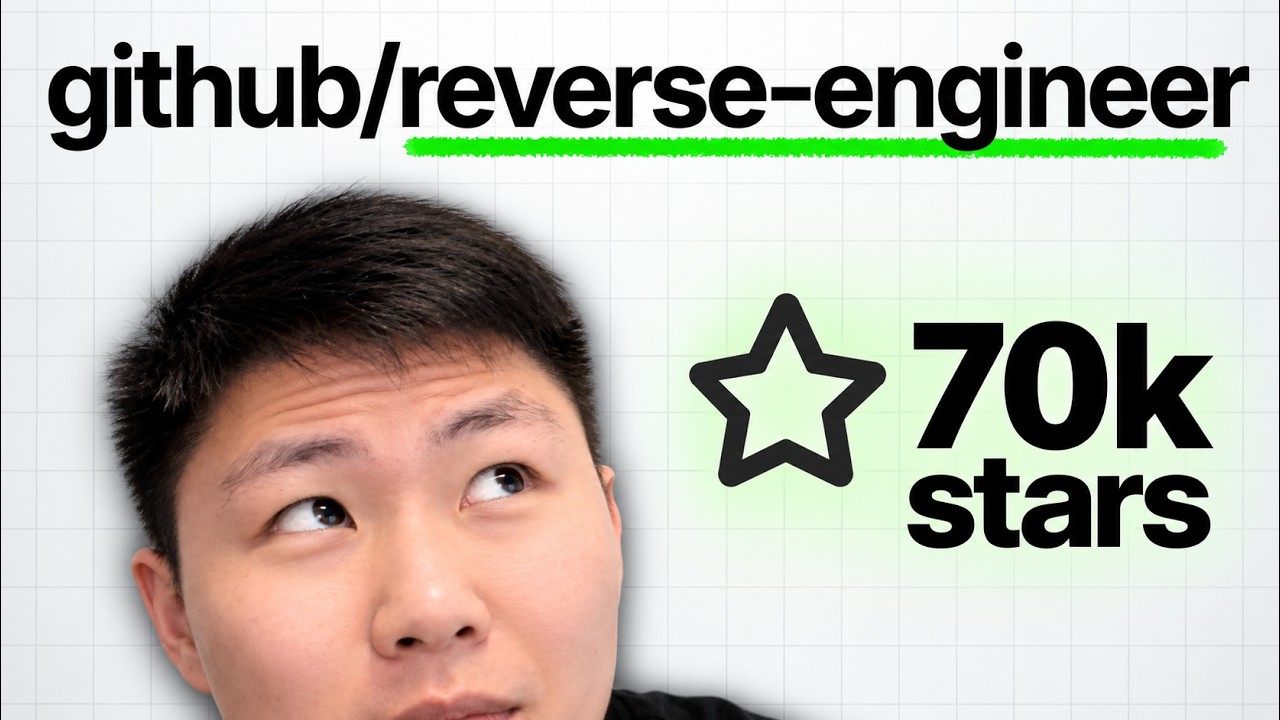
0:00Eric Tech frames REA as the way to reverse-engineer "any application with AI that has the highest accuracy" — and opens with the claim that it cleared 60,000 GitHub stars within days of release (it's actually higher now; see below). His promise: walk through what REA is, how it works under the hood, and how he cloned a voice-to-text app he uses daily.
What REA is
0:44REA — "Reverse Engineer Anything" — is morluto/rea. The pitch: you see a feature you like in a desktop, web, or mobile app, and REA gets "down to the binary level" to understand exactly how the app works, giving the AI far more context to build accurate results. 1:06He ties it to the spec-driven-development idea that predates AI: to build with high accuracy you need context, and "that context is really the key" — REA's job is to supply it. The framing is explicit: "if you want to clone anything, you've got to give more context, more evidence on exactly how this application works behind the scenes."
How it works
1:32His mental model: treat REA as a skill with many MCPs underneath — Hopper for desktop binaries, JavaScript/browser for web apps, plus mobile and hardware MCPs. REA is "a skill that teaches the AI agent how to use these tools" to collect information from the target application itself. That's the layer worth understanding: REA isn't a decompiler doing the analysis itself — it's an orchestrator that walks the agent through the right tools and turns raw binary analysis into instructions the model can act on.
Setup, step by step
2:07The concrete steps, in order:
- 2:21Check
node -v— REA requires Node v24+; upgrade withbrew upgrade nodeif needed. - Run the install command (the
npx rea-agents setupflow) in the repo. - Pick your AI agent harness — he selects Claude Code and Codex, noting OpenCode works too.
- 2:56Install Hopper for deep binary analysis — a third-party disassembler REA drives to turn a compiled app's behavior back into "proper instructions" the agent can reason about.
- 3:35Approve the ~5 changes it applies: the Hopper deep-analysis provider, your chosen coding agents, and the reverse-engineering skills.
The Hopper disassembler pops up with a "try the demo" option, and the setup reports everything installed.
The WhisperFlow clone
5:01For the demo he opens Claude Code and targets WhisperFlow, a voice-to-text app he uses every day (hotkey → speech transcribed to text, plus meeting notes). 5:46His prepared prompt: find WhisperFlow on the desktop, use REA to inspect the app, use the official website as background, explain what can be reproduced from the application files, and produce "a small working version." He pastes it and lets Claude do the rest.
What came out
6:20The result he shows is a working clone: the conversation list with everything he said, a note-taker view with past notes and full transcripts, and a global shortcut (Option+1) to start a new session. 7:03It handles multiple languages in the same input (English and Chinese shown), and — his emphasis — transcription runs locally on the machine, so the voice never leaves the box. "It's actually able to use the reverse-engineering tool to analyze exactly how it works and create a similar version using our AI agents."
The moat take
7:41His "two cents": this is revolutionary because the code is no longer the moat — the brand, the users, and the data are. 7:55The clear example he cites is PhotoCraft, the recent viral project cloning the entire Adobe suite (Premiere, Photoshop, and the rest) "one-to-one" in Rust — "Rust is actually a lot faster than any other languages." His conclusion: if a stronger brand can't be taken away, then "building better brands, marketing, applications, and how you scale" is where the defensible value now lives. (This last stretch is also where he pivots to his paid community — flagged below.)
Claims checked
REA is real and exploding. morluto/rea — MIT, TypeScript, pushed today. Live GitHub API count: 77,833★ / 16,688 forks.
Star count is stale again. The video says "over 60,000 stars"; it's now 77.8K. Trajectory across our three REA deep-dives: 28.5K (Oct 9) → 28.5K (Oct 10) → 77.8K (Oct 11) — the repo roughly tripled in two days.
"Clone" is loose. REA does not recover original source (it's gone after compilation); it produces pseudo-code, call paths, and evidence the agent uses to reimplement behavior. The WhisperFlow result is a working look-alike, not byte-for-byte source — the same nuance flagged in our earlier REA deep-dives.
Auto-caption garbles normalized: "RDA"/"Ra"→REA, "claw code"/"clot"→Claude Code, "codeex"/"codecs"→Codex, "open code"→OpenCode, "hopper"/"hover"→Hopper, "whisper flow"→WhisperFlow, "photocraft"→PhotoCraft, "specdriven development"→spec-driven development.
His paid "school community" (AI agents/automations/SaaS building, pitched around a senior-AI-engineer-at-Amazon-and-Microsoft background) is promoted mid-video and at the end. Flagged; no link included.