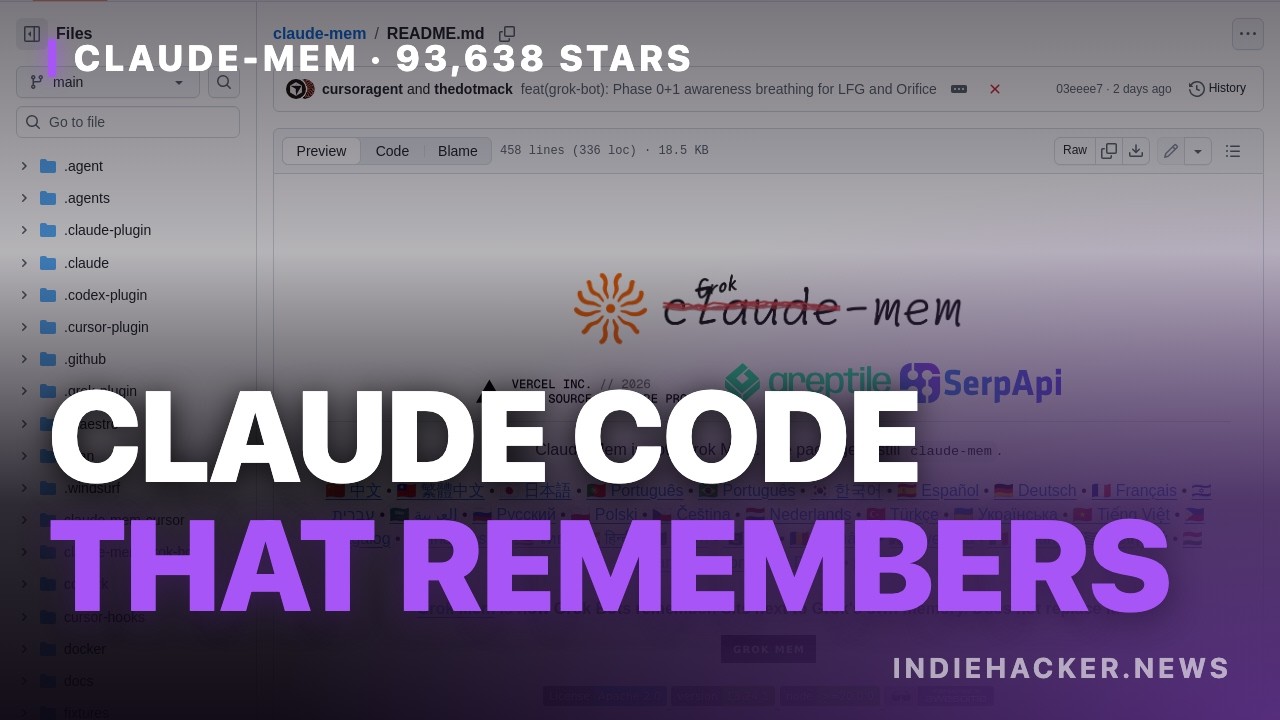
🎬 93,000 Stars, Wrong Name 0:00
The video opens on a detail that turns out to be the whole story in miniature: a Claude Code memory plugin sitting at 93,000 stars, whose own README's first line says the project has a different name now. The repo is thedotmack/claude-mem 🔗 — Apache 2.0, first commit by Alex Newman on August 31st, 2025.
Eight days before this video, the README heading was rewritten to read "Grok mem" — because it's now Grok's memory layer too. But the rename lives on the front page and nowhere underneath it: the repo still answers to claude-mem, and so does the package on npm. The identity is half-migrated, which is a fair preview of the whole project's character — sprawling, fast-moving, and never quite matching its own label.
📖 Their Own README & the Company It Keeps 1:05
The README is what you'd expect from a serious product, not a weekend project: a logo, three sponsor badges across the top (Vercel's open-source program, WebTile, SerperAPI), a row of 33 translations, and a star chart that turns nearly vertical around the middle of this year.
Three details the video flags as tells. First, the install block is a single npx command, but directly under it a paragraph warns that the installer will stop and ask you to sign into an account in your browser — "a lot of ceremony for a plugin." Second, it promises four MCP search tools and then lists three. Third, at the very bottom of the page, under its own heading, sits a paragraph about a crypto token with its contract address printed underneath.
The market context matters. Memory is the most crowded corner of the agent ecosystem, and this repo doesn't pretend otherwise: its own GitHub topic tags include Mem0, Open Memory, and Super Memory — direct competitors, sitting there as search keywords on its own page. (I verified the tags on the live repo — mem0, openmemory, and supermemory are all present.) Anthropic ships memory natively in Claude Code, and the README is careful about that boundary: this "sits next to the model's memory rather than replacing it."
🧠 The Shape of It 2:31
The scale numbers are genuinely striking. The project is 376 days old and has tagged 325 releases in that time — close to a release a day. But the distribution of the work is the warning sign:
| Metric | Video claim | Verified (GitHub API, Sep 14 2026) |
|---|---|---|
| Stars | 93,638 | 93,828 ✅ (slightly higher) |
| Forks | 8,232 | 8,253 ✅ |
| License | Apache 2.0 | Apache-2.0 ✅ |
| First commit | Aug 31, 2025 | created 2025-08-31 ✅ |
| Commits by one maintainer | 83% of 2,551 | (not re-audited) |
| Open pull requests | 286 | (not re-audited) |
One person wrote 83% of the commits, and 286 pull requests sit open behind them. That's the shape of it: an enormous, active surface area resting on a single pair of shoulders. It's not a knock on the maintainer — it's a structural fact about what happens when your patch lands in a deep merge queue.
📝 How It Takes Notes 2:49
The capture mechanism is the elegant part. It runs out of band, so nothing ever blocks while you're working. Every tool call your agent makes goes through a hook, which hands the raw activity to a second model — and that model compresses the activity into what the project calls observations.
Those observations are typed (a decision reads differently from a security alert), timestamped, and attached to a specific project. On the way in there's a privacy filter, and you can wrap anything at all in private tags to keep it out of the database entirely.
The division of labor is worth underlining: your coding agent does the work, and a separate model watches and summarizes it. That's why the project can be billed as memory "for every agent" rather than memory for one model — the observer is independent of the worker.
🔍 Retrieval & How Far It Reaches 3:50
Retrieval is the more interesting half. Instead of dumping history into the context window, it hands the agent a compact index first — somewhere around 50–100 tokens per result. Full detail is only fetched for the handful of IDs the agent actually asks for, which is where the project's ~10× token saving claim comes from. It's the right architecture for a context-window economy: index first, hydrate on demand.
The reach is broader than the "Claude" name suggests. The repo carries separate plugin folders for Cursor, Codex, Grok, and Windsurf right at the top level, plus a one-line curl installer aimed at OpenClaw gateways. The plugin ships 20 skills — and the names are a window into how it's built, since one is called babysit and another wower-point.
Modes are the other lever. A single setting in the config switches the workflow between code, chill, and investigation — and that same setting picks the language your memories get written in. Flip it to code--zh and you get simplified Chinese. There's even a live web viewer running off the local worker, so you can watch the memory fill up while you work.
🔌 How It's Wired 4:36
Underneath, hooks.json registers seven commands across six lifecycle events — which is how it sees everything without you doing anything. The worker is a local HTTP service managed by bun, holding both the search API and the web viewer.
Storage is SQLite with FTS5 for full-text search, with Chroma sitting next to it as a vector index — so search comes back hybrid (keyword + semantic) rather than keyword-only. The MCP layer exposes three tools: search, timeline, and get-observations, meant to be called in that order.
The npm package is interesting for what isn't in it: two runtime dependencies (both authentication libraries) against 54 development ones. Bun and UV get pulled in automatically if you don't already have them — "a lot of machinery to arrive off a single line."
📦 Installing It & v13.24.5 5:27
Getting it running is one command and then a decision you should actually read. Partway through, the installer hands you a magic link — and that account isn't cosmetic. It provisions a key for their hosted "observer," free for 30 days, after which the compression falls back onto whatever plan is already powering your agent unless you subscribe.
If you'd rather skip all of that, a provider flag and an environment variable turn the online opt-in off completely — and in CI it never asks at all. So the account ceremony is a default, not a requirement; the friction is in the defaults, not the capability.
The current tag is v13.24.5, shipped two days before the video. The headline note is that Fleet can install from npm again — "a blunt way of saying the build before it couldn't." Under that, four PRs in the 3,900s land CCS align, a new bundled skill with a middle cache and a rules walker. There's also a grokbot awareness pilot that quietly appends dated lines into another bot's memory log — worth reading the code before you turn it on. And the release adds daily price history from OpenRouter, so you can finally see what all that compression actually costs you.
⚖️ Verdict 6:42
The video's verdict is measured and, on the evidence, correct. The risk isn't the software — it's the person count. One maintainer holding a merge queue this deep means your patch can sit unanswered for months, while every contributor who tried to help and heard nothing back quietly stops trying. That's the real, structural cost of an 83%-single-author project with 286 open PRs.
The second caveat is the boundary document in the tree, which spells out in writing which parts stay behind the paywall. The ceiling on the free tier is not something you get to move: paid access to the reserved half starts at $30/month.
💡 Key Takeaways
- It's cross-agent memory, not just Claude. Despite the name (and the half-finished "Grok mem" rename), it plugs into Cursor, Codex, Grok, Windsurf, and OpenClaw — and lists Hermes in its own description.
- The model remembers you; this remembers what the agent did. That boundary is the product's core pitch and its answer to Anthropic's native memory.
- Capture runs out of band. Every tool call flows through a hook to a second model that compresses it into typed, timestamped observations — nothing blocks while you work.
- Retrieval is index-first. A 50–100 token index per result, with full detail hydrated on demand, is the source of the ~10× token-saving claim.
- Hybrid search under the hood. SQLite FTS5 for full-text plus Chroma for vectors, behind three MCP tools called in order: search → timeline → get-observations.
- The default install asks you to sign in. That account provisions a hosted observer (30 days free); a provider flag and env var turn the online opt-in off.
- The real risk is bus factor. One maintainer wrote 83% of 2,551 commits with 286 open PRs — your patch may sit for months.
- Not everything is free. A boundary doc reserves part of the feature set for the paid tier, starting at $30/month.
🔗 Resources & Links
- 📦 github.com/thedotmack/claude-mem — the repo (Apache-2.0, TypeScript)
- 🌐 claude-mem.ai — the site
- 📚 npmjs.com/package/claude-mem — the npm package
Source video: youtube.com/watch?v=P368eheJbS0