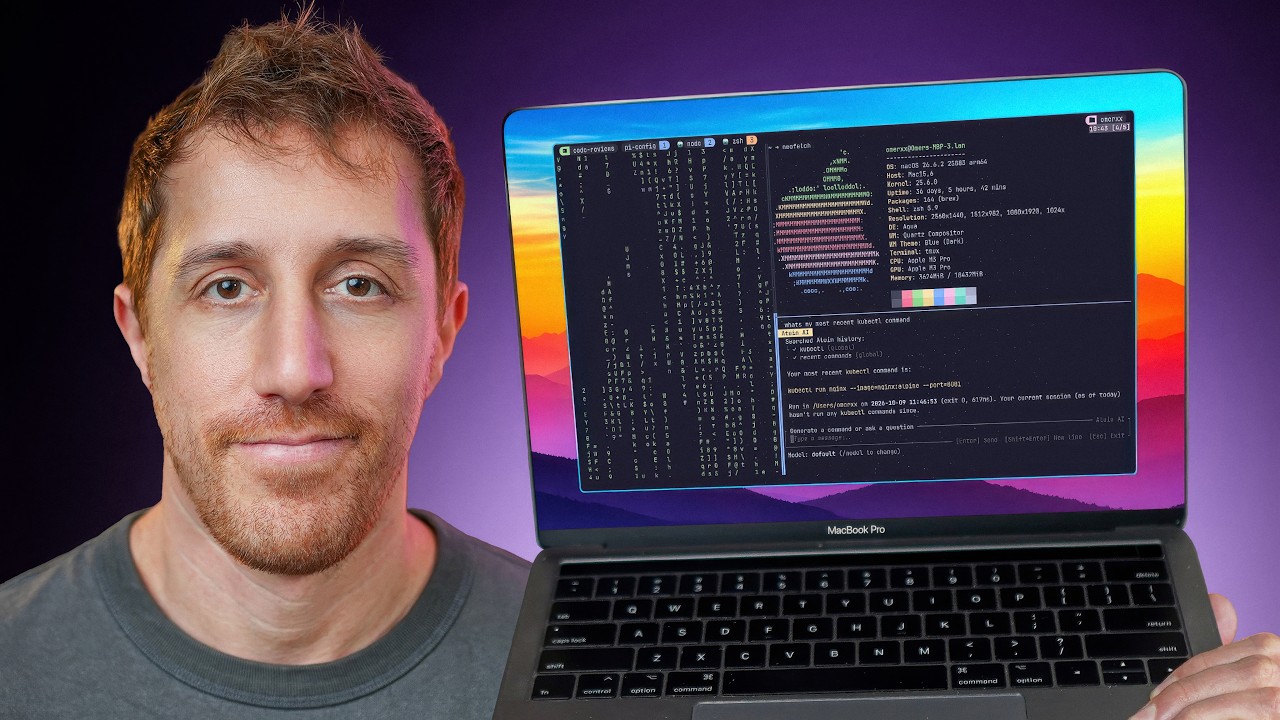
0:00"Your terminal config doesn't matter" is what a LinkedIn influencer would say. Omer (the "DevOps Toolbox" channel, GitHub omerxx) spends 20 minutes walking through everything he kept after reviewing "so many tools" — the ones that survived because they work for him, layered from the terminal emulator up to the coding agent. Almost every project has a dedicated video on the channel; this is the consolidated map. Note: this transcript is heavily auto-captioned — a lot of tool names arrive garbled, and I've corrected every one and verified the repos below.
The stack at a glance
- Terminal: Ghostty
- Multiplexer: tmux (local), with Herdr and TUIOS as alternatives
- Worktrees: Worktrunk + workmux
- Agent: Pi (Codex on web subscription)
- Shell/prompt: bash + eza + Starship
- Nav/history: zoxide, Atuin, fzf
- Editor: Neovim (LazyVim)
- Files/dev: Yazi, Superfile, Television, mise
Terminal: Ghostty
1:12Ghostty is the pick — a fast, GPU-accelerated, cross-platform terminal emulator written in Zig by Mitchell Hashimoto (founder of HashiCorp), with "almost nothing to configure" beyond a small (already "bloated," his words) config file. The video notes Hashimoto donated the project to a nonprofit to lock in its open-source, free nature, and has since founded a company building a multiplexer. 2:52The multiplexer tease sets up the next section.
Multiplexers: tmux, Herdr, TUIOS
3:06For local use, it's still tmux. Two others get name-dropped: 8:00Herdr (herdr.dev) — a full-blown "agent multiplexer" with tabs, splits, and a status bar showing which agents are running in which workspaces and their state, mouse-controllable and pretty out of the box. 8:30And TUIOS (tuios.dev) — "a terminal operating system," which is a fancy way of saying multiplexer: new panes float like OS windows, with minimize/maximize/kill buttons, metrics, tiling, and workspaces. Both are the "new school" of agent-aware terminals.
tmux plugins
3:33His tmux config loads a reset-conf baseline, then plugins. Two of them he built himself (open source): 4:00tmux-sessionx — a fuzzy session manager with previews — and tmux-floax — floating panes over tmux (zoom/shrink/reset, a persistent popup). He also runs sesh (by Josh Medeski, joshmedeski/sesh), the more featureful session manager he recommends for most people, and the Catppuccin theme.
Parallel worktrees
6:29Git worktrees are "Git's best feature with the worst UI" — and with agents running many parallel, "featureful yet lifeless" tasks, controlling their lifecycle matters. 6:48Worktrunk (max-sixty/worktrunk) is the CLI that makes worktrees as easy as branches — wt switch, wt list, wt merge, wt remove, with hooks, LLM commit messages, and build-cache sharing. 7:09On top of it, workmux (raine/workmux) glues worktrees + tmux windows into a TUI dashboard — projects and worktrees with git diff, PR-exists/merged status, run time, a preview pane that can even drive the agent directly. His go-to: workmux add <name> to spin up a new session with Pi.
Coding agent: Pi
10:33Pi (earendil-works/pi) took over from OpenCode. What won him over: speed, simplicity, and the Unix approach — yellow by default, everything else is an extension. No fancy banner, just ready to go; a conversation tree you can review and fork; model switch with one keystroke; session export and gist sharing. He's on Codex here via paid web subscription (not API tokens). He also built a small /head slash command for Pi (on his GitHub) to jump to the top of the last answer.
ASD-STE100 for agent instructions
12:25A neat nugget: he configured ASD-STE100 — "Simplified Technical English," a standard from the 1980s used in Apollo missions and fighter-pilot protocols — into Pi to simplify agent instructions. Andrej Karpathy popularized it for LLM prompts, but a Pi extension had installed the STE protocol two months before the tweet. If it's good enough for aerospace, the logic goes, it works for a coding agent.
Navigation & history
13:11zoxide — "an educated guess machine" for cd: type z + a word and land in the right place nine times out of ten (Rust, descended from the 267-line z bash script). 14:25Atuin — the shell-history manager that keeps a local SQLite DB (you never lose a command), searches it fast, and now adds natural-language search over history. 15:28And fzf — the "king of CLI" fuzzy finder that sessionx itself is built on.
Shell & prompt
9:20Awkward admission: after advocating Nushell for the better part of a year, he's back to bash (POSIX-compatible), with eza doing ls work and trees — though he can still nu ls when he wants the fancy output. 16:07The prompt is Starship (Rust) — dynamic git/AWS/Golang status that knows when input is meaningful — chosen over Oh My Zsh (~200k stars) which he found slow, script-heavy, and hard to track.
Editor
17:00Neovim with LazyVim is the "one and only beloved IDE" — LSPs, debuggers, file exploration, code suggestions. The Neovim team's 2027 goal of an "out-of-the-box Neovim" is, he notes, a response to a vibe-coded world where everything ships configured. Zed and Helix get honorable mentions.
File explorers
18:07A saturated category — nnn, Ranger, and the most popular, Yazi — but his pick is Superfile: "fancy" and "beautiful and smart," with text/file previews, a pinnable favorites board, and clean cut/copy/delete flows. Television (alexpasmantier/television) is "fzf in a TUI" — channels as lists (files, directories, aliases, AWS buckets) with a "TV remote" panel.
Dev env: mise
19:29Last discovery: mise (jdx/mise) — dev tools, env vars, and task runner. Drop into a project with a mise.toml and it sets everything for you, unsets env when you leave (a direnv replacement, but "does it better"), and can serve tools on-demand via Nix. Everything is tracked in his public dotfiles repo; the video covers ~95% of his day-to-day.
Claims checked
Ghostty ghostty-org/ghostty (62,285★, MIT, Zig); Pi earendil-works/pi (115,691★, MIT); Worktrunk max-sixty/worktrunk (9,260★, Rust); workmux raine/workmux (2,854★, MIT); TUIOS Gaurav-Gosain/tuios (5,416★, MIT, Go); tmux-sessionx omerxx/tmux-sessionx (1,394★, GPL-3.0); tmux-floax omerxx/tmux-floax (880★, GPL-3.0); sesh joshmedeski/sesh (2,868★, MIT, Go); Television alexpasmantier/television (6,353★, MIT, Rust); mise jdx/mise (35,073★, MIT, Rust).
The presenter is Omer H. (omerxx), whose GitHub profile lists "[DevOps Toolbox]". He's the author of tmux-sessionx and tmux-floax, so the "two plugins I built myself" claim checks out.
Hashimoto's nonprofit donation and his new multiplexer company are stated in the video but I couldn't independently verify the exact current legal/commercial status. Ghostty itself is MIT-licensed and open source — that part is solid. The ASD-STE100/Karpathy timing ("Pi extension 2 months before the tweet") is the presenter's own recollection.
Every tool gets a video on his channel, and the two tmux plugins are his own. Sponsor segment: Internxt (encrypted, zero-knowledge cloud storage — 85% off lifetime plans, 30-day guarantee). No affiliate links reproduced.