☆ Overview
Matthew Berman showcases four free, open-source GitHub projects that solve real problems for AI engineers and power users. From a human-voting-powered search engine and a fully local NotebookLM clone, to a structured agentic engineering workflow and an LLM context compression tool that can slash your token bill by up to 92% — these projects are already racking up tens of thousands of GitHub stars and deserve your attention.
1 Last30Days — Human-Backed Search Engine
Last30Days is a new kind of search engine built as an agentic engineering skill — you install it in your coding environment (Cursor, Codex, Claude Code) and use it via the /last30days slash command. It currently has over 40,000 GitHub stars and was created by Matt Van Horn, co-founder of the company that became Lyft.
How It Works
Unlike Google, which serves links and ads, Last30Days aggregates human-voted content from multiple platforms simultaneously:
- Reddit upvotes — searches across subreddits and ranks by upvote count
- X/Twitter likes — tracks engagement signals
- YouTube transcripts — pulls and analyzes video content
- TikTok engagement — monitors trending content
- Polymarket odds — backed by real money, not just opinions
- Hacker News stories — ranks by upvote counts
The engine searches all platforms in parallel, scores results by real human engagement, and then an AI agent judge synthesizes everything into a single coherent brief.
The V3 Engine — Smart Pre-Search Resolution
The V3 engine doesn't just search for your topic — it figures out where to search before the search begins. For example, typing "OpenClaw" causes the engine to automatically resolve to Peter Steinberger's Twitter handle and all relevant subreddits. This pre-resolution makes searches dramatically more relevant.
Demo: Loop Engineering
Matthew demonstrates by searching for "loop engineering" — a concept born on June 7th, 2025. The tool returned that Peter Steinberger posted: "You shouldn't be prompting coding agents anymore. You should be designing loops that prompt your agent." The brief surfaced 32 Reddit threads with 45,000 upvotes, 40 Hacker News stories, and content from r/cloudai, singularity, and prompt engineering subreddits.
Extra Features
- HTML export — type
emit=htmlor ask for "a sharable HTML brief" and it generates a nicely formatted shareable page - Source transparency — every brief lists exactly which sources and how many threads/upvotes were used
2 Open Notebook — Local NotebookLM Clone
Open Notebook is a free, open-source, and optionally completely local clone of Google's NotebookLM. It's sitting just below 30,000 GitHub stars and provides the same core capabilities — document ingestion, Q&A, and podcast generation — but with full control over your data and models.
Core Capabilities
- Document ingestion — upload PDFs, articles, or paste URLs. Matthew demoed ingesting a Thrive Holdings essay called "Long Humans" by simply pasting a link
- Q&A against documents — ask any question and get sourced answers with specific references back to the document. Can handle thousand-page PDFs
- Podcast generation — generates multi-host synthesized podcasts from your uploaded content. Matthew generated a 23-minute, 36-second podcast from a single article
- Transformations — a suite of built-in document processing tools: extract key insights, dense summary, paper analysis, reflection questions, simple summary, table of contents
Model Configuration
The project supports multiple LLM providers — you can use hosted models (OpenAI) or run everything completely locally with Ollama or LM Studio. Matthew's recommended configuration:
- Chat model: GPT-5.5 (latest)
- Embedding model: text-embedding-3-large
- Text-to-speech: GPT-4o mini
- Speech-to-text: GPT-4o Transcribe
- Tools model: GPT-5.5
- Transformation model: GPT-5.4 mini
Podcast Customization
The podcast generation is hyper-customizable: multi-host conversations, different tones, custom script editing, and full control over the output. For more natural voices, Matthew recommends integrating ElevenLabs.
3 Agent Skills — Structured Agentic Engineering
Agent Skills is a project by Addy Osmani (well-known Google Chrome engineer) that provides a structured workflow for agentic engineering. It has over 56,000 GitHub stars and delivers seven slash commands that map to the seven stages of engineering.
The Seven Stages
- /spec — spec-driven development, creating detailed specifications
- /plan — break down tasks into small, achievable pieces
- /build — execute the implementation
- /test — test the built features
- /review — code review and quality checks
- /simplify — code simplification and cleanup
- /ship — deployment and shipping
The Interview Flow
The standout feature is /interview-me, which runs a step-by-step interview to extract exactly what you're trying to build. It asks structured questions, offers guesses, helps you explore edge cases, and outputs a clean markdown file that feeds into the rest of the workflow. Matthew demoed building "a library/website of agentic loop ideas" and the tool immediately proposed a hypothesis, asked about target audience, and explored edge cases.
Additional Skills
- Security and hardening — security review of your code
- Code simplification — clean up and refactor
- Performance optimization — speed and efficiency improvements
Comparison to GStack
Matthew compares Agent Skills to GStack by Gary Tan (reviewed in a previous video). The key difference: GStack is focused on helping you build an entire company, while Agent Skills is laser-focused on just the engineering workflow. Both are installed as skills — just paste the GitHub URL and tell your agent to install it.
/interview-me command alone is worth the install for how well it extracts and structures your ideas.4 Headroom — Context Compression for AI Agents
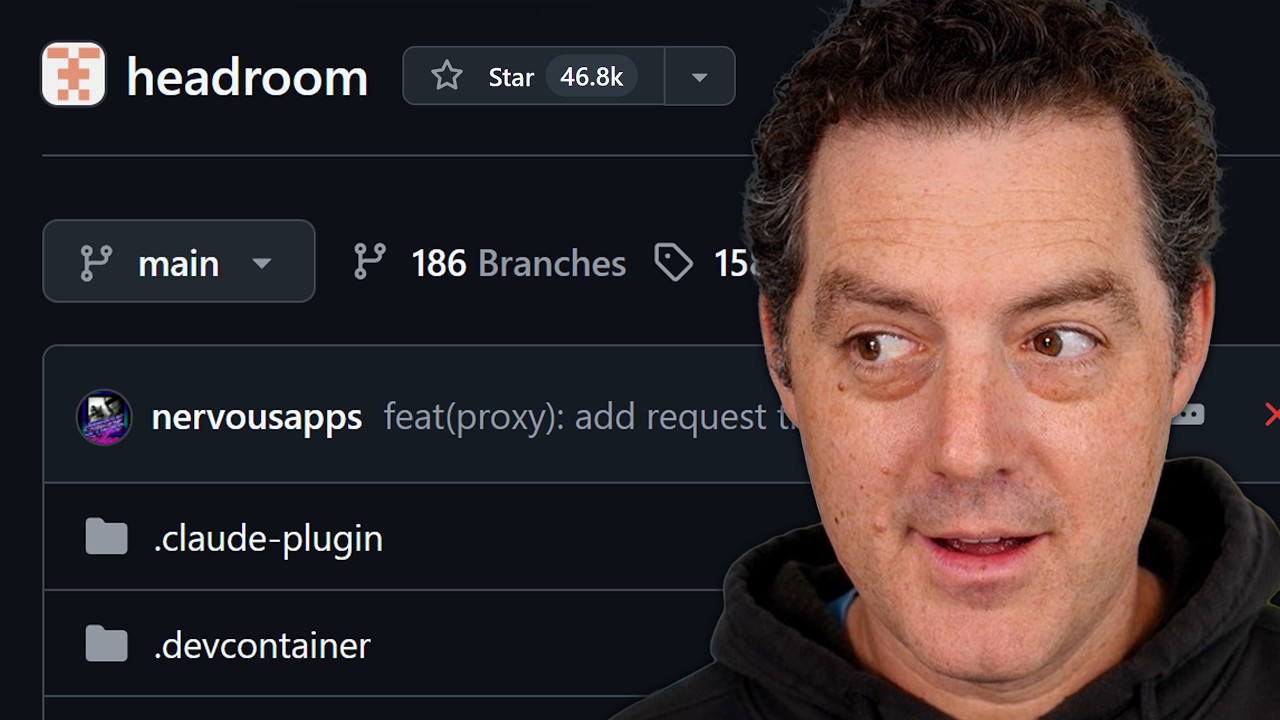
Headroom is Matthew's pick for the most interesting and potentially underrated project in this list. With just over 24,000 GitHub stars (but exploding in June 2026), it compresses the context sent to your LLM — tool outputs, logs, RAG chunks, files, and conversation history — delivering the same answers with a fraction of the tokens.
Token Savings Benchmarks
- Code search (100 results): 17,000 → 1,400 tokens (92% savings)
- Incident debugging: 65,000 → 5,000 tokens (92% savings)
- GitHub issue tracking: 54,000 → 14,000 tokens (73% savings)
- Codebase exploration: 78,000 → 41,000 tokens (47% savings)
Quality Preservation
The compression does not degrade quality. Testing on GSM8K, TruthfulQA, SQuAD V2, and BFCL showed essentially perfect scores across all benchmarks — the model gets the same answers with dramatically fewer tokens.
Compatibility
Headroom works as a transparent wrapper around your existing agentic coding tools:
- Claude Code — via
headroom wrap claude - Cursor — drop-in integration
- Codex — seamless wrapping
Once wrapped, it looks and works exactly like the original tool. Matthew demoed running headroom wrap claude -d --no-proxy and using it to review his AstroHub codebase.
Performance Monitoring
Type headroom perf to see detailed breakdowns: per-model token savings, cache performance, optimization overhead, and conversation size metrics.
Headroom Learn
The headroom learn command is a standout feature — it mines failed sessions from your logs, analyzes what went wrong, and writes corrections to your claude.md and agents.md files. In Matthew's demo, it analyzed 9 sessions with 378 calls and suggested specific improvements like "deploy to here.now" context awareness and saving 8,000 tokens per session by loading deferred tool schemas.
Important Caveats
- Serena bundled by default — Headroom installs a tool called Serena by default, which is unrelated. Use
-d --no-saflag during installation to skip it - Telemetry enabled by default — make sure to disable it if you want privacy. The code is open source so you can remove it
headroom learn feature that actively improves your setup over time.🎯 Key Takeaways
🔑 Key Takeaways
- Skills are the new install paradigm — three of the four projects (Last30Days, Agent Skills, Headroom) install as simple skills by pasting a GitHub URL into your agent
- Human-voted data beats algorithmic ranking — Last30Days uses Reddit upvotes, X likes, Polymarket odds, and YouTube engagement instead of ad-driven algorithms to surface recent trending information
- NotebookLM is now fully replicable locally — Open Notebook provides document Q&A, podcast generation, and transformations with full model flexibility, running entirely on your machine if desired
- Structured engineering workflows matter — Agent Skills' seven-stage pipeline (spec → plan → build → test → review → simplify → ship) turns chaotic agentic coding into a repeatable process
- The /interview-me command is a game-changer — before writing any code, Agent Skills extracts a structured specification through an interactive interview
- Context compression can save up to 92% of tokens — Headroom achieves massive savings on real workloads without degrading answer quality, as verified across multiple benchmarks
- Headroom learn mines failures for improvement — the tool analyzes failed sessions and auto-generates corrections for your configuration files, creating a continuous improvement loop
- Watch for bundled extras — Headroom installs Serena by default and has telemetry enabled; use
--no-saand disable telemetry explicitly - All four projects are free and open source — collectively representing 150k+ GitHub stars and solving real problems for AI engineers
- Installation is trivial — Matthew demonstrates that modern AI projects can be installed simply by pasting a GitHub URL into Cursor, Codex, or Claude Code and saying "install this"
🔗 Resources & Links
- Last30Days — Human-voted search engine skill for agentic coding platforms (40k+ stars)
- Open Notebook — Free, local NotebookLM clone with podcast generation (30k stars)
- Agent Skills — Seven-stage agentic engineering workflow by Addy Osmani (56k+ stars)
- Headroom — LLM context compression with up to 92% token savings (24k+ stars)