0:00AICodeKing's take on the direction "every AI lab is heading": persistent teammates with a standing job, a memory of the work, and a computer of their own — instead of disposable chats that forget when you close the tab. The clearest productized version is Grokbot (SpaceX AI), and this video reviews the open alternative: OpenBot.
What Grokbot got right
0:03Grokbot's shape: you create a bot, give it a name and a job, and it lives on an always-on cloud computer with its own browser, filesystem, and terminal. It signs into the tools you already use, runs multi-step work start-to-finish, keeps going after you close the laptop, runs routines on a schedule, and only comes back when something needs your approval. The trade-offs baked in: the computer isn't yours (cloud-hosted in the US), your logins stay signed in there, model selection is managed for you, and access is bundled with paid Cursor plans and SuperGrok subscriptions. For people already paying for ChatGPT, Claude, Gemini, and Grok separately, that's "another walled garden that asks you to trust someone else's computer."
What OpenBot is
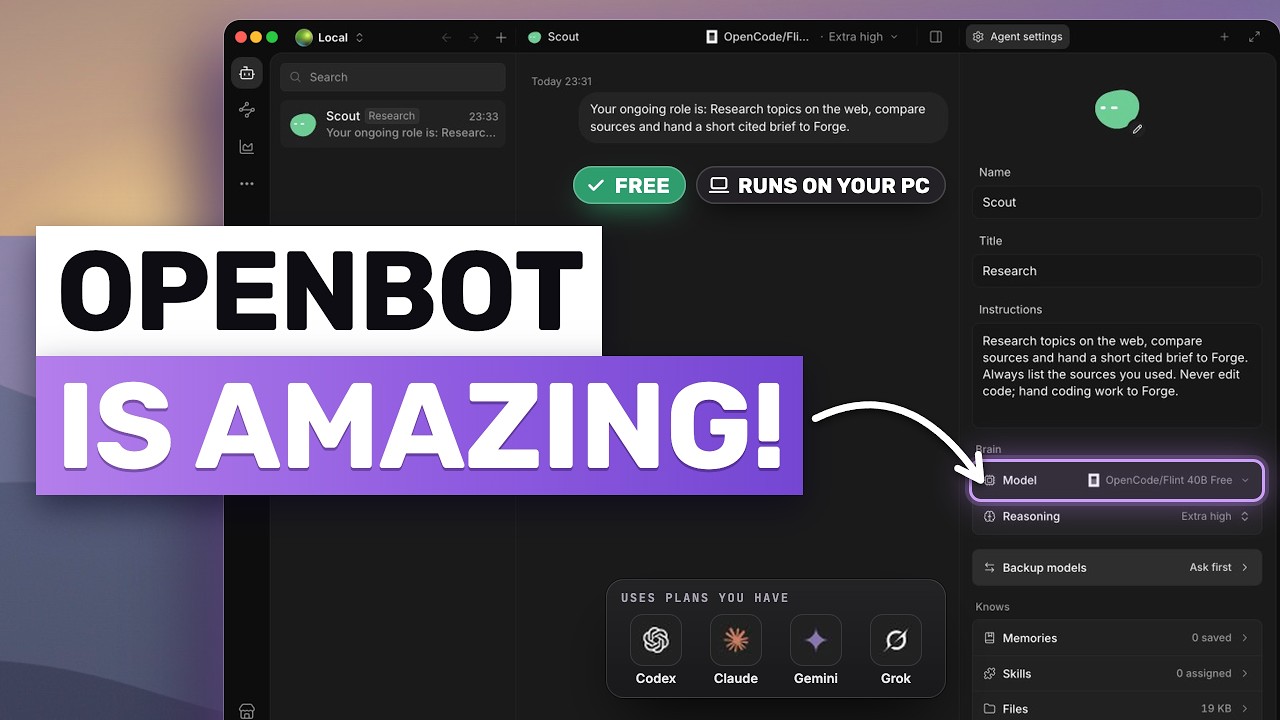
3:07OpenBot (from openbot.run) is "the Grokbot idea rebuilt to run on your own computer with the harnesses and plans you already pay for." A free desktop app for macOS, Windows, and Linux, with iPhone/Android/web apps that connect back to your machine — so you talk to your agents from your phone while the work stays where it started. Inside, every agent is persistent the way Grokbot made popular: a name, its own instructions, its own workspace, its own conversation, still there tomorrow with the context of what it did today. OpenBot sells no model — you bring the ones you already have.
Per-agent providers
3:55Each teammate can run on a different engine: Codex (ChatGPT plan), Claude Code (Claude plan), Gemini (Google AI), Grok (xAI key), and the same pattern through Cursor, Kline, MuseCode, OpenCode, Pi, Mercury (Inception) — plus anything speaking the Agent Client Protocol (like Goose or Qwen Code) pointed at any OpenAI-compatible endpoint, or local models via Ollama and LM Studio. The researcher can sit on one provider, the coder on another, and the cheap background checker on a free or local model. You pick provider, model, and reasoning effort per agent instead of accepting a managed default.
Swap engines, keep the teammate
4:42Two consequences he flags as the real value. First, changing an agent's provider keeps its role, workspace, and conversation — "you're changing the engine, not firing the teammate." Second, when a plan hits its limit or a provider goes down, the agent can fall back to a backup model on another provider and keep working, with a note in chat showing the switch. If you've ever watched a long task die because a weekly limit ran out mid-run, that's the feature that hurts in a good way.
Team behavior
5:14The familiar multi-agent shape: agents message each other, hand off tasks, and review each other's work in shared channels — one agent fixes a bug, a second reviews, a third closes the loop, without you relaying every message. Each channel task has one clear owner, with delegation controls (stop, resume, reassign, archive, restore). There's a built-in browser agents can open, read, and control (for work behind a login with no API), a task queue (send the next job while one runs, pause/resume/cancel, steer running work), routines that start on a schedule (with a keep-awake option on Mac/Windows), Slack/Discord/Telegram answering, a voice pane where local models handle speech, and a vault — logins and payment cards encrypted by the OS with 1Password/Bitwarden connections, where agents only ever see a card name and last-four digits.
Local-first trade-off
6:43The honest cost sits in that same sentence: local-first means the machine running OpenBot has to stay on while your agents work. Grokbot keeps going in the cloud with nothing switched on at your end; OpenBot's answers are a desktop or home server that stays on, or a hosted server in the EU from €20/$25 a month, or a managed Teams offer where they run the servers for your company. And "local-first" is not offline: your chosen provider still receives the prompts, and opened pages still use the network — what stays home is the workspace, conversations, files, and browser data, not the model calls themselves.
The warning
9:09OpenBot states it plainly, and so does he: it's a development preview, and right now agents run with full access and no per-action approval after first-launch consent. In plain words, an agent can read and change files, run commands, use the network, and drive the browser without asking each time — "a lot of trust to hand any agent on your real machine." Grokbot's separate cloud computer exists partly to keep that blast radius off your laptop. His advice: run it only with agents and tasks you trust, keep real backups, and consider a spare machine or server if you let teammates run all day.
The license catch
10:02Pricing: the app is free with no locked features; your spend stays with the plans and API keys you already have, plus the optional hosted server. The catch is the license. The source is public and readable, and free to run for non-commercial use (personal, study, research), but it ships under PolyForm Non-Commercial 1.0.0 — so commercial use needs a separate license. "Source-available with a real restriction attached" — price that conversation in before building on it, not after. His verdict: choose Grokbot for the fully managed version; choose OpenBot if you already pay for Codex/Claude/Gemini/Grok plans, your files need to stay on your own hardware, and you want a free app whose code you can actually read.
Claims checked
The repo and license are real. nightly-labs/openbot (≈1.9k★, created Aug 2026) — "a local-first desktop workspace for persistent AI teammates." The LICENSE file is PolyForm Noncommercial License 1.0.0, confirming the source-available-not-open-source caveat. Grokbot (SpaceX AI) is real.
Per-agent provider support and the fallback/swap behavior are as demonstrated in the video, not independently re-tested. The "free, no locked features" claim reflects the current dev-preview state.
Auto-captions garble "Grokbot" (Grockbot), "Grok" (Grock), "Codex" (Codeex), "Kline" (Klein), "Qwen Code" (QN code), "Ollama" (Ola), "co-worker" (co-orker). Corrected. The Switch AI segment is a sponsor read (no link).