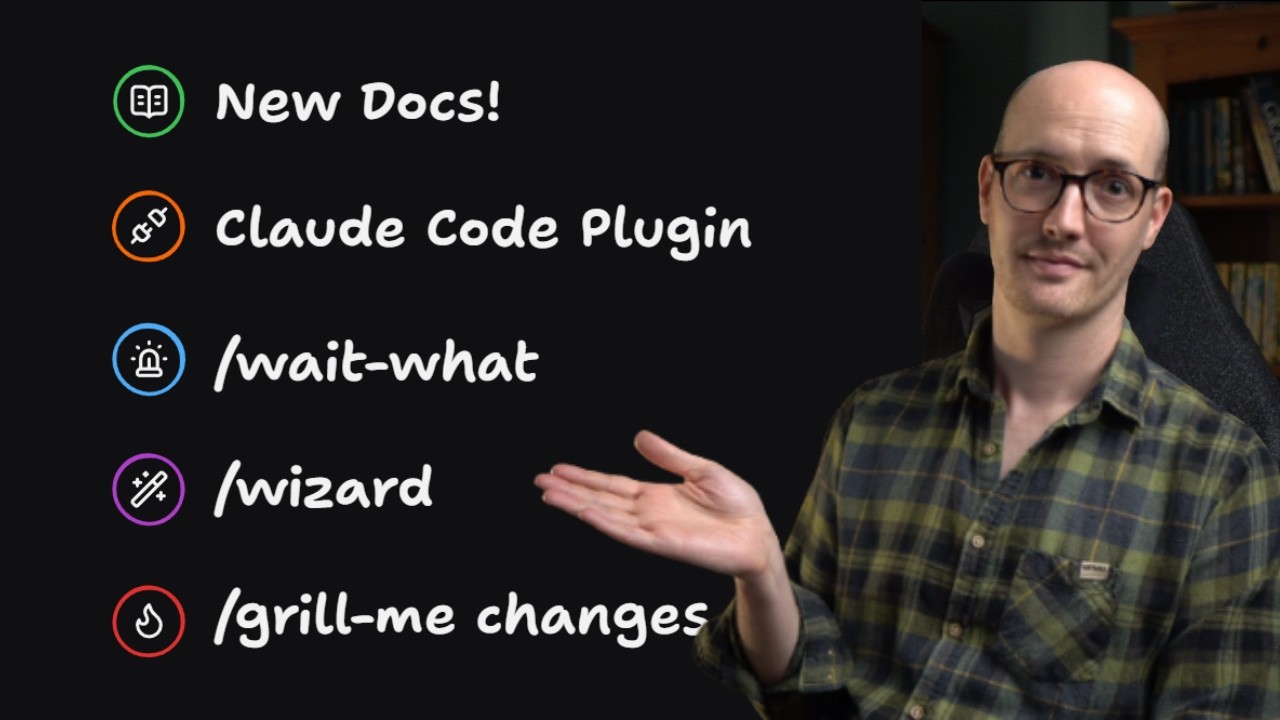
📌 What this release actually ships
| Item | What it is |
|---|---|
| AIHero.dev/skills | New documentation site — skills grouped by workflow stage, with a dictionary and FAQ |
| Claude Code marketplace | Official plugin — claude plugins install mattpocock-skills |
| Codex openai.yaml sidecars | Every skill ships a file enforcing allow_implicit_invocation: false for Codex |
| /wait-what | "Say that again, in plain English" — targets Opus 5's verbosity |
| /grill-me | Multi-question rounds with a dependency graph — no more one-at-a-time |
| /writing-for-agents | A formal language for agent instructions — context pointers, information hierarchy, completion criteria, leading words |
| /wizard | Generates a deterministic bash wizard for provisioning infrastructure |
| /to-questionnaire | Pulls grilling decisions into a collaborative document for non-agent collaborators |
mattpocock/skills — 204,742 stars, MIT licence, created 3 February 2026. The tag v1.2.0 was published 5 August 2026 — earlier today. The docs site is live. The Claude Code marketplace listing is real: /plugin search mattpocock. The openai.yaml sidecar files are present in the repository — checked in skills/productivity/grill-me/agents/openai.yaml. The /wizard SKILL.md was confirmed at skills/engineering/wizard/SKILL.md.📚 The docs, the marketplace, and Codex 0:18
| Infrastructure change | What it means |
|---|---|
| Claude Code plugin marketplace | /plugin search mattpocock → install → read-only bundle, auto-updated. "No extra steps. Any updates I make will be automatically pulled down." |
| Codex openai.yaml sidecars | Every skill ships an openai.yaml with allow_implicit_invocation: false. Without this, Codex treated every skill as model-invokable — the equivalent of a skill description sitting in context at all times, spending tokens every turn. |
🛑 /wait-what — the Opus emergency brake 2:32
The skill does two things: references ASD-STE100 (simplified technical English — a controlled language standard used in industry) as a leading word for clear declarative sentences, and grounds responses in the ubiquitous language from the project's context — the domain terms already established in /grill-with-docs.
That is the same mechanism as the "leading words" concept in §4: a shared vocabulary between the human and the agent, where the word recruits the model's pretraining and anchors a behaviour. Apply your own vocabulary rather than begging the model to use fewer words.
🕸️ /grill-me — the graph beneath the questions 4:02
Previously: one question per turn. The failure mode was the end of a session — you had already resolved the hard things and spent several turns saying "yes, that sounds good" to easy ones. He describes it as "incredibly frustrating and dead slow."
The new design: questions are a graph with dependencies. Some questions require earlier answers before they can be asked. The agent pushes as fast as possible down the "frontier of questions" — the set whose dependencies are already satisfied, asked in rounds.
He adds emoji markers for each question and recommended answers — "I know you probably don't like it, but I love it" — which makes the UI navigable by eye. With dictation, he can answer a whole round at once: "Q1, I agree. Q2, I agree. Q3, we need something to change there."
allow_implicit_invocation: false comment led to checking the repository — the openai.yaml sidecar for every skill was confirmed present. This is the mechanism that prevents Codex from loading the skill description into context on every turn.✍️ /writing-for-agents — the formalism 6:27
The video covers this in ninety seconds. The SKILL.md is 81 lines and 10,966 bytes of what is essentially a formal language for designing instructions an agent will read — and it is worth treating as a document rather than as a summary. What follows is its conceptual structure, with verbatim excerpts.
Context pointers
A pointer names some out-of-context material and encodes the condition for reaching it. Its wording, not its target, decides when the agent reaches the material — and how reliably.
The rules:
- Front-load the leading word — the pointer is where it does its triggering work.
- One trigger per branch. Synonyms that rename a single branch are one branch written twice.
- Cut identity the body already carries.
The two loads
Context load — the cost of always-loaded material on the agent's window. Cognitive load — the cost on the human: which documents exist and when to reach for each.
The information hierarchy
A ladder ranked by how immediately the agent needs the material:
- In-file step — the primary tier: what the agent does, in order.
- In-file reference — consulted on demand.
- Disclosed reference — pushed behind a context pointer, loaded only when the pointer fires.
Progressive disclosure is the move down the ladder — out of the main file and behind a pointer. Co-location is the within-file companion: keep a concept's definition, rules and caveats under one heading so reading one brings its neighbours. Sprawl is the failure mode — a document too long, even when every line is live.
Steps and completion criteria
Every step ends on a completion criterion with two properties:
- Clarity — can the agent tell done from not-done? A vague bound invites premature completion: ending the step before it is done, attention slipping to being done. The visible steps still ahead supply the pull; the criterion's clarity is the resistance.
- Demand — how much it requires. "Every modified model accounted for" forces thorough work where "produce a change list" does not.
Leading words
A compact concept already living in the model's pretraining that the agent thinks with while running the document. Repeated as a token, never as a sentence, it anchors a whole region of behaviour.
His examples are the right kind of concrete: "fast, deterministic, low-overhead" → tight. "a loop you believe in" → red. A fuzzy gate becomes a binary observable state — the loop goes red on the bug, or it does not.
Negation
Steering by prohibition drags the forbidden behaviour into context and makes it more available. The ban half-reads as an instruction to do the thing.
Pruning
- Single source of truth. Duplication costs maintenance and inflates a meaning's prominence past its real rank.
- The environment is a source of truth too —
package.json, config files, directory layout. A document that restates it is a cache: earn its load only when the lookup is expensive. Cache the unwritten convention, the reason behind a choice, the gotcha no config confesses. - Check every line for relevance. The default fate without pruning is sediment: stale layers settling because removing feels risky.
- Hunt no-ops: an instruction the model already obeys by default pays load to say nothing. Test it by running the document.
SKILL-MECHANICS.md, covers frontmatter, invocation choice and router skills — the mechanical layer the video does not touch. It was confirmed at 2,651 bytes in the repository.The video mentions the skill was rebranded from "writing great skills" to "writing for agents" because he found himself using it for "stuff other than skills… anything that an agent read" — AGENTS.md, CLAUDE.md, any document an agent consumes. The formalism works across both.
🧙 /wizard — deterministic provisioning 7:27
The skill generates an interactive bash script that walks a human through steps only they can perform — opening pages, pasting API keys, changing settings. It is deterministic: "nothing's touching an agent here. It's not sending it off to Anthropic or anything."
"I just know how long it took me before" is the reason — the agent writes the walkthrough, the human walks it. The agent is a documentation tool here, not a runtime. That is a legitimate category boundary.
skills/engineering/wizard/SKILL.md. He kept it "in progress for a couple of months" before releasing.📋 /to-questionnaire — collaboration outside the agent 8:58
Pulls the decisions from a grilling session into a markdown document you can share with someone who does not use agents — a stakeholder, a partner, a client.
🏦 Reading this from a bank
| Property | Implication in a regulated setting |
|---|---|
| MIT licence, public repository | No licensing barrier. Every skill is an auditable text file |
| /writing-for-agents is a formal language for instructions | Writing agent instructions to a shared standard is the missing link between "prompt it" and "govern it" |
| Context pointers and "the two loads" | Frames what most teams solve by instinct: some material always hurts, some hurts only when the human forgets it exists |
| Negation prohibition | Negated instructions in regulated environments ("do NOT disclose") are both common and precisely the failure mode this identifies |
| Single source of truth and environment-as-source | Caching config the agent can read directly is the durable answer to stale documentation |
| /wizard is deterministic, agent-free at runtime | Provisioning without an agent in the loop at execution time removes an entire class of risk |
| Claude Code plugin is read-only, auto-updated | Convenient for individuals; a review gate between update and deployment is a governance requirement |
| /to-questionnaire bridges to non-agent collaborators | Practical answer to the most common blocker in regulated environments: the decision authority cannot use the agent |
| Skill format not fully portable across harnesses | Confirmed by the Codex sidecar fix. A procurement commitment to one harness is larger than it appears |
| Progressive disclosure and the information hierarchy | An audit trail for why a document is structured as it is. "The agent sometimes misses this" is a different argument from "this section belongs behind a pointer because only some branches reach it" |
/writing-for-agents describes — context pointers, completion criteria, leading words, pruning. They are doing them instinctively, inconsistently, and without names. Naming the levers is what turns craft into a system, and a system is what lets you teach it, review it and improve it across a team.🔍 Claims checked
| Claim | Result |
|---|---|
| Repository has 204K stars | 204,742 — mattpocock/skills, MIT, created 3 Feb 2026 |
| "24th most starred repo of all time" | Not independently verified — noted as his claim |
| v1.2.0 published today | 5 August 2026 — confirmed via GitHub API |
| Docs site at AIHero.dev/skills | Live, with skill groupings, dictionary and FAQ |
| Claude Code official plugin marketplace | Listing confirmed — /plugin search mattpocock |
Codex openai.yaml sidecars for every skill | Confirmed — checked in skills/productivity/grill-me/agents/openai.yaml |
| ASD-STE100 as the leading word in /wait-what | Standard exists; not independently confirmed that it is exactly the string used |
| Grill-me now uses a dependency graph for multi-question rounds | Demonstrated on screen with rounds and dependency resolution |
| /writing-for-agents SKILL.md is 81 lines | Confirmed — fetched from skills/productivity/writing-for-agents/SKILL.md, 10,966 bytes |
| SKILL-MECHANICS.md companion reference exists | Confirmed — 2,651 bytes, covering frontmatter and invocation |
| Skill rebranded from "writing great skills" to "writing for agents" | Coherent with the SKILL.md description: "use when creating or editing skills, or modifying AGENTS.md or CLAUDE.md" |
| /wizard generates deterministic bash scripts | Confirmed — SKILL.md present at skills/engineering/wizard/SKILL.md |
| /wizard does not use an agent at runtime | His description: "deterministic script… nothing's touching an agent here" |
| /to-questionnaire produces a markdown document | Demonstrated; used for a garden-office Wayfinder session |
| "I hope someday to delete it" (about /to-questionnaire) | Honest framing of a bridge skill |
| AI coding crash course upcoming | His announcement; not verified. Link in description |
yt-dlp and transcribed locally with Whisper large-v3-turbo — 236 segments across the full 11:32. It rendered Opus as "Opos", Codex as "cortex" in one instance, Pocock as "Pocock", grill-me as "Grill Me" and ASD-STE100 indistinguishably — all corrected against the repository and the speaker's own on-screen text. Repository claims were verified through the GitHub API and by fetching raw files from main: the v1.2.0 tag, the SKILL.md for /writing-for-agents and its companion SKILL-MECHANICS.md, the openai.yaml sidecar, and the /wizard skill location. The docs site was rendered in a browser. Nothing was installed, no Claude Code plugin was added. Verified 5 August 2026.💡 Key takeaways
- The skill nobody called exciting is the one worth reading.
/writing-for-agentsis a formal language for designing agent instructions — context pointers, information hierarchy, completion criteria, leading words, negation and pruning — and it is directly applicable to every document on this site. - "Progressive disclosure" is not a token optimisation — it is how the hierarchy is protected. Material that only some branches reach belongs behind a pointer, or it buries the primary steps and makes attending to them a coin flip.
- Negation is a failure mode, not a technique. "Don't think of an elephant" — and the elephant is all there is. Prompt the positive target so the banned behaviour is never spoken.
- The environment is a source of truth. Don't cache in a document what
package.json, the directory layout or--helpalready says. Cache the unwritten convention, the reason, the gotcha. - Completion criteria have two levers: clarity and demand. "Every modified model accounted for" forces thorough work; "produce a change list" does not. The visible steps ahead supply the pull; the criterion's clarity is the resistance.
- Grill Me's dependency graph is a better design than sequential questions, and the mechanism — only ask questions whose dependencies are resolved, in rounds — is the right way to speed up without losing coherence.
- /wait-what is the right answer to verbosity: ground responses in the ubiquitous language you already defined, not in abstract pleas for simplicity.
- /wizard makes a deliberate choice against the industry direction: deterministic scripts with no agent at runtime. The agent as documentation tool, not as operator — a legitimate category boundary.
- /to-questionnaire is a bridge, and the honesty is in the framing: "a skill I hope someday to delete." Agents cannot collaborate with non-agents yet; the bridge is a markdown file.
- The vendor landscape is converging. A day after Telnyx published 238 agent skills, the largest independent skills library joins the Claude Code marketplace and ships Codex sidecars. The skill format is becoming the distribution mechanism for both capability and process.
🔗 Resources & links
- New Skills! v1.2 brings /wait-what, /writing-for-agents, and fixes /grill-meSource video — Matt Pocock, 11:37, 5 August 2026
- mattpocock/skills204,742 ⭐, MIT. 25 skills across six workflow stages
/writing-for-agentsSKILL.md81 lines, 10,966 bytes — the document this article's §4 is drawn fromSKILL-MECHANICS.mdCompanion reference for frontmatter, invocation choice and router skills- AI Hero — Skills documentationThe new docs site, with skill groupings and an AI coding dictionary
/wizardskillDeterministic bash wizard generation for infrastructure provisioning