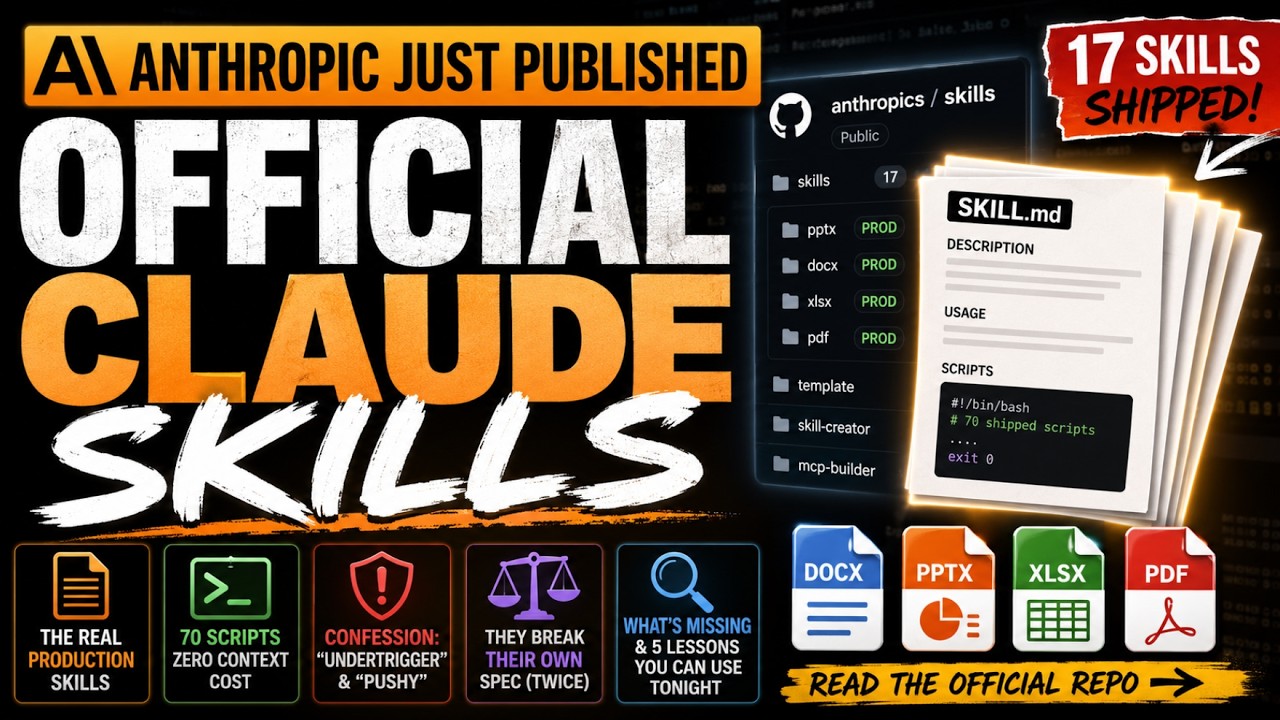
📦 What Actually Shipped — 17 Skills, Two Families
For a month, every big name published skill repositories — except the company that invented the format. This week Anthropic finally shipped. The repository contains 18 skill files: 17 real skills plus a template so small it can be read in full. They split into two families. 2:21
Family One — The Production Document Skills (4)
Word documents, PDFs, slide decks, spreadsheets. The README states something Signal Coders has "never seen a lab do": "These are the skills that power Claude's document capabilities under the hood," shared "as a reference for more complex skills that are actively used in a production AI application." 2:33
Family Two — The 13 Example Skills (Builders)
A skill for creating skills, one for building tool servers, web artifacts, testing web apps, creative systems, canvas design, algorithmic art themes — even an animated emoji maker. Plus internal communications, brand guidelines, and document co-authoring. 3:11
🔓 The Licence Twist — Who Pays
The two families ship under different licences. The 13 examples are Apache 2.0 — genuinely open. But the four production document skills carry a different front matter: "License: proprietary.txt — has complete terms." The README states it plainly: "Source available, not open source." 3:32
🏗️ The Architecture — Three Layers, Published Numbers
The best file in the repo is the skill that teaches skill-making, because it writes down "the actual context arithmetic everyone else handwaves." The three-level loading system, verbatim: 4:02
| Level | Content | Cost |
|---|---|---|
| 1 — Metadata | Name + description, always in context | ~100 words — "the permanent tax" |
| 2 — Body | Loaded only when the skill triggers | Under 500 lines ideal |
| 3 — Bundled resources | Scripts, loaded as needed | Unlimited — "scripts can execute without loading" |
The whole spec distilled: the template is six lines — name, description ("describe the skill and when Claude should use it"), a heading that says "Insert instructions below." That's the winning format of the format wars. 5:24
🎯 The Description Doctrine
If the official set has one obsession, it's the description field. The skill-creator file calls it "the primary triggering mechanism": "Include both what the skill does and specific context for when to use it. All when-to-use info goes here, not in the body." 5:39
They practice what they preach. The slide-deck skill's actual description: "Use this skill anytime a PPTX file is involved in any way, as input, output, or both. Trigger whenever the user mentions deck, slides, presentation. If a PPTX file needs to be opened, created, or touched, use this skill." "That's not documentation prose. That's a tripwire, engineered." 6:35
😅 The Confession — "Undertrigger" and "Pushy"
The sentence Signal Coders flagged as "the single most useful sentence I've read about making skills actually fire," quoted verbatim from the official file: 5:58
"Anthropic, in an official repository, documenting a behavioral weakness of their own model and prescribing the fix. Not 'our model intelligently selects the right skill.' The honest version: it hesitates, so write descriptions that lean on it." The technique: don't write "how to build a dashboard" — write "use this whenever the user mentions dashboards, data visualization, metrics, or wants to display any kind of data, even if they don't explicitly ask for a dashboard." 6:10
⚙️ Code Over Tokens — The Move the Community Isn't Making
The deepest difference: 70 Python files in this repository. The community packs ship almost none. Open the slide-deck skill and it "barely explains anything — it's a routing table": write a script against the pre-installed library, run the converter, thumbnail.py, duplicating slides, cleaning orphaned media, validating against the format's schema with "an auto-repair flag for common breakage." 7:10
The instructions don't teach the model delicate XML surgery in prose — "they hand it instruments." A script is deterministic: "it cannot hallucinate a malformed relationship file. It does the same thing on run one and run one million, which is what you need when the output ships inside a product." 7:50
🤫 The Strangely Quiet Guardrails
The finding that genuinely surprised Signal Coders — a number. The community files "shout capital letters everywhere: NEVER do this, ALWAYS do that, WARNING stacked like sandbags." So he ran a count across all 17 official skills: 10:34
| Imperative | Count (across 17 skills) |
|---|---|
| "NEVER" (capitals) | 3 |
| "ALWAYS" | 5 |
| "DO NOT" | 1 |
| Total raised voices | 9 |
"17 skills — including the four that run in production — and the home team raises its voice nine times across the entire set. Some community files exceed that in their first screen." How? "Constraint doesn't live in volume here. It lives in structure." The workflow is a table with one recommended tool per task, so the wrong path isn't offered. Dangerous operations are wrapped in validators that name their own fixes. Exactness lives in scripts. 11:02
🔍 Two Honest Violations
Score the 17 against their own rules (descriptions carry triggers, bodies under 500 lines, structure over shouting) and 15 pass clean. Two don't — and both violations are more interesting than compliance. 11:44
Violation one: the API skill is 548 lines — the longest file, and the only one over the team's own 500-line ideal. "The spec's author exceeding the spec, lightly." 12:01
Violation two: the internal-communication skill — 32 lines, the shortest real skill — is written in the first person: "A set of resources to help me write all kinds of internal communications using the formats that my company likes to use." "Help me. My company." "That is not a document written for publication. That's somebody's actual working file from inside Anthropic — published with the fingerprints still on it." 12:18
🕳️ What's Missing — and What the Absence Reveals
Read the inventory and notice what is not there: no coding-style skills, no test-driven-development skill, no code-review skill, no debugging methodology, no personas, no "act as a senior architect," no domain packs for finance or marketing or law. "The official set is capabilities and builders." 13:10
The contrast with the month's other shelves is the finding: personal collections are essays, workflow philosophy, methodology, taste. The search giant ships job descriptions by the dozen. The home team ships short routers, 70 scripts, measured triggering, nine raised voices. 13:28
Which settles where the format war stands: "The moat they're choosing isn't secrecy. It's being visibly better at writing instructions than anyone else — in public, where it doubles as the reference implementation." 14:28
✅ Five Lessons — Portable to Any Agent
- Write the trigger, not the essay. All the "when to use" lives in the description, and the description leans — because the author of the model told you in writing that firing is the failure mode.
- Spend context late. 100 words always, 500 lines on trigger, unlimited tooling that never loads. Three levels, budget accordingly.
- If it must be exact, make it a script. Language for judgment, code for precision. A script can't hallucinate a malformed file.
- Document the foot guns, not the API. The model read the docs during training. It didn't read the postmortems. "The model knows the API — these are the foot guns."
- Whisper. Nine raised voices across 17 production-grade files. Structure beats capitals. "Capitals are what you reach for when you haven't built the guardrail."
🔗 Resources & Links
- 📺 Original video — Signal Coders' full audit
- 📂 Anthropic's official skills repository — 17 skills + 70 scripts