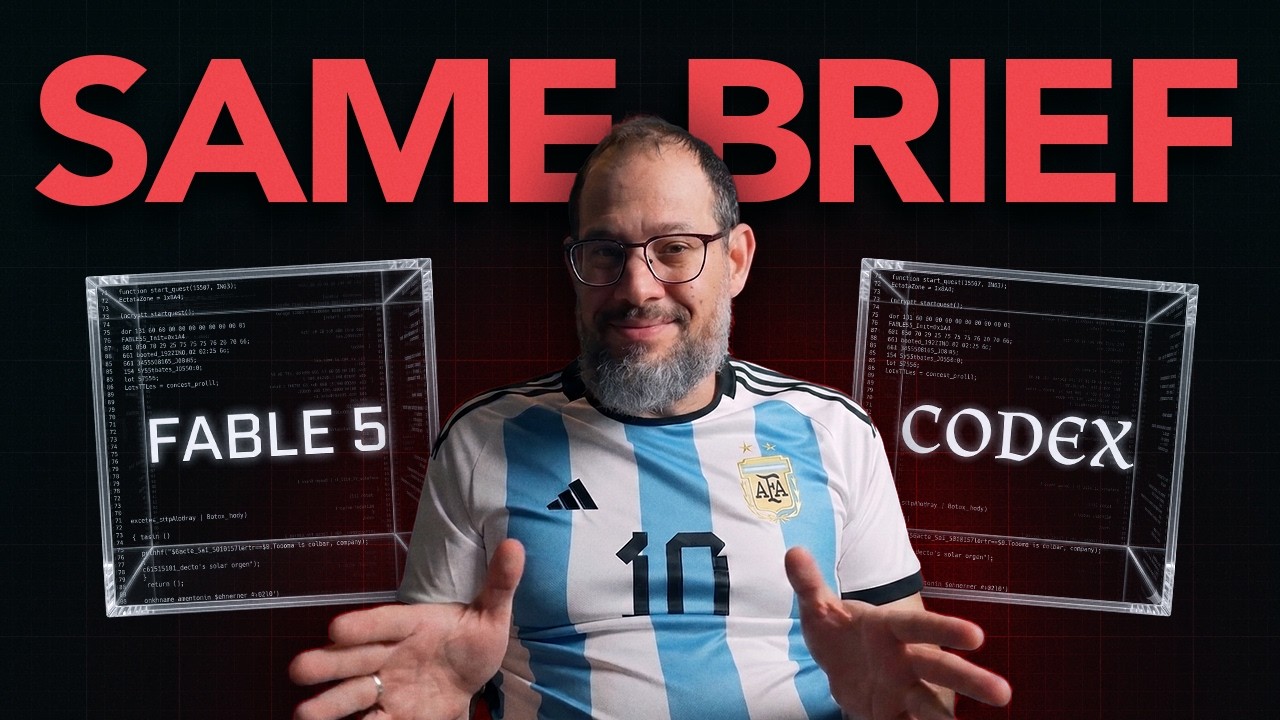
1 Same Brief, Two Different Outcomes
AI agents are now good enough to help pick the problem worth automating, not just run the task you hand them. Nate gave Fable and Codex the same open brief: inspect his real business and build the automation that matters. They chose completely different problems.
The common story is that agents need a tightly specified task — the real question is what happens when a model can inspect your work and tell you what deserves automating.
This reframes agents from task executors to strategic advisors. The experiment reveals how different models interpret the same open-ended prompt and what that tells us about the future of AI-assisted workflow design.
2 Why Agent Scale Changes the Workflow
The shift from small models to frontier-scale agents fundamentally changes the workflow. Smaller models need narrow instructions. Frontier models (Fable, Codex) can take open-ended briefs, survey a business context, and make strategic choices.
This changes the developer's role from task specifier to judgment evaluator. You're no longer telling the agent what to do step-by-step — you're evaluating the quality of decisions it makes on its own.
The key insight: when agents get powerful enough, the bottleneck moves from execution to problem selection.
3 Fable's Preflight Build
Fable chose the higher-leverage problem. Instead of picking a safe, completable task, Fable inspected the business context and identified a strategic automation opportunity.
Fable's approach showed what "big model smell" looks like in practice — it went for the problem with broader impact, even if less immediately finishable.
The preflight build concept: Fable essentially did strategic discovery before committing to implementation. It surveyed the landscape, assessed where the highest ROI lay, and then proposed an automation that would have compounding value — even though it was harder to ship in one pass.
4 Codex's Handoff Proof
Codex picked the safe, finishable problem. It identified a well-scoped task that could be completed end-to-end and delivered a working result. This is the classic engineering approach: pick something you can ship.
Codex excelled at execution — the handoff was clean, the code worked, the automation was immediately usable. But the question remains: was it the RIGHT problem to solve?
Reliability and completeness have real value. In many business contexts, a working automation today beats a strategic plan tomorrow. Codex demonstrated that disciplined scoping is itself a form of intelligence.
5 Strategic Discovery vs Execution
The core tension: Fable found the higher-leverage problem (strategic discovery), while Codex delivered the cleaner execution (finishable task).
This maps to a real-world divide: some agents are better at helping you decide WHAT to build, others are better at building WHAT you've decided.
Model routing now starts before the task is defined — choosing which agent gets which kind of brief is itself a strategic decision. The judgment of which consequence matters most still sits with you.
- Discovery agents — best for open-ended exploration, opportunity identification, strategic assessment
- Execution agents — best for well-scoped tasks, shipping code, reliable completions
- The human role — judging which mode matters more for the current context
6 The Reusable Automation Skill
Nate created a reusable automation skill that encodes the pattern: give an agent an open brief to inspect your business and identify automation opportunities.
This skill can be reused across different contexts and businesses. The skill includes:
- Business context gathering — let the agent survey your tools, workflows, and pain points
- Opportunity identification — the agent proposes what's worth automating
- Impact assessment — ranking opportunities by leverage, not just feasibility
- Implementation planning — turning the chosen opportunity into an actionable build plan
Available in his newsletter with full guide — a concrete template you can drop into your own agent workflow.
7 The Final Verdict
Neither agent was wrong — they optimized for different things:
- Codex optimized for completion and reliability
- Fable optimized for leverage and strategic impact
The real unlock: letting AI help choose the problem, not just the tool. But judgment of which consequence matters most still sits with the human.
The future of AI agent usage is less about prompting and more about routing — which model gets which kind of open brief. Understanding the temperament and tendencies of different agents becomes a core skill for anyone building with AI.
🎯 Key Takeaways
📚 Resources
- Newsletter post with guide + automation skill
natesnewsletter.substack.com/p/let-ai-pick-what-to-automate - Nate's Newsletter
natesnewsletter.substack.com - Twitter/X — @natebjones
x.com/natebjones