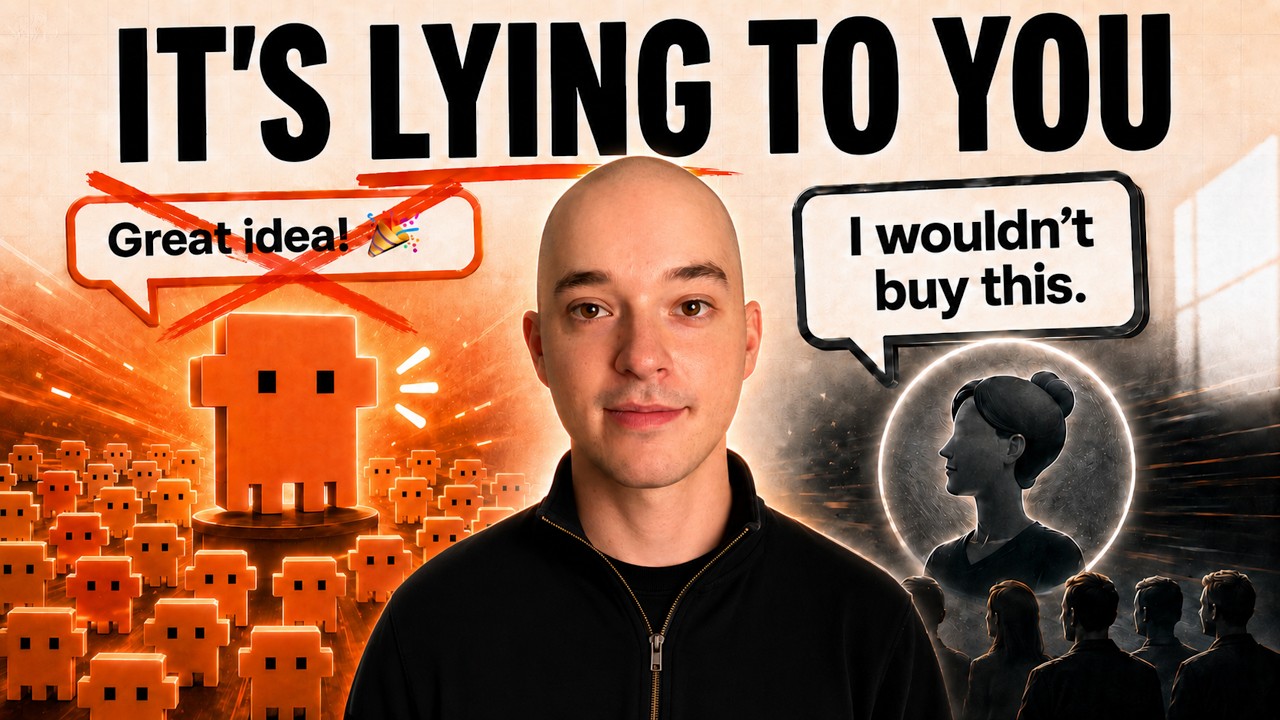
🤥 The Yes-Man Problem 0:00
AI is the world's biggest yes-man. No matter how good or bad your idea is, it will justify exactly what you want to hear. It validates, it encourages, it cheers — and that's a dangerous default when you're making real business decisions.
Brad built a skill that solves this by making Claude genuinely honest. The approach: clone your real customers into AI agents and let them react to your ideas the way actual people would — with indifference, skepticism, or enthusiasm depending on what you show them.
🎯 Running a Focus Group 0:57
Type /focus-group and paste anything you want tested: a landing page, an offer, an email, a price point. The skill spawns separate sub-agents for each seat on your custom focus panel.
- Each agent represents a composite avatar built from your real customer data
- Agents run simultaneously but isolated — Marcus has no idea what Dana said
- No groupthink, no anchoring bias — each reaction is genuinely independent
- Works with any content format: text, URLs, screenshots, pricing tables
🔄 Two-Round Reaction System 1:25 1:49
Round 1 — Quick gut check: Did this get their attention? The system mimics how real people engage with content:
- If they'd skim it and move on, you get a two-line brush-off like a real person would give
- Only strong reactions (positive or negative) get full explanations
- This filters out the polite noise that makes normal AI feedback useless
The Moderator: A separate moderator agent reads all reactions and finds the sharpest disagreements. Critically, it adds no opinions of its own — it's purely an observer identifying conflict.
Round 2 — Debate: Only the disagreeing agents are called back, and each sees the opposing argument. This tests whether they'd genuinely change their mind when confronted with a counter-position.
📊 Actionable Readout 2:09
After both rounds, you get a 30-second summary: what they said, what's missing. Every verdict is cited from real customer quotes — not AI opinions.
- Consensus view: Where the panel agrees (and where they don't)
- Cited verdicts: Every claim backed by actual words from your customer transcripts
- The killer section: "What would change the mind of each holdout?"
After the readout, you can grill any agent directly — ask follow-up questions, probe deeper into their objections, or test revised messaging on the spot.
🧬 How Avatars Are Built 2:33
On first run, the skill reads your entire sales call library. A fleet of sub-agents each processes a few transcripts, extracting:
- Exact words customers use to describe their problems
- Every objection raised during the call
- Price reactions — how they responded to pricing
- Buying decision stakeholders — who else is involved
- Word-for-word quote bank — verbatim language for each person
The system then groups real people by how they buy to create composite avatars. The critical rule:
🧠 Persistent Memory & Evolution 4:01
Each avatar gets a full dossier saved as markdown:
- Who they are and how they buy
- Complete objection map
- 30+ real quotes from actual customers
- Coverage map showing what data backs each trait
Memory is persistent across sessions. Agents remember past decisions and never contradict themselves. A position file gets updated after every session to track evolving stances.
🛠️ Three Use Cases 4:35
1. Testing Messaging & Positioning
- Landing pages, emails, hooks, pricing — iterate before anything goes live
- Get reactions from customer archetypes rather than guessing
2. Validating Concepts Before Building
- Ask the panel if the need is even real before you invest time
- Surface objections you haven't thought of from people who match your buyers
3. Post-Mortem on Failures
- Launch email got no replies? Run it through the panel
- Get failure causes with receipts: who scrolled past and why, which objection triggered, what would change their mind
⚡ Setup 5:38
2 minutes to install. Works on Claude Code, Codex, Cursor, and regular Claude.
Two commands: add the marketplace, then install the focus-group skill. Completely free.
First run asks where your sales data lives:
- Local transcript folder (recommended) — point it at your call recordings/transcripts
- MCP connection — Fireflies, Google Drive, or other integrations
The system reads your calls, finds avatars, asks you to confirm the panel — and then you have a standing focus group forever.
🎯 Key Takeaways
- AI is a yes-man by default — this skill forces honest customer reactions
/focus-groupspawns isolated sub-agents based on composites of your REAL customers- Two-round system: gut check → moderator finds disagreements → only dissenters debate
- Every verdict cited from actual customer quotes, not AI opinions
- The killer insight: "What would change the mind of each holdout?"
- Avatars built from sales call transcripts — needs at least 3 real people per seat
- Persistent memory: agents remember past decisions, never contradict themselves
- Panel evolves: new calls refresh dossiers, can propose new seats
- 3 use cases: test messaging, validate concepts, post-mortem failures
- Free skill, 2-minute install, works on Claude Code / Codex / Cursor