🧠 What This Model Actually Is
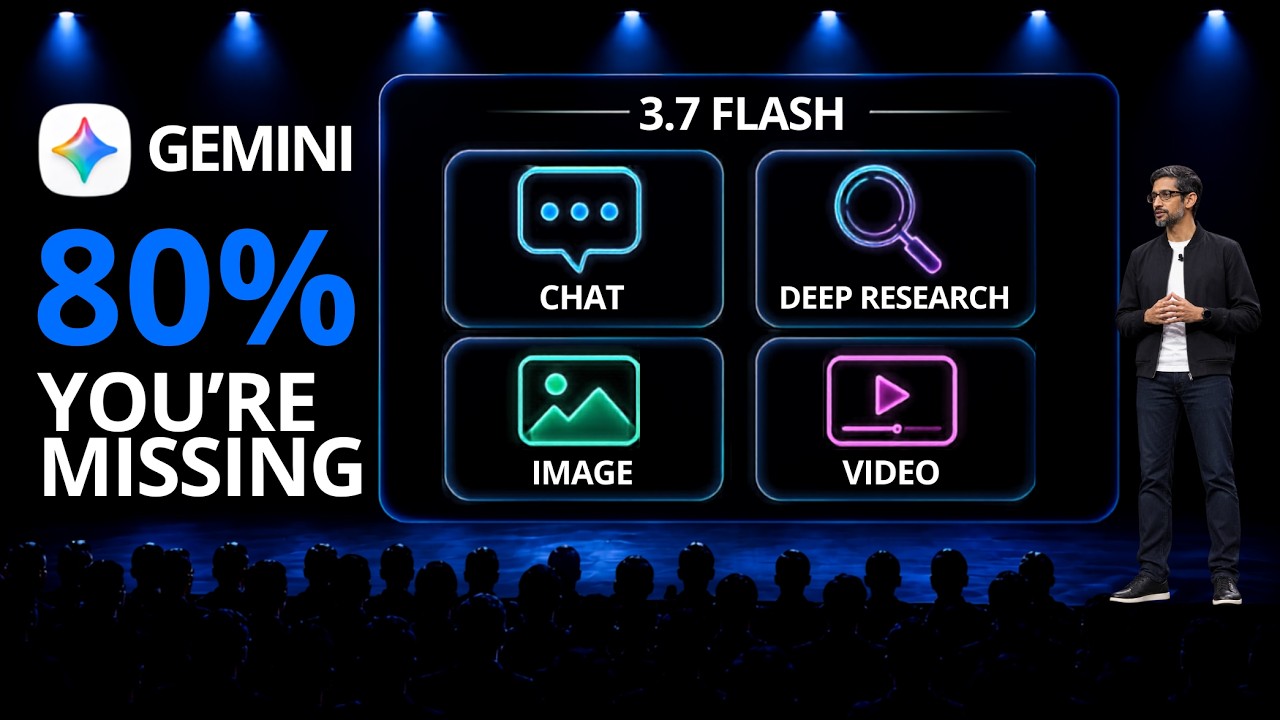
Gemini 3.7 Flash went live Aug 13, 2026 — Google calls it its "most intelligent workhorse model yet for coding and agents," built on 3.6 Flash with real reasoning upgrades. "Flash used to mean cheap and fast, nothing more — now Google is putting serious reasoning inside its speed tier." 1:13
| Spec | Value |
|---|
| Input context | ~1,048,576 tokens |
| Output | up to 65,536 tokens |
| Modalities | text, images, PDFs, video, audio |
| Thinking levels | low / medium / high (medium default) |
| Real tools | Google search grounding, URL context, code execution, computer use, function calling, structured outputs, file search |
| Does NOT do | image/audio generation, live API (those live in the Gemini app) |
Document handling is more than text extraction — "it processes page imagery too, which matters when charts or layout carry the actual information."
2:05
The real story: "the missing 80% isn't a hidden prompt — it's reasoning controls, a million tokens of context, live grounding, and real tools sitting untouched behind a normal-looking text box." Most people "open a chat and type like it's 2023."
2:56
🗑️ The Habit Wasting Half Your Prompts
Google's own Gemini 3 docs say the opposite of two years of prompt-engineering content: "overly elaborate, over-engineered prompting can make the model over-analyze and actually perform worse." Gemini 3 wants prompts that are direct and structured, not padded. 3:17
Dead weight to drop: "act as the world's greatest expert," the $200 tip, "take a deep breath," demanding chain-of-thought before answering — "none of it is technically wrong, it's just dead weight. Superlative flattery and fake incentives add tokens without adding information."
3:44
Even temperature tuning is outdated: "Google's 3.7 migration docs tell developers to remove temperature, top_p, and top_k entirely when moving to this model." These tricks are "noise the model has to read past to get to the part that actually tells it what to do."
4:24
🧩 The Framework (C.L.E.A.R.E.R.)
The author's structure: Concrete goal → Load context → Explicit boundaries → Anchors & examples → Response contract → Enable evidence & tools → Review & validate. "You don't need all seven letters every time — you add only what's missing." 4:35
Before: "Research the AI industry." (No decision, no definition, no audience, no timeframe, no evidence standard — "it can't fail, but it can't succeed either.")
4:56
After: "Explain the five most important AI industry changes in 2026 most likely to affect B2B SaaS companies through 2029. Focus only on foundation models, agents, developer tools, AI search, and enterprise adoption. Use search grounding, prioritize primary sources over marketing claims, and give me a ranked list with an evidence table under 1,500 words." — ~50 words longer, but "every added line removes an ambiguity the first version left wide open. No persona, no flattery, no fake incentive."
5:40
Same model, same question, different output: he tested "will AI-native search replace Google in 3-5 years?" — the weak prompt gave "a confident article-shaped opinion with no dates"; the structured one came back with "dated evidence for both sides, a table separating company claims from independent measurement, and an explicit confidence rating. The model didn't get smarter — it just stopped having to guess what you wanted."
6:52
💻 A Coding Partner, Not a Guesser
Coding is where Google says the biggest gains landed — "meaningfully higher scores on Frontier Code and Deep SWE, plus a jump in Web Dev Arena" (Google's own reported numbers, not independent proof). 7:14
Before: "Add pagination to the users endpoint." — invites the model to guess your database layer, invent a pagination style, and break a client's response shape.
7:40
After: "Add cursor-based pagination to API /users so it stops timing out on large accounts. Inspect the existing repo before assuming a pattern and preserve the current response shape so nothing else breaks. Add tests for empty result, partial page, and full page, then run the actual suite and
report the results." — inspect before assuming, protect what matters, prove it at the end.
8:02
"Report the results" is the single most useful line in the whole video: "Don't just say it passes. That one sentence is worth more than any persona — it turns 'trust me' into something you can verify before you merge."
8:50
🖼️ Screenshots Like an Engineer
"Describe this screenshot" gets you adjectives ("clean, modern, nicely spaced") that are worthless for rebuilding. Since Gemini 3 processes the image itself, treat it as a design reference, not a caption target. 9:20
The crucial phrase isn't "you're a senior designer" — it's the three labels: "Analyze the image itself, not just visible text. Identify layout, typography hierarchy, spacing, and component structure. Label every observation as
observed, inferred, or unknown, and don't invent anything that isn't visible." Forcing those tags stops it from confidently inventing hover states and off-screen behavior.
9:45
Per-image resolution: "Google lets you set resolution per image — give the busy screenshot with fine text the higher setting, and save tokens on anything decorative."
10:20
🎚️ Reasoning Is a Dial
For years, more reasoning meant typing "think step-by-step and show all reasoning." Gemini 3.7 Flash replaces that with three real settings — low, medium, high. Independent testing (Artificial Analysis): Intelligence Index climbs 51 → 53 → 56, while time-to-first-token climbs ~1s → ~6s → ~12s. 10:40
| Level | Intelligence Index | Wait | Use for |
|---|
| Low | 51 | ~1s | Action items from meeting notes |
| Medium | 53 | ~6s | PR review (default for complex work) |
| High | 56 | ~12s | Genuinely hard problems |
The skill isn't maxing the dial — "it's matching the weight you're willing to accept to how expensive being wrong is." A hard problem earns the 12 seconds: "We have an intermittent production race condition. Inspect code, logs, tests. Form competing hypotheses, use evidence to eliminate them, implement the smallest safe fix, add a regression test, and don't claim it's fixed until it passes."
11:20
🔍 Stop Asking "Are You Sure?"
The replacement for "check your answer" isn't a phrase — it's a checklist. "Check your answer" doesn't tell the model what to check (sources? math? dates?). The shift is from introspection to inspection. 12:10
The working version: "Audit the answer above using only observable checks. Classify every factual claim as supported, partially supported, unsupported, or at risk of being outdated. Verify the cited sources actually back each claim, recompute key numbers, and flag anything stronger than the evidence. Then give me a corrected answer with remaining uncertainty labeled."
12:25
Why it works: instead of asking "are you sure?" you ask "which claims lack evidence? Recompute this. Does the source actually say that?" — playing to grounding + code execution, turning "trust me" into something checkable.
13:00
🧓 Habits Worth Retiring
- ✅ XML tags vs Markdown headings — "pick either one; Google says both work as long as you're consistent. Stop treating one as secretly superior."
- ✅ Few-shot examples aren't dead — Google still recommends them for locking in pattern/tone/format. Just don't pile on so many the model copies surface style over intent.
- ✅ Stop mega-prompts — for multi-stage work (research → synthesis → draft), chain prompts: "the output of one stage becomes the input to the next. You catch a bad assumption while it's cheap to fix, instead of buried in a polished draft." 13:20
📋 The Template Worth Saving
The reusable version, stripped down: goal, context, boundaries, evidence/files, the specific task, output format, which tools to turn on, and one validation line when getting it wrong would cost you something. "Most prompts need two or three of these, not all six." 14:15
Honest caveats: the model card is upfront that it can still hallucinate and occasionally times out; "even a million-token context doesn't guarantee perfect recall when you're pulling multiple specific details out of one huge document." Pricing: introductory rate runs through end of 2026.
14:40
The verdict: "the gap was never a missing 20% — it was reasoning controls, a million tokens of context, live grounding, and real tools behind a normal-looking chat box. Not smarter typing — just fewer ambiguities left for the model to guess at."
15:05
✅ Key Takeaways
- The 80% isn't a secret prompt — it's reasoning controls, huge context, live grounding, and real tools sitting unused behind the text box.
- Retire persona/flattery/tipping/"think step-by-step" — Google's own docs say over-engineered prompts make Gemini 3 perform worse; drop temperature/top_p/top_k too.
- Use C.L.E.A.R.E.R.: concrete goal → context → boundaries → anchors → response contract → evidence/tools → review & validate. Add only what's missing.
- "Report the results" beats any persona — inspect first, protect what matters, prove it at the end.
- Label screenshots as observed / inferred / unknown to stop invented hover states and off-screen behavior.
- Reasoning is a dial — match the level to how expensive being wrong is (low for to-dos, high for race conditions).
- Replace "are you sure?" with an audit — classify claims as supported/unsupported, recompute numbers, verify sources.
📍 Timestamp Index
4:35 The C.L.E.A.R.E.R. framework
12:10 Stop "are you sure"