Overview
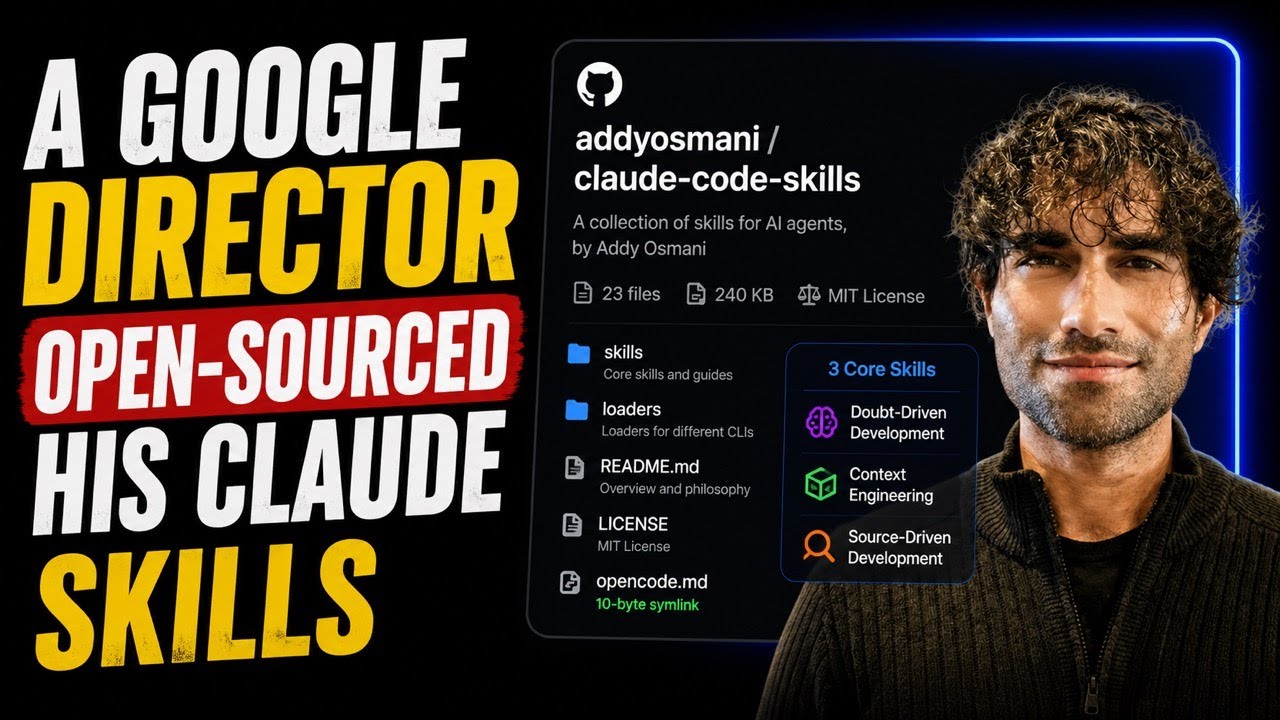
Addy Osmani — 14-year Chrome DevTools veteran and current Google Director — open-sourced his personal AI agent workflow as a GitHub repository of 23 markdown "skill" files. The repo hit 51,000 stars and became #1 on GitHub Trending. Bitwise AI opens the repo on camera, walks through the three standout skills (doubt-driven development, context engineering, and source-driven development), examines the cross-agent loader architecture, delivers an honest audit (zero benchmarks, mostly repackaged best practice, ~4 genuinely new ideas), and places the repo in a broader wave: senior engineering judgment is now shipping as markdown.
1 Who Is Addy Osmani
The video establishes Addy Osmani's credentials to explain why this repo carries weight:
- 14 years on Chrome's developer tools team — one of the longest-tenured contributors to the browser tools ecosystem
- Director at Google — not a staff engineer experimenting on the side, but a senior leader encoding how he actually works
- JavaScript Design Patterns — author of the canonical book that shaped how a generation of developers structured frontend code
- "Beyond Vibe Coding" — his latest O'Reilly book, literally named after the problem this repo tries to solve
The repo appeared in February 2026 and organically accumulated 27,000 stars before any press coverage. A Hacker News submission in April initially scored just 2 points. Then Addy published a companion blog post in May, hit the front page with 376 points, and the repo accelerated to ~800 stars/day.
2 Inside the Repo
Opening the repository reveals a deliberately framework-free architecture:
- 23 skills — 22 covering the full software lifecycle (define → plan → build → verify → review → ship) plus 1 meta-skill that routes between them
- ~250 KB total — a quarter of a megabyte of pure markdown, no dependencies, no runtime
- No framework — no npm packages, no Python libraries, no build step. Just
.mdfiles organized in folders
The narrator describes it as "Google's engineering handbook compressed into a quarter megabyte" — referencing specific Google-isms found throughout the files:
- Hyrum's Law — "With a sufficient number of users, every observable behavior of your system will be depended upon by somebody"
- The Beyoncé Rule — Google's internal saying: "If you liked it, you should have put a test on it"
- 100-line change sizing — Google's code review practice of keeping PRs small and focused
3 What's a Skill, Anyway
The video pauses to explain the underlying format, which is "the actual story" according to the narrator:
- A skill is a folder containing a
SKILL.mdfile — a structured markdown document with a name, description, and instructions - Origin — the format started at Anthropic for Claude Code but is now an open standard (agentskills.io)
- Cross-agent compatible — the same format loads in Claude Code, Codex, Cursor, Copilot, and Gemini CLI
The Context Window Optimization
A critical design detail: 23 skills don't flood the context window. The agent only reads the one-liner descriptions at startup. The full skill file is loaded on-demand only when a task actually matches the skill's trigger conditions. This lazy-loading pattern means you can have dozens of skills without paying a token cost until they're needed.
4 Doubt-Driven Development
The headliner skill — at 16 KB, the largest file in the repo. It implements a structured adversarial review process for AI agent decisions:
The Protocol
- Claim — the primary agent formulates its conclusion as a compact, testable claim
- Extract — the claim is extracted and isolated from its original reasoning
- Doubt — a second agent is spawned with a clean context to attack the claim
- Reconcile — conflicts between the original and the challenger are resolved
- Stop — maximum 3 rounds to prevent infinite loops
The Key Design Insight
The reviewer agent never sees the original conclusion. It only receives the extracted claim. This is deliberate — handing the reviewer the full reasoning would bias it toward agreement (anchoring bias). By withholding the original context, the doubt agent is forced to attack the claim on its own merits.
5 Context Engineering
The narrator argues this skill addresses the actual reason AI agents fail: wrong context, not low intelligence. The skill defines a 5-level hierarchy of what to load into the agent's context window, in priority order:
- Rules — project-level constraints and conventions (always loaded first)
- Files — relevant source files for the current task
- Specs — design documents, API specifications, requirement docs
- Relevant source — related code from other parts of the codebase
- Error output — stack traces, logs, test failures
- Conversation — prior chat context (lowest priority — most likely to be stale)
The Confusion Block
The standout rule: when sources conflict, the agent cannot silently pick one. Instead, it must stop and present a structured "confusion block" to the user:
- Option A: [source + interpretation]
- Option B: [source + interpretation]
- Option C: [source + interpretation]
- → Explicit ask for human decision
6 Source-Driven Development
The third standout skill enforces a strict evidence-based coding discipline:
The Workflow
- Detect the exact version from your dependency file (
package.json,requirements.txt, etc.) - Fetch the official documentation for that specific version
- Implement using only verified API surfaces
- Cite the URL in a code comment — creating an audit trail
The Banned Sources List
The skill explicitly bans certain "primary" sources that AI agents typically rely on:
- ❌ Stack Overflow — often outdated or version-mismatched answers
- ❌ Blog posts — may reference deprecated APIs or contain errors
- ❌ The model's own training data — the most insidious source, because the agent treats it as ground truth
The file's maxim: "Confidence is not evidence."
When the agent cannot verify a claim against official docs, instead of bluffing it must ship an explicit [UNVERIFIED] block — making the uncertainty visible to the developer rather than hidden behind confident-sounding prose.
7 One Repo, Three Agents
The narrator calls this "the part nobody covers" — the cross-agent loader architecture that makes one skill set run in three different AI coding agents:
Claude Code
- A tiny plugin manifest maps the skills folder
- 7 slash commands are registered (e.g.,
/doubt,/context) - One-command install from the Claude Code marketplace
Gemini CLI
- The same commands are mirrored as TOML configuration files
- Skills install natively — Gemini CLI supports the skill format directly
opencode
- The entire port is a symlink — 10 bytes pointing at the same skills folder
- A 7 KB
AGENTS.mdfile ties the three integrations together
The architecture follows a clean separation: skills are the how (instructions), personas are the who (role definitions), commands are the when (trigger conditions). Write your judgment once, run it in any agent.
8 The Honest Audit
The video delivers a balanced critique — unusual for a 51K-star repo coverage:
The Weaknesses
- Zero benchmarks — no with/without comparisons anywhere in the repo. No evidence that these skills actually improve agent output quality
- Plenty of renamed common sense — many of the 23 files are standard engineering practices "wearing a lanyard." Example: the Git workflow skill triggers on "any code change, always" — which is just "use version control"
- LLM compliance is not guaranteed — as Hacker News pointed out, "the model can drop any rule in your markdown whenever it likes." These are instructions, not constraints
The Verdict
The genuinely new ideas live in maybe 4 of the 23 files. The rest is a very good checklist with a famous name on it. The value proposition is not novelty — it's curation and packaging of proven practices into a machine-readable format.
9 The Lineage — Markdown as Engineering Judgment
The video zooms out to place Addy's repo in a broader 5-month wave — a new genre of "engineering wisdom as markdown":
- January 2026 — A fan repo distills Andrej Karpathy's Claude.md notes → 172,000 stars (Karpathy didn't even publish it himself)
- February 3, 2026 — Matt Pocock ships his skills folder → 124,000 stars
- February 15, 2026 — Addy Osmani publishes agent-skills → 51,000 stars (and climbing at 800/day)
The narrator's thesis: "Senior engineering judgment — the thing you used to absorb over years of code review — now ships as a markdown repo."
The progression tells its own story:
- Karpathy shipped notes (a single file)
- Pocock shipped a folder (organized skills)
- Osmani shipped a format (cross-agent architecture + open standard)
10 What to Steal
The closing recommendation: treat the repo as reference, not a dependency. Even Hacker News agrees on this. Rather than installing the full plugin:
The Top 3 Patterns to Steal
- Doubt-Driven Development — the adversarial two-agent review protocol. Spawn a second agent with clean context to attack your first agent's conclusions
- The Confusion Block — when sources conflict, force the agent to surface options instead of silently choosing. A simple structural pattern with outsized impact
- "Interview Me" — a skill that interrogates the user before coding, asking clarifying questions until it reaches 95% confidence on what you actually want. Prevents the "it built the wrong thing" failure mode
The narrator's advice: adapt these patterns to how you work, don't install them wholesale. The value is in the ideas, not in Addy's specific implementation of them.
The video closes with an open question: "Karpathy's notes became a file. Pocock shipped a folder. Addy shipped a format. Whose workflow goes viral next?"
🎯 Key Takeaways
🔑 Key Takeaways
- 51K stars, zero frameworks — the entire repo is 23 markdown files (~250 KB) with no code dependencies, proving that structured instructions alone carry immense value
- Doubt-driven development is the headliner — a 16 KB skill implementing adversarial two-agent review where the challenger never sees the original reasoning, preventing anchoring bias
- "Confidence is not evidence" — source-driven development bans Stack Overflow, blog posts, and the model's own training data as primary sources, requiring official documentation citations
- The confusion block pattern — when sources conflict, the agent must surface all options in a structured block instead of silently choosing. Simple, powerful, and applicable everywhere
- Context hierarchy > intelligence — the context engineering skill argues agents mostly fail from wrong context, not low capability, and defines a 6-level priority for what to load
- Write once, run in any agent — one skill set loads into Claude Code (plugin), Gemini CLI (TOML), and opencode (10-byte symlink) through a clean loader architecture
- Only ~4 of 23 skills are genuinely novel — the honest audit: most files are well-curated standard practice, not new ideas. Zero benchmarks, no with/without evidence
- Skills are the emerging standard — originated at Anthropic, now open (agentskills.io), supported by Claude Code, Codex, Cursor, Copilot, and Gemini CLI
- The lineage: notes → folder → format — Karpathy (172K ⭐), Pocock (124K ⭐), Osmani (51K ⭐) trace a 5-month evolution of engineering judgment shipping as markdown
- Reference, not dependency — the recommended approach is to steal the best patterns (doubt protocol, confusion block, interview-me) and adapt them to your own workflow
🔗 Resources & Links
- addyosmani/agent-skills — the repo: 23 AI agent skills covering the full software lifecycle (51K+ ⭐)
- Addy's "Agent Skills" blog post — companion article that hit the Hacker News front page (376 pts)
- agentskills.io — the open standard for the SKILL.md format, supported across Claude Code, Codex, Cursor, Copilot, and Gemini CLI
- doubt-driven-development SKILL.md — the 16 KB headliner skill implementing adversarial two-agent review
- source-driven-development SKILL.md — "confidence is not evidence" — bans training data as primary source
- context-engineering SKILL.md — 5-level context hierarchy + confusion block pattern
- Matt Pocock's skills — the 124K-star skills folder that preceded Addy's by 12 days
- Hacker News discussion — 376-point thread with the honest community critique
- Beyond Vibe Coding (O'Reilly) — Addy Osmani's latest book on structured AI-assisted development