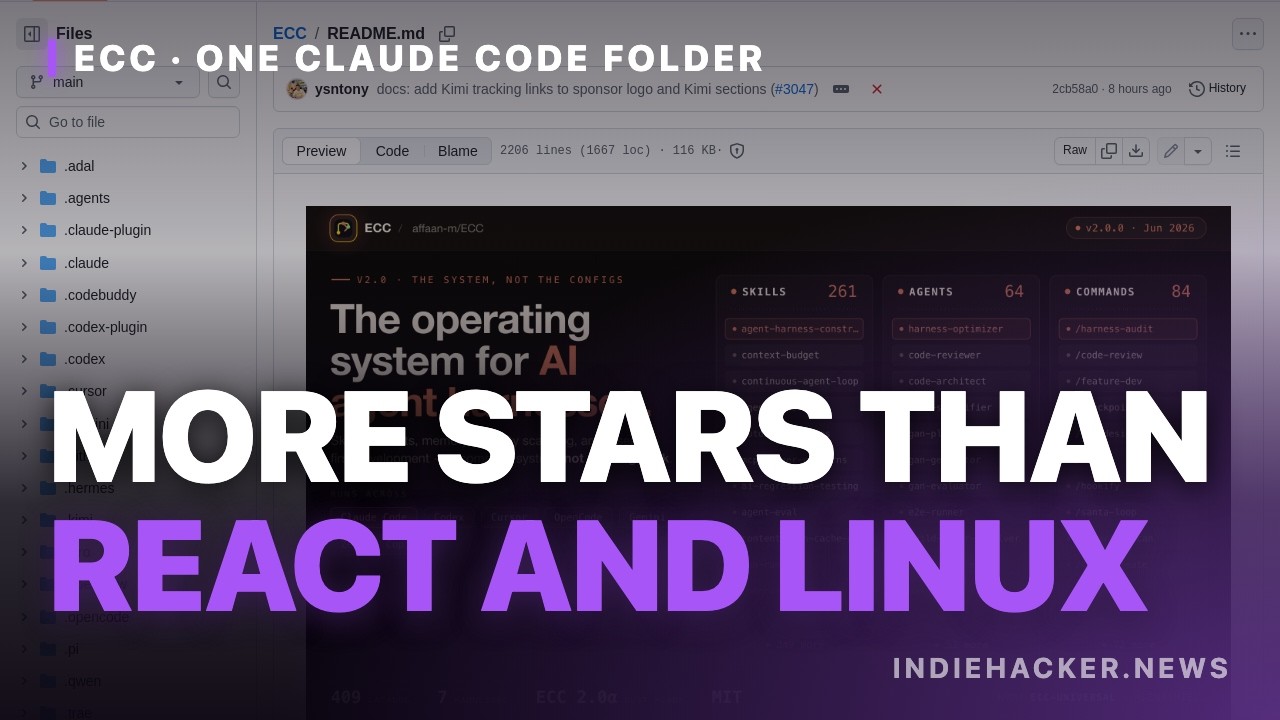
⭐ More Stars Than React
In January, a developer uploaded his Claude Code config folder to GitHub. It now has more stars than React. 0:00
ECC — "Everything Claude Code" — started as 9 agents, 9 slash commands, 8 rule files, 7 skills, pulled from 10 months of Afaan Mustafa's daily use. Pushed January 18th; 40,000 stars in 20 days. Now 255,000 stars, 38,000 forks, MIT-licensed — the 16th most-starred repo on all of GitHub, above the Linux kernel. And it grew to 68 agents, 286 skills, 94 commands.
🔗 github.com/affaan-m/ECC · ecc.tools · github.com/affaan-m/agentshield
📄 Their Own README
The pitch is 2,200 lines — and the first thing is a warning. 0:58
The first line tells you to install only from official sources — "the kind of line you write after somebody clones your repo and ships malware under your name."
The line the whole project runs on: "Optimize the context window. Persist everything else."
The honest table: a map of what's inside, "one row per concept spelling out what loads when" — and near the bottom, one table where "plenty of the cells just say not supported."
🏆 The Company It Keeps
The part that should tell you something about the moment we're in. 2:09
Three of the 20 most-starred repos anywhere are now folders of markdown that tell a coding agent how to behave: ECC, Matt Pocock's
skills ("skills straight from my agents directory"), and Superpowers (an agent-skills framework built the same way). The difference is scope — those two stay close to skills; ECC tries to be "the whole operating layer around them."📐 The Shape of It
235 days old, 2,670 commits deep. 2:47
The numbers: 570 separate instruction files an agent can load — and one person wrote 58% of the commits behind them.
🤖 What It Does to Your Agent
The core loop: plan, then test, then a chain of stages that keeps going long after the code works. 3:03
| Stage | What it enforces |
|---|---|
| Plan mode | Request → editable artifact; you approve before a line is written |
| TDD workflow | Gates you — capture a failing test as evidence before implementation can start |
| Review | Runs in a fresh context — "the context that wrote the code is the worst possible reviewer of it" |
| Distillation | Summarizes sessions into summaries + "instincts" (patterns with confidence scores) recalled when relevant |
| Skill clustering | When the same win keeps showing up, one command clusters those instincts into a new skill |
"The whole argument is that you shouldn't be retyping any of that into every prompt."
🛡️ AgentShield & Hooks
The second half — what most config packs skip entirely. 4:09
AgentShield scans your own agent setup — project instructions down to MCP servers — treated as an attack surface, not trusted config. One flag points three Opus agents at it: an attacker, a defender, and an auditor. The run exits with a build-breaking code the moment it finds something critical.
Hooks in profiles (minimal → strict): you decide how much of the runtime fires at all. The hooks file registers 24 commands across 7 lifecycle events, and two of those matchers fire on every single tool call. "On a normal install, there's code running before and after basically everything."
Install lands in your home directory, not the project — live in every session. Rules load into context on every run (which is why you're told to install only the language packs you use); skills sit on disk until something asks for them. In June they cut default MCP connectors from 6 down to 1 — "a skill wrapping a CLI tool does the same job for a fraction of the context."
⚙️ Installing It
One command — and it's loud about what it's about to do. 5:53
The guided setup walks you through scope and hook profile before writing a single file — and if the profile you picked would switch the hook runtime on, it stops and makes you say yes out loud.
The most-repeated warning in the README: don't stack two install paths into the same harness — you get duplicated skills and every hook firing twice.
v2.2.1 (Sep 8, two days prior) reads like a security patch: the command guard now recognizes destructive PowerShell, stops a later variable assignment from hiding an unresolved command, keeps exemption globs inside the project root, won't overwrite what it can't prove it owns, and uninstall finally respects the dry-run flag. 12 fixes, mostly "about not damaging something already on your machine."
⚖️ The Verdict
Two things to weigh before you run it. 7:09
1. 53 of 68 agents are handed bash. "A lot of shell for a folder you downloaded off the internet."
2. There's a file in the root called
soul the agent reads as its own identity — and the numbers in it stopped being true months ago. "Anything growing this fast outruns its own documentation, and you're the one who finds out where.""If that trade sits fine with you, nothing else out there is anywhere near this thorough. The builders who get value out of it are the ones who actually read what they switched on, then keep what fits and throw the rest away."
💡 Key Takeaways
- 255k stars, 16th most-starred repo on GitHub — a Claude Code config folder now outranks the Linux kernel.
- The thesis is "optimize the context window, persist everything else" — the whole operating layer around skills.
- Plan → test → review → distill → cluster — the core loop: approve before code, failing-test gate, fresh-context review, instinct distillation, skill clustering.
- AgentShield treats your own setup as an attack surface — attacker/defender/auditor Opus agents, build-breaking exit on critical findings.
- 24 hooks across 7 lifecycle events — code fires before and after basically everything; install in home dir, live in every session.
- Skills over MCP — they cut default MCP connectors 6 → 1, arguing a skill wrapping a CLI tool is cheaper context.
- The honest caveats — 53/68 agents get bash, and the
soulfile's numbers are stale. Read what you switch on.