1 The Phenomenon of Grill Me
Matt wrote 4 sentences that became the most influential he's ever written — the Grill Me skill. It interviews you relentlessly until reaching shared understanding, walking down each branch of the design tree, resolving dependencies between decisions one by one. He receives ~5 messages daily from people praising it.
"Absolute game-changer"
"Goated"
"Might save time — you just one-shot everything after gathering context."
2 Where Grill Me Falls Short
Despite the praise, Matt found recurring problems:
- The agent would be verbose about concepts that already had established terms
- He'd have to remind it "there's already a term for that"
- When they did land on good shared language, it wasn't documented anywhere
- He had to re-explain all non-obvious things about the codebase and domain before every productive session
- Domain jargon (e.g.,
"standalone video"= a video withlessonId === null) wasn't captured
Core frustration: communication was effective, but lacked persistent shared vocabulary.
3 Ubiquitous Language — The Missing Piece
Inspired by Domain-Driven Design (Eric Evans' "Big Blue Book"), Matt created a ubiquitous language skill. The concept: code, developers, and domain experts should all use a shared language documented in a single source of truth.
He started using it alongside Grill Me — calling the ubiquitous language skill mid-session to sharpen terms and create a context.md file. Then realized: why not combine both into one skill?
4 Grill with Docs — The New Skill
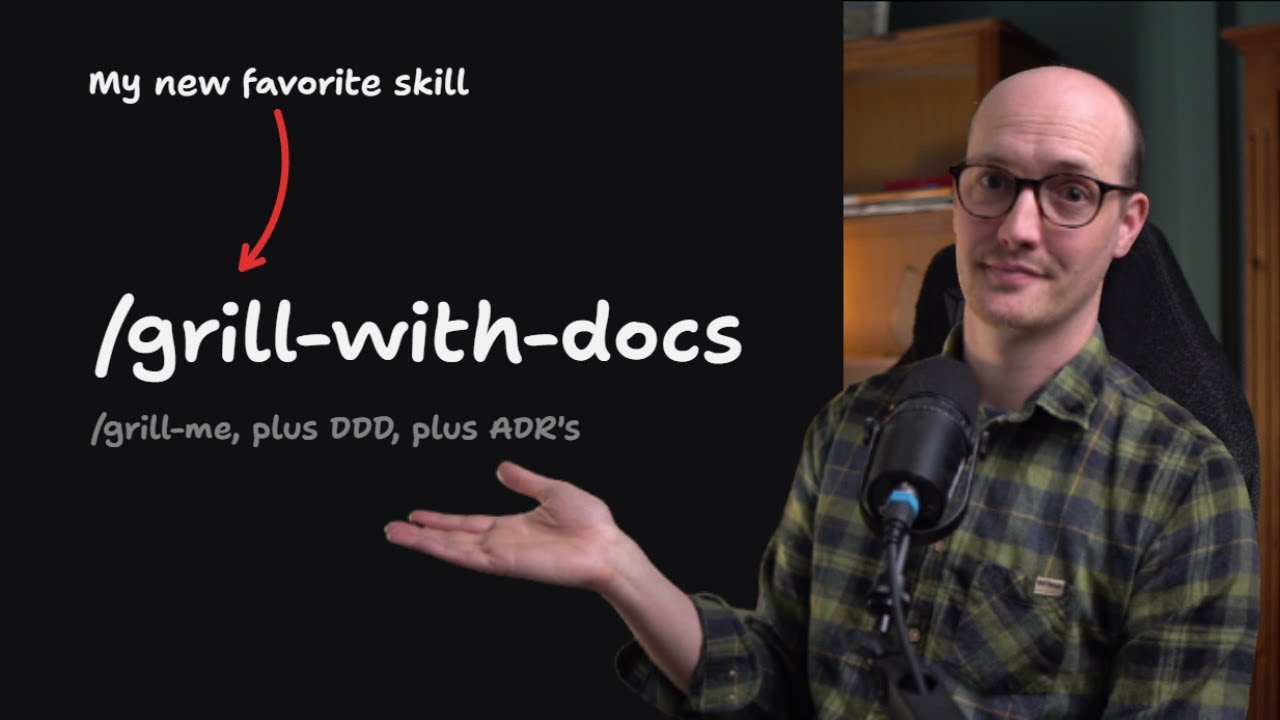
Grill with Docs = Grill Me + Ubiquitous Language + ADRs, combined into one skill.
Three Layers
- context.md ▶ 5:03 — Documents all shared language (glossary of domain terms). Uses DDD's concept of bounded contexts. One context.md per bounded context; scales to monorepos with a context map.
- Grill session enhancements ▶ 5:42 — Challenges language usage against the existing glossary, sharpens fuzzy language, discusses concrete scenarios, cross-references with code, and updates context.md as you go.
- Architectural Decision Records (ADRs) ▶ 7:27 — Simple markdown files documenting non-obvious decisions. Created only when a decision is: hard to reverse, surprising without context, and the result of a real trade-off.
User feedback ▶ 6:02: "magically aligned with your thoughts" after 4–5 sessions.
5 Live Demo — Grilling in Action
Matt demos adding a "pitch" entity to his app (courses/lessons/videos platform). The pitch concept: Mr. Beast-style packaging — create the video title/description/framing before the actual content.
What Happens During the Session
- Agent immediately reads
context.md, finds"standalone video"already defined - Surfaces a terminology tension: cardinality between pitch and standalone video (one-to-many) ▶ 9:12
- Detects a terminology collision: standalone videos can now be either pitched or unpitched
- Forces a design decision: keep "standalone video" as any lessonless video, or redefine
- Language decisions cascade into UI sections, code structure, deletion cascades, variable names ▶ 10:05
"This might seem like bike-shedding, but this language affects every variable name, every file name in the generated code."
6 The context.md Updates
After the grilling session, Claude updates context.md with new entries:
- Pitch — the entity itself
- Pitch status — idle / scheduled / shipped
- Pitched standalone video
- Unattached standalone video
The language becomes precise and persistent across all future sessions.
7 Benefits of Grill with Docs
Three concrete benefits:
- Concise replies — AI uses fewer tokens because shared vocabulary eliminates verbose re-descriptions
- Aligned thinking traces — AI's internal reasoning uses the same language, so fewer tokens spent thinking = more aligned with your intention
- Easier to navigate code — Code mirrors the documented language, making search and navigation natural
"These are the same benefits described in Domain-Driven Design. The same techniques that work with humans also work with AI."
8 When to Use Which Skill
- Grill with Docs — when you have a codebase (even a new one — especially at project start when establishing shared language)
- Grill Me — when you don't have a codebase (productivity, writing, planning). Moved to the "productivity" area.
Amazing non-coding use case: someone wrote a eulogy using Grill Me to surface stories about their mom.
🎯 Key Takeaways
- Grill Me's weakness: no persistent shared vocabulary between sessions
- Ubiquitous language (from DDD) solves this — code, developers, and domain experts use the same terms
- context.md is the single source of truth for domain vocabulary
- Language decisions cascade into everything: variable names, file names, UI, deletion rules
- ADRs capture non-obvious decisions that context.md can't
- The payoff compounds: 4–5 sessions in, Claude "magically aligns with your thoughts"
- Concise replies + aligned thinking + navigable code = the three concrete benefits
- DDD techniques work just as well with AI as with human teams
- Grill with Docs for codebases, Grill Me for everything else
- "Getting the language right is absolutely crucial for feeling aligned with the AI"