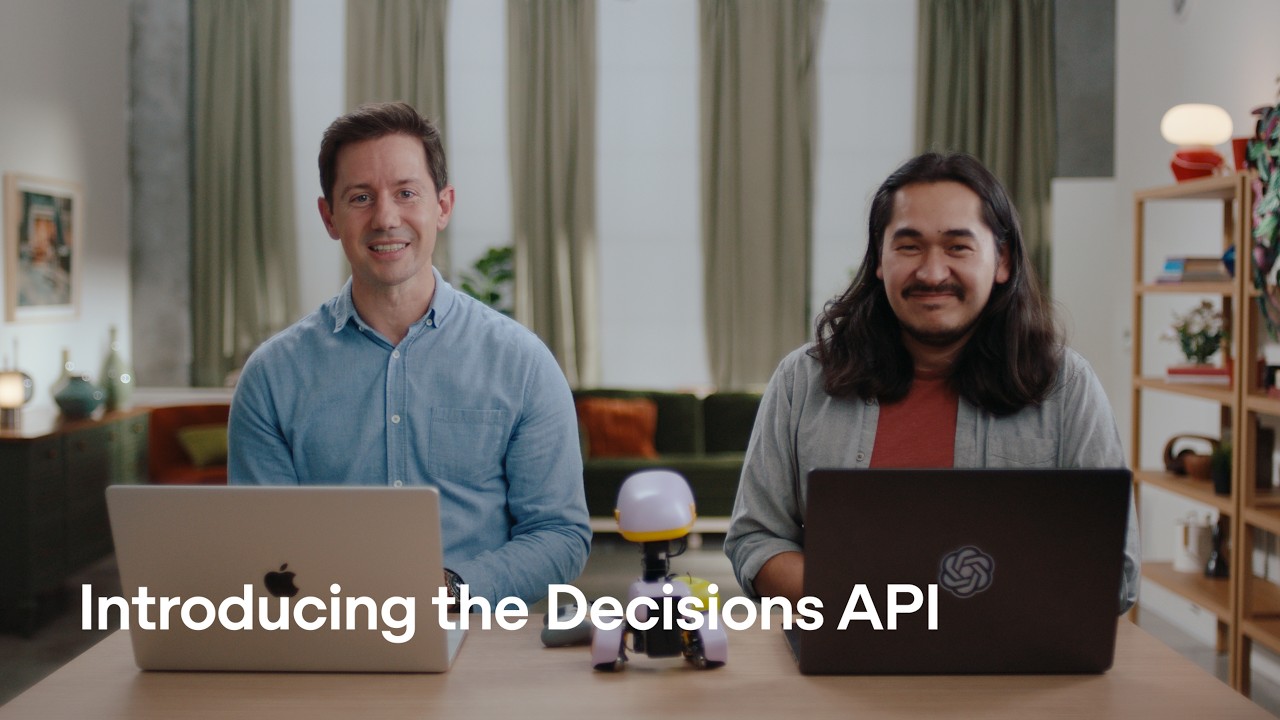
0:00OpenAI's official launch video for the Decisions API: a specialized endpoint for the moments your app needs "a smart decision really, really fast" — routing a request, classifying an image, or picking what an agent should do next. This is OpenAI entering the same "decision model" category that TypeSafe's Jev helped popularize (covered in the previous deep dive), and it's worth reading the two together: one is an independent lab's System One model, the other is the biggest frontier lab bolting a fast-decision path onto GPT-6.
What the Decisions API is
0:09The Decisions API runs on GPT-6 Luna, a model in the GPT-6 family tuned for fast, finite decisions rather than open-ended generation. It responds "in a fraction of a second" — under 100ms on the server side — so interacting with it feels effectively instant. The pitch is about trade-off done deliberately: 0:27by constraining the model to "just a few choices," OpenAI makes it nearly 10× faster than a reasoning model while keeping image understanding, broad language support, and safety protections.
How it works
0:17The interface is deliberately simple: give it text or an image, define the question and the possible answers, and use the returned choice in your app. It's a classification/decision primitive rather than a chatbot — the same "state in, typed decision out" shape as other decision models, except here the output space is your own enumerated options. OpenAI names classification, routing, and choosing an agent's next step as the target applications.
Text: routing & classification
0:39The first demo is the bread-and-butter case: taking unstructured text — "loose user input" — and turning it into structured action. Extract form fields from a long paragraph, or 1:02route support tickets and inbound sales requests to the right teams. The on-screen demo shows several free-form messages being classified into sales leads in real time, and 1:09the host flags the key line — "this is not sped up": the API responded in under 100 milliseconds server-side.
Vision: games & computer use
1:19The vision demo is more striking: a simple driving game where the Decisions API analyzes frames of the road and obstacles and chooses "stay in lane, go left, or go right" — and still steers correctly when the game speed is turned up, "at the fraction of the time a reasoning model would take." 1:52The stated ambition is pairing it with computer use: take screenshots and quickly send actions back. 2:04OpenAI is explicit that sophisticated browser/computer-use scenarios still want Astra — the frontier reasoning model — so this is the fast/simple layer, not a replacement for the heavy one.
Voice & robotics
2:09Two more modalities round it out. Paired with GPT-Live-1 (OpenAI's speech-to-speech model), the Decisions API picks which expression an animated character should show as it talks, making live voice interactions feel more responsive. 3:07Then the robotics demo: Hugging Face's open-source Microduck biped robot (named "Lavender") uses GPT-Live for voice and the Decisions API to choose where to look based on its camera — every few frames are analyzed to steer its head. The host pushes it with ambiguous requests: "follow the fruit" and "what's more fun to play with?" (it correctly picks the gamepad over the apple), showing the model handling underspecified inputs with reasonable choices.
Why it matters
5:13The through-line of the video is speed as a product decision: a sub-100ms decision primitive lets AI sit in loops that reasoning models are too slow for — real-time game control, live voice companions, robot gaze, inline routing. The category is consolidating fast: TypeSafe's Jev came first on OpenRouter, and now OpenAI is shipping its own answer. Expect decision models to become a standard, cheap layer that shrinks how often you need a full reasoning call.
Claims checked
The Decisions API is real. Public beta announced Oct 6, 2026, via POST /v1/decisions; gpt-6-luna is the only model available. See OpenAI's Decisions guide.
Microduck is real. An open-source ~25cm biped duck robot from Hugging Face and Pollen Robotics, launched Aug 27, 2026 at $399. The "nearly 10× faster" claim is corroborated by third-party reporting as "up to 10× faster than GPT-6 Luna via the Responses API."
This is OpenAI's own launch video — the demos and speed/latency figures are OpenAI's, though the API's existence and model name are independently confirmed. "Astra" and "GPT-Live-1" are OpenAI model names as referenced in the video.