0:00Everyone's obsessed with LLMs, "but if you look at what real businesses actually run on, it's not text — it's traditional tables." Transactions, churn, sensor logs, fraud claims, inventory. And when you need to predict something from a table, you still reach for classical ML — with a workflow the host has lived for years: clean the data, hand-engineer features, train a gradient-boosted tree, tune hyperparameters, and repeat the whole grind for every new dataset.
The GPT-3 moment for tables
1:33Text had this same pain until GPT-3: instead of training a separate model for sentiment, spam, and translation, you showed a foundation model a few examples in the prompt and it "magically figured out everything." Tables never had that moment — "until now." 1:50Google Research dropped TabFM, a foundation model built purely for tabular data, and the "crazy part": you don't train it on your dataset. You pass the rows with known labels, tag the unlabeled rows you want predicted, and it infers the answers in a single pass — "your dataset is literally the prompt now."
What TabFM is
2:26How Google built it: the model was trained entirely on an "endless stream of synthetic data" — synthetic tables, each generated by sampling a random causal DAG, generating rows from it, and forcing the model to predict held-out cells. Because it never memorizes a specific dataset, it learns "the meta algorithm on how to learn from tables" — in-context learning for tabular prediction, the same trick that made GPT-3 generalize. 3:04A heads-up the host is explicit about: the weights are currently non-commercial research-only, so treat this as an architectural blueprint rather than drop-in production code.
The semantic gap
5:02The catch. Because TabFM is trained purely on synthetic causal graphs, it has never seen a column header or label during training — it treats everything as a number. It can't tell that one column is monthly spend and another is temperature, can't know that 1/2/3 are event labels or that a special tag means "missing." Your tables carry semantic meaning that the raw model is blind to.
TabFM-Auto
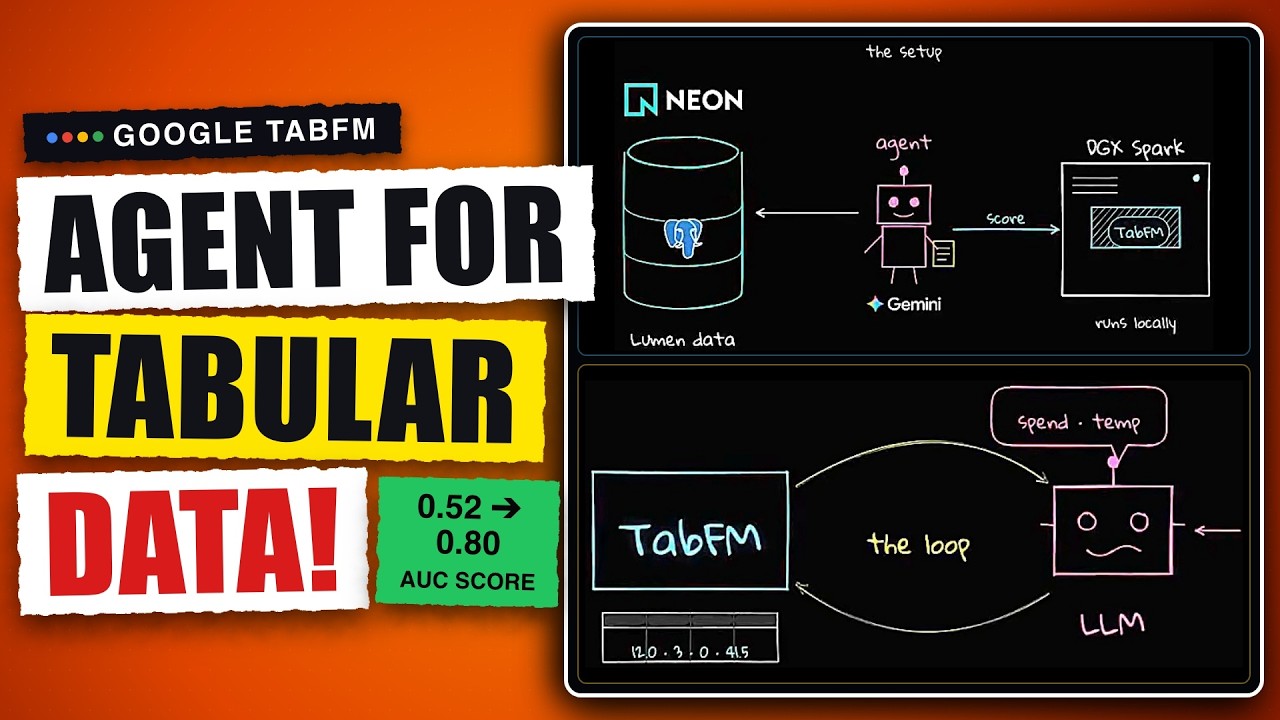
5:50This is where an LLM re-enters — "understanding semantic context is what large language models do best." The researchers paired TabFM with an LLM in an architecture called TabFM-Auto: TabFM stays frozen as the inference engine, while a language-model agent runs the whole pipeline. 6:03The agent inspects column names, writes transformation logic, selects context rows, and calibrates predictions — and the paper reports it can hit top rank on the TabArena benchmark. Since TabFM-Auto's code isn't public, the host used Opus 5.5 to build his own implementation with Gemini as the orchestrator.
The agentic architecture
6:59Three things matter when you let an agent do data science against a live backend (his data lives in Postgres on Neon, TabFM runs locally on a DGX Spark, and the agent executes against the database):
- Semantic grounding. Store data dictionaries directly as Postgres column comments, so the agent uses schema + inline comments to decide what code to write.
- 7:15A sandbox. You can't let an autonomous LLM mutate production. Every experiment spins up an isolated Neon branch — a copy-on-write clone ready in ~1 second — where it builds feature tables, tests joins, and drops columns; delete the branch on failure and production stays untouched.
- 7:50Protection against data leakage. His dataset had a "retention" column populated only after a customer cancels — a silver-bullet feature to any agent looking at today's snapshot, but it encodes the past outcome. In half his test runs the agent spotted the correlation and "completely ignored the temporal risk and baked it into the pipeline." The fix: train against an isolated branch restored to the exact timestamp before the prediction window.
The churn demo
4:00The concrete example: synthetic SaaS data (customer profiles, product usage, invoices, support tickets) with the goal of predicting churn. He pulls the raw customer table from Neon, feeds label history into TabFM, and scores the rest — "no training involved at all." 4:50With zero feature engineering on a single table, TabFM already beat a tuned tree-based model he'd trained (an AUC of 0.60 — not great, but notable for zero work, and it's exactly where the semantic-gap problem shows). 9:28The leakage lesson landed empirically: the model that "looked perfect" in testing was the worst in production because it used the leaky column, while the leak-free model did great. In production the pipeline runs nightly as a Neon function — build features, queue a job the DGX Spark picks up, write a churn score back per customer, drop the at-risk list in object storage. Moving the clock forward a month and checking against reality, most of the customers at the top of the list had in fact asked to cancel.
Takeaways
9:50Three: (1) for tabular prediction, the model doesn't have to be trained on your data anymore — "your data can just be the prompt"; (2) the LLM is still extremely useful, but as the part that reads column names and brings domain knowledge, not as the predictor; (3) if you let an agent do data science, give it a real backend — its own branch per experiment, the meaning of every column next to the data, and a way to see the data exactly as it looked when the prediction would have been made.
Claims checked
TabFM is real. google-research/tabfm — 2,738★, Python. "A 400M-parameter tabular foundation model… zero-shot classification and regression via in-context learning." Paper: arXiv 2609.37959, with a Google Research blog post to match.
TabFM-Auto is real (the video renders it "TabFusion Auto"). arXiv 2609.37989 — "pairs a tabular foundation model, TabFM, with a language model agent that evolves the data pipeline around it."
TabArena is real. autogluon/tabarena — 343★, Apache-2.0. "A living benchmarking system for tabular ML."
The repo is Apache-2.0, but the video's warning is about the weights ("non-commercial research only"). Code and weights carry different licenses — don't assume production rights from the Apache-2.0 code license.
Neon (serverless Postgres with instant branching) is the mid-roll sponsor and the backend for the demo. Flagged; link omitted from Sources.
Auto-caption garbles normalized: "Tab FM"→TabFM, "TabFusion/TabFusion Auto"→TabFM / TabFM-Auto, "Tab Arena"→TabArena, "causal tag"→causal DAG.