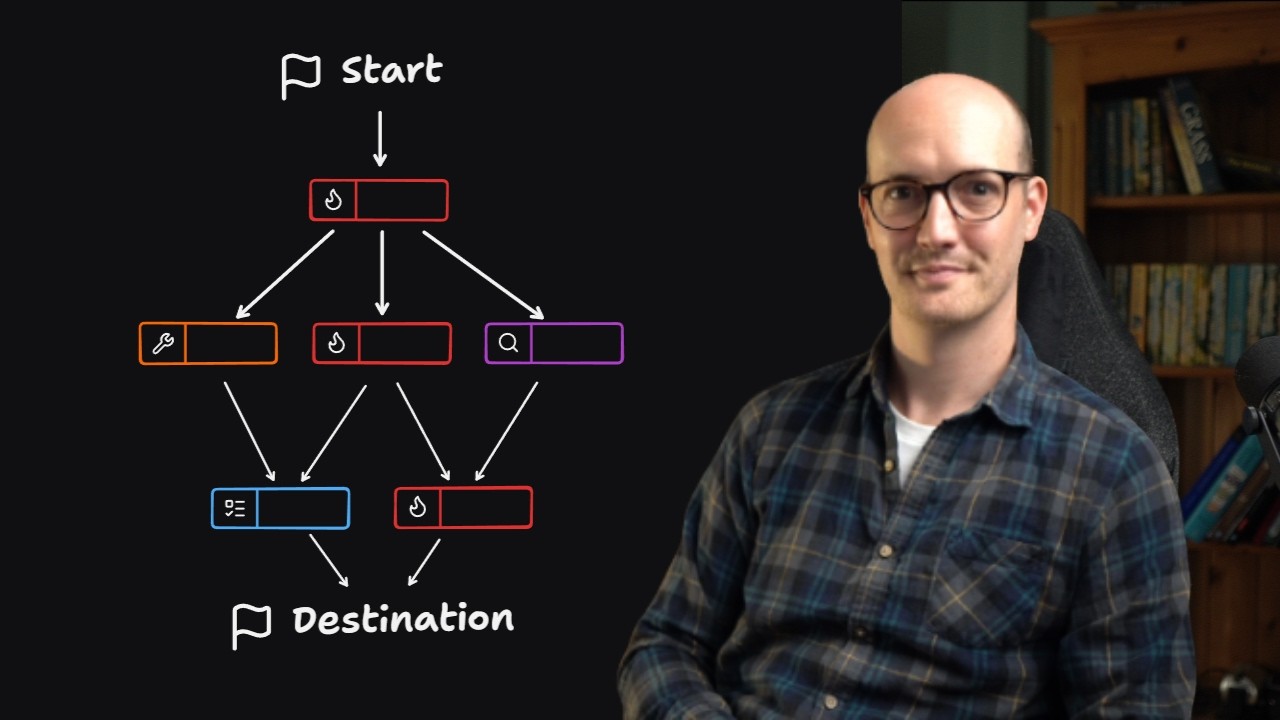
🎯 The constraint being removed 0:00
The opening diagnosis is the most valuable sentence in the video, and it is aimed at the author's own previous tools:
That second clause is the real problem. Not that the plan gets lost — that the ambition gets trimmed to whatever survives one conversation. Anyone who has silently narrowed a piece of work because it would not fit in one agent session has hit this without naming it.
🗺️ The map, and why the tracker 2:10
The structural move: the plan stops being conversation state and becomes an artifact in your issue tracker. A parent issue is the map; child issues are the decision tickets.
He shows a real one — a map with 12 sub-issues, decisions resolved inside their tickets, with a one-line summary written back up to the parent.
🎟️ Decision tickets 13:15
The distinction that resolves most of the confusion people bring to this:
| Ticket kind | What it contains | When it exists |
|---|---|---|
| Decision ticket (Wayfinder) | A question whose resolution is a decision | During planning, on the map |
| Implementation ticket (normal) | A slice of the build to execute | After the spec, downstream |
Each ticket is sized deliberately: the skill specifies a body "sized to one 100K token agent session". Tickets are claimed by assignment before any work begins, so concurrent sessions skip them — that is what makes parallel work safe rather than just possible.
🌫️ Fog of war as a design rule 3:36
The central metaphor, and it earns its place rather than decorating the idea. The map is deliberately incomplete. Tickets you can state now form the frontier; everything else sits in fog until a resolution clears it.
There is also an Out of scope section, distinguished carefully: fog gathers only toward the destination, so work beyond it is not fog and never graduates.
🧩 Four ticket types 7:41
Each ticket carries a wayfinder:<type> label, and the type determines how the session runs.
| Type | Purpose | Use when |
|---|---|---|
| Research | Surface a fact a decision waits on; runs in a subagent and reports back | Knowledge outside the working directory is needed |
| Prototype | Build something cheap and concrete to react to | "How should it look / behave" is the question |
| Grilling | One-question-at-a-time discussion | The default case |
| Task | Real-world work that unblocks a decision | Nothing to decide until something is provisioned or done |
His own example of that generality: he used Wayfinder to plan a garden office — site survey, contractors, research. The skill backs this up, calling the map "domain-agnostic — engineering work, course content, whatever fits the shape."
👥 The split the video omits 7:44
Reading the skill source alongside the video surfaces a distinction that matters more than the four types, and it never gets stated on camera.
And the skill names the failure mode explicitly: "the agent never stands in for the human's side of it (a grilling agent that answers its own questions has broken this)."
disable-model-invocation: true, and its agent config sets allow_implicit_invocation: false. Wayfinder cannot start itself — a human has to invoke it deliberately. Sensible for something that creates issues in your tracker.🏗️ Why it isn't waterfall 8:22
He raises the strongest objection himself rather than waiting for the comments — that this looks like a lot of up-front planning.
🔗 Primary sources over summaries 10:53
The most underrated benefit in the video, and he frames it as a fix for a weakness in his own earlier approach.
Specs generated from a map link back to the decision tickets that produced them. So when the agent — or a person — is confused about why something is specified a certain way, they can open the original discussion.
A telling detail he laughs past: the first spec generated from one map exceeded GitHub's character limit. That is a real operational constraint, not a joke — dense maps produce documents big enough to break their own container.
🗑️ Disposable specs 13:27
His most contrarian position, and he flags that it will annoy people:
His reframing: a spec is not documentation, it is a destination document for multi-session work — scaffolding that exists so a long effort knows where it was heading.
🧭 When not to use it 11:38
The FAQ opens with the objection that it is too much process, and the answer is refreshingly unambitious:
He is also clear that Wayfinder replaces one step rather than adding a layer: it slots exactly where grill-with-docs sat in his pipeline — map → spec → tickets → implement → code review.
🔍 Claims checked
| Claim | Result |
|---|---|
| Wayfinder exists in the public skills repo | skills/engineering/wayfinder/SKILL.md — read directly |
| Repo is public and permissively licensed | MIT, 195,978 stars, 16,887 forks, created Feb 2026 |
| Actively maintained | Last push 29 July 2026 — one day before the video |
| Grilling and prototype skills are real dependencies | Both present as separate skills, plus changesets referencing Wayfinder |
| Four ticket types: research, prototype, grilling, task | Exactly as described, with wayfinder:<type> labels |
| Research runs in a subagent | "Resolved by a /research subagent" |
| Issue-tracker agnostic | Tracker-specific operations are externalised; local-markdown is the default fallback |
| Works for non-coding work | Skill states "domain-agnostic… course content, whatever fits the shape" |
| HITL / AFK distinction | Never mentioned in the video — and it is the constraint that keeps the map honest |
| Skill cannot self-invoke | Not mentioned — disable-model-invocation: true, implicit invocation disabled |
| Tickets sized to one session | Skill specifies "one 100K token agent session" |
| Claiming prevents collisions | Assignment happens before any work; unassigned open ticket = unclaimed |
| "Works with any coding agent" | Plausible — skill is markdown with an OpenAI-format config; no compatibility matrix published |
| Community adoption (testimonials shown) | Screenshots shown on screen; individually unverifiable, though repo metrics support broad usage |
Repository metadata, SKILL.md and agent config retrieved and verified 30 July 2026.
💡 Key takeaways
- The real cost of session-bound planning is trimmed ambition, not lost notes. You quietly shrink work to fit what one agent conversation can hold.
- Move the plan into the issue tracker. Persistence, permissions, history, notifications and cross-linking already exist and are already trusted — no new system to run.
- The map is an index, not a store. A decision lives in exactly one place — its ticket. The map only gists and links, which is what stops it becoming another context-window problem.
- Decision tickets ≠ implementation tickets. One resolves a question; the other executes a slice. Conflating them is the most common misreading.
- "The pull to just do the work is the signal you've reached the edge of the map." A useful heuristic regardless of tooling.
- The fog test: can you state the question precisely now? Not whether you can answer it. Sharp question → ticket, even if blocked. Vague area → a note, not a pre-sliced ticket.
- Blocking should use the tracker's native dependencies so the frontier renders visually in the tracker UI — a human sees what is takeable without opening the map.
- Claim before you work. Assignment marks a ticket taken so concurrent sessions skip it, which is what makes parallel planning safe rather than merely possible.
- Prototype tickets are what stop this being waterfall. Waterfall failed by planning entirely on paper; prototypes inject reality checks during planning.
- Task tickets earn their place by unblocking a decision, not by delivering the destination — which is what lets the method cover non-software work like site surveys and contractors.
- Every ticket is HITL or AFK — and the video never says so. The skill forbids the agent standing in for the human's side: "a grilling agent that answers its own questions has broken this."
- A self-answered map is worse than no map: plausible, traceable, and encoding nobody's judgement.
- Wayfinder cannot invoke itself.
disable-model-invocation: trueand implicit invocation disabled — sensible for anything that writes to your tracker. - Specs that link back to decision tickets let you re-examine reasoning, not just obey conclusions. A summary loses the reasoning; reasoning is exactly what you need when circumstances change.
- Disposable specs work only because the tickets persist. Adopt the deletion half without the substrate and you destroy the record.
- The trigger is uncertainty, not size. Known path, however large → single session. Foggy path, however small → map it.
🔗 Resources & links
- /wayfinder: Nothing is too big to plan anymoreSource video — Matt Pocock, 15:09
- mattpocock/skillsThe skills repo — MIT licensed, 195,978 stars
- wayfinder/SKILL.mdThe primary source — stricter and more informative than the video
- Wayfinder documentationLonger-form docs in the same repo
- prototype skillThe dependency that keeps Wayfinder from becoming waterfall
- grilling skillThe default HITL ticket type