★ Overview
Oh My Pi by can1357 is a Pi extension that rethinks what a terminal-based AI coding agent should be. Instead of fragile shell wrappers and line-number diffs, it moves critical developer tools into the agent's core process — content-hash anchored patching, Tree-sitter AST rewrites, Rust native utilities linked directly into a Bun workspace, LSP diagnostics, subagent orchestration in cloned worktrees, and an RPC mode for headless CI/CD pipelines. This 5-minute technical breakdown covers every architectural layer.
1 Terminal Agent Architecture & UI Stability
Most terminal-based AI coding agents operate as thin API wrappers, relying on the host OS to execute fragile shell commands. Oh My Pi takes a fundamentally different approach:
- Fixed editor cluster — permanently pinned to the bottom of the screen. The active input area remains static while chat history and system feed scroll above.
- Differential rendering engine — during high-speed LLM streaming, calculates the exact lines that have changed, moves the hardware cursor to those specific coordinates, and clears only the necessary terminal space. Prevents visual tearing.
- In-process deterministic execution — moves away from unpredictable shell scripting entirely. Tools run inside the same process rather than spawning external commands.
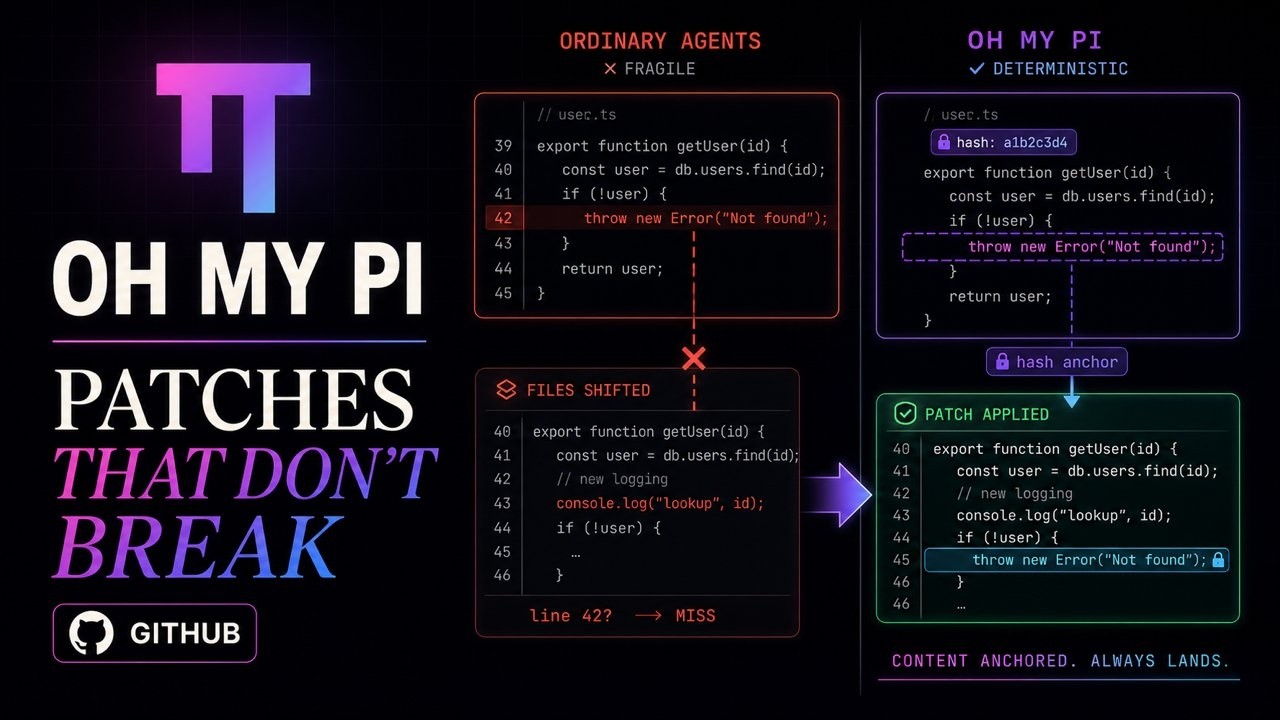
2 Hash-Anchored Patching — Beyond Line Numbers
Traditional AI code patching relies on unified diff formats and rigid line numbers. In a complex development environment, this method is fatally fragile:
- The problem — if a file is edited manually while the agent generates a response, line-number-based diffs break because the coordinates no longer match. The patch fails to apply.
- Content hash anchoring — Oh My Pi identifies code by its structure rather than its physical location. It uses semantic content hashes to locate target code blocks.
- Stale anchor recovery — if a developer shifts code mid-turn, the tool identifies the new semantic location and applies the patch accurately. No more catastrophic file corruption from line-number drift.
3 Tree-sitter Structural Editing
For modifications that alter the fundamental structure of a file, simple string matching is insufficient. Oh My Pi uses specialized tools powered by over 50 compiled Tree-sitter grammars:
- Native AST parsing — the agent parses and understands the code's abstract syntax tree directly, not through regex or string operations
- Structural logic modifications — edits are applied as queries and rewrites against the syntax tree, injecting or replacing executable nodes directly
- Syntactic validity guarantee — every edit maintains syntactic correctness by construction. The agent cannot introduce basic syntax errors like orphaned closing brackets.
- AST-aware patching — the code is guaranteed syntactically sound before any physical changes are written to disk
4 In-Process Rust Tooling — Zero-Latency Execution
Executing external shell commands for every tool call introduces significant latency — starting new processes for search or file navigation slows down the agent's reasoning loop:
- Rust backend — a compiled Rust binary linked directly into the runtime
- Bun JavaScript workspace — connected via a high-performance Node API boundary (N-API)
- Same memory space — native utilities operate inside the agent's process, eliminating fork-exec cycles entirely
- Enterprise-scale navigation — can navigate massive codebases without the delays of standard subprocess management
5 LSP Diagnostics & Symbols
Rather than relying on LLM-generated guesses about code errors, Oh My Pi acts as a native Language Server Protocol (LSP) client:
- Real diagnostics — queries the local language server for actual compiler warnings, errors, and type information
- Symbol navigation — accesses function signatures, type definitions, and symbol references from the LSP rather than inferring them
- Ground truth — eliminates the common AI coding failure mode where the agent guesses at error messages or invents function signatures
6 Subagents in Cloned Worktrees
Managing massive parallel tasks in a single LLM context window degrades reasoning quality and inflates token costs. Oh My Pi's subagent architecture solves this:
- Isolated workers — the main agent dispatches subagents into cloned git worktrees running in the background
- No UI approvals — background workers bypass interactive approval gates for autonomous operation
- Schema-validated JSON returns — subagents return strictly typed, schema-validated data, not free-form text
- Deterministic async functions — converts unpredictable language model outputs into predictable, strongly-typed asynchronous function calls
7 RPC Mode for Enterprise Pipelines
Integrating an agent into automated enterprise pipelines requires abandoning the interactive terminal interface entirely:
- RPC mode — the agent drops its visual rendering engine for a strict newline-delimited JSON protocol
- stdio communication — all interaction occurs over standard input/output, making it trivially integrable with CI/CD systems, scripts, and orchestrators
- Same tool harness — the agent retains all its capabilities (patching, Tree-sitter, LSP, subagents) but operates headlessly
8 Docker Deployment, Triage & Extensibility
- Lean Docker image — a specialized dockerization strategy strips away visual assets and source artifacts, leaving only native binaries and runtime
- Autonomous repo maintainer — inside a container, the agent operates autonomously: follows Python triage policies to categorize inbound issues and submit formatted pull requests
- Extensibility framework — system engineers govern the automated workflow by intercepting internal events and selectively blocking actions based on local safety policies
- Deterministic governance — the same tool harness works across human-driven terminals and headless server clusters, ensuring AI-driven modifications remain deterministic regardless of deployment environment
🎯 Key Takeaways
🔑 Key Takeaways
- In-process over shell commands — Oh My Pi moves critical developer tools into the agent's core process, eliminating fragile shell wrappers and subprocess latency
- Hash-anchored patching solves the drift problem — semantic content hashes locate code blocks by structure, not line numbers, enabling stale-anchor recovery when files mutate mid-turn
- 50+ Tree-sitter grammars for AST-aware editing — structural edits are applied against the syntax tree, guaranteeing syntactic validity by construction
- Rust + Bun = zero-latency tools — native Rust utilities linked via N-API operate in the same memory space, fast enough for high-volume reasoning loops on enterprise codebases
- LSP integration provides ground truth — real compiler diagnostics and symbol information replace LLM guesses about errors and types
- Subagents return typed data, not text — workers in cloned worktrees produce schema-validated JSON, converting LLM outputs into deterministic async functions
- RPC mode enables headless CI/CD — newline-delimited JSON over stdio makes the agent a first-class participant in automated pipelines
- Lean Docker for autonomous repo maintenance — stripped images run issue triage and PR submission with governance hooks for safety policies
- Consistent harness across environments — the same tool layer works in interactive terminals and headless servers, ensuring deterministic behavior everywhere
🔗 Resources & Links
- Oh My Pi GitHub Repository — terminal AI coding agent with hash-anchored patching, Tree-sitter AST edits, Rust tooling, subagents, and RPC mode by can1357