Top #1 Opportunity for Senior Engineers: Agentic Engineering
Overview
IndyDevDan returns from a two-week trip to Greece with a clear thesis: the single greatest opportunity for senior engineers right now is agentic engineering — and Karpathy just confirmed it at Sequoia AI Ascent. In this raw, direct video, Dan lays out five compounding pillars that separate high-performing agentic engineers from everyone else: agent harnesses, software factories, extensible software, always-on agents, and agentic access. The core message is clear: stop building features — build the system that builds the system.
1 The #1 Opportunity — Agentic Engineering ▶ 0:00
Dan opens with a direct message: after two weeks unplugged in Greece, he compacted his context around a single question — what's the greatest opportunity for senior engineers? The answer: agentic engineering, the same answer it's been for over a year, but now the window of being early is closing fast.
- Karpathy named it — at Sequoia AI Ascent, Karpathy called out agentic engineering directly. "When Karpathy names something, the industry follows."
- By end of 2026, it's the default — the opportunity window where you're early is shrinking rapidly.
- Two engineers, same 200K tokens, massively different results — the gap is real, and it's explained by five pillars Dan is about to break down.
- Ceiling vs. floor — Dan's community at agenticengineer.com has been pushing the ceiling of agentic engineering, not the floor of vibe coding.
2 Pillar 1 — The Agent Harness ▶ 2:04
The first and arguably most important pillar: whoever controls the agent harness controls your results. Dan reveals he's building one new custom agent harness every single day — and explains why tools like Claude Code, Codex, and OpenCode are a great start but a terrible finish.
- The agent is everything — the agent gives you superpowers, unlocks agentic speed. The agent lives in the harness, therefore the harness controls your results.
- Pi Coding Agent — Dan uses the Pi agent harness (by Mario) to build composable units of customization, stacking unique experiences into net-new agent harnesses.
- Claude Code, Codex, OpenCode — fantastic tools, great starting point, but they are "the floor, not the ceiling." If you don't own the agent harness, you'll always be limited by what another tool tells you what you can and cannot do.
3 Custom Harness in Action — Multi-Agent Teams ▶ 3:18
Dan shows live demos of his custom agent harnesses built on the Pi agent platform, demonstrating capabilities that are impossible with out-of-the-box tools.
- UIA J Team — a multi-team orchestration system with three tiers of agents: an orchestrator that pings all teams (setup, brand, UI, generation, validation), team leads that coordinate with workers, all operating in a chat-room-like interface.
- Agent communication network — agents operating on a network that Dan can prompt and talk to directly from any other agent. His current setup includes a "Presentation Opus 4.7" agent and a "Helper Gemini 3.5 Flash" agent working together.
- Composable customizations — sandbox tools, sub-agent delegation, damage control, model fallbacks, model routing — all assembled from composable slices in the Pi harness.
4 One Tool, Many Versions — Specialization Is the Moat ▶ 5:46
Dan outlines two classes of agent harnesses you can build and why specialization is the ultimate competitive advantage.
- Engineering-pattern harnesses — the Pietoie agent harness, agent chains, verifier harnesses (one agent always checking another's work).
- Domain-specific harnesses — DevOps harness, testing harness, billing harness. "The specialization is truly endless." This is what most engineers are NOT tapping into.
- One tool, many versions — build many specialized versions from one harness platform. If you can specialize the experience to outperform someone using an out-of-the-box agent for your specific product or service, you win.
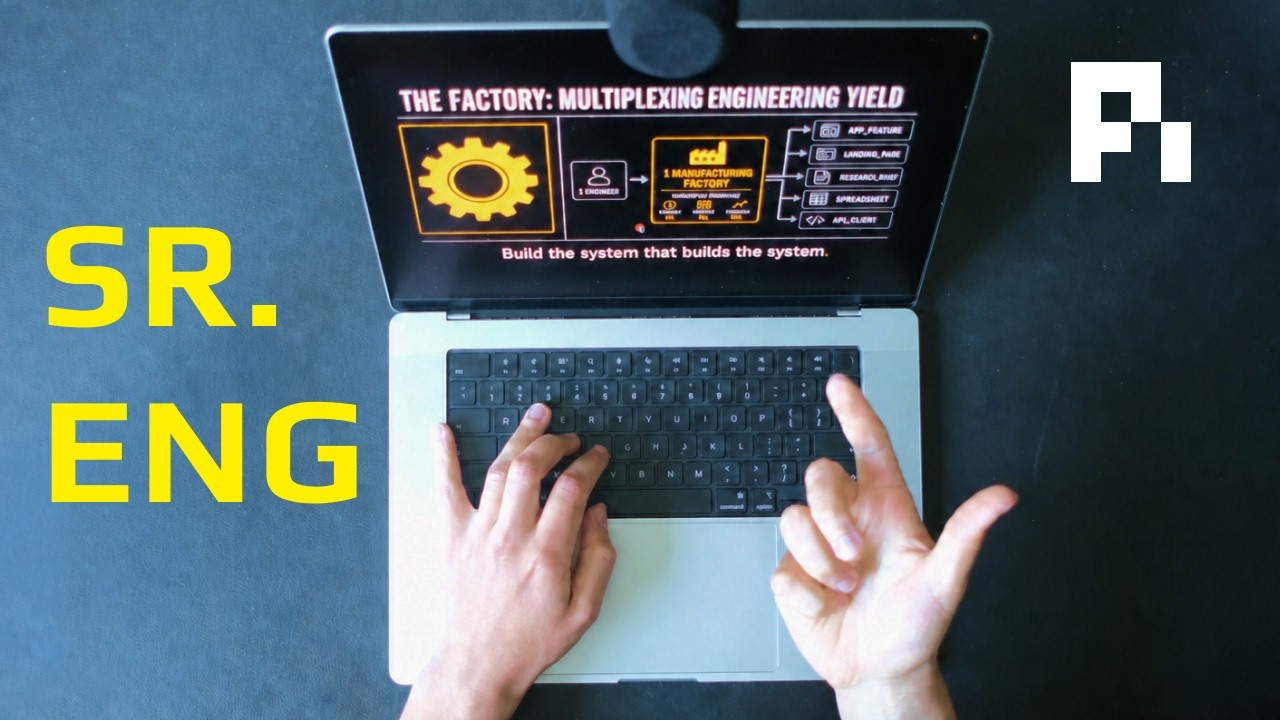
5 Pillar 2 — Software Factories: Build Factories, Not Features ▶ 6:53
The second pillar is a fundamental mindset shift: you don't build the feature — you build the factory that builds the feature. Dan calls this "building the system that builds the system."
- The plan prompt / spec prompt — the first place this shows up. You're giving your agent a formula for how engineering work is done. "What is a plan? It's a prompt scaled."
- The full factory pipeline — planning, plan reviewing, scouting, validating, building, testing, reviewing. All of this is part of your software factory.
- Output per unit time goes parabolic — while one engineer prompts back and forth with 2, 5, or 10 agents, the factory engineer writes one prompt and their factory of agents + code produces an entire feature.
- AI Developer Workflows (ADWs) — in Tactical Agent Coding, these combine agents + code to outperform either alone, getting repeat results in YOUR system.
6 The Dark Factory and Reproducible Results ▶ 9:05
Dan explains how the software factory creates a "stamp" — a system of reproducible results that's on-spec every time.
- Template your engineering — when you build factories, you produce that high-quality result over and over, like a factory producing identical cars on an assembly line.
- Built-in verification — your factory always runs tests, always gets validation. You might have a staging environment for preview, or a whole team of agents that fixes regressions.
- Frees you from the terminal — this ties directly into the "always-on agents" pillar.
7 Zero Touch Engineering (ZTE) ▶ 10:52
The ultimate destination of the software factory concept: Zero Touch Engineering (ZTE) — going from prompt directly to production.
- By end of year — all your products in production should have software factories. You should write a prompt and see a result near production.
- ZTE is super advanced — prompt → production with no manual intervention. Dan acknowledges this is the frontier, not the starting point.
- It's a new skill — agentic engineering is a software engineering skill just like full-stack, backend, frontend, or DevOps. It takes deliberate practice.
- Industry adoption — "The top 500 companies, everyone is building a software factory. Soon this will be a requirement."
8 Pillar 3 — Extensible Software ▶ 11:40
Dan admits this is one of two ideas he personally missed in his original course — and it's now a core pillar. In a world of constant change (new models, tools, prompts, technology), extensibility is survival.
- Open to extension, closed to modification — Dan's favorite software principle, now more critical than ever. If you're adding rather than modifying, you have a massive advantage.
- Pluggability, extensibility, composability — these are the three keys. Software with "a million trillion rules and cascading if statements" will suffer because agents will be slow and error-prone navigating it.
- Two classes — engineering work (enhancing your development tools, like the agent harness) and production work (deploying agentic products or maintaining traditional software).
- Why the Pi harness matters — it's swappable, dynamic, change-on-the-fly. Different tools, prompts, agents, system prompts, models — all instantly configurable.
9 Pillar 4 — Always-On Agents and Tokconomics ▶ 14:53
The ceiling of agentic engineering isn't just running agents — it's running agents that generate useful tokens. Dan introduces his "tokconomics" framework with three levels.
- Level 1 — Use more tokens — "token maxing." Great place to start, terrible place to finish. Silicon Valley term for simply burning through API calls.
- Level 2 — Make tokens useful — where most companies and engineering teams are stuck. "A lot of tokens getting generated, not a lot of value getting generated."
- Level 3 — Capture the revenue — the token arbitrage. You buy tokens at a certain price, make them valuable, roll them into products, and capture the revenue generated.
- Only THEN go always-on — once you've achieved the arbitrage, turn the system on 24/7. "There are a million agent cron jobs running. 90% of them are dead useless and just burning cash."
10 The Token Arbitrage — Scaling Your Agent Economy ▶ 16:54
Dan breaks down the economics: if you can buy a token for $1 and generate $1.10 of value, you have an infinite cash-generating engine — "also just known as a business."
- Rising API bill as KPI — once you're at Level 3, your rising API costs become a productivity KPI, not a cost center.
- Scale to the moon — just like a great ad campaign, once the unit economics work, you scale it. This is literally what the big AI labs are doing.
- It goes through the entire stack — from AI labs down to individual developers. If you buy a token for $1 and sell the output for $2, that's a 2x. Then scale.
- Dan's own usage is surprisingly low — his token growth is a "very smooth curve" because he only scales once he finds the key value arbitrage.
11 Pillar 5 — Agentic Access ▶ 19:46
The final pillar is deceptively simple: API access is a requirement of agentic speed. Agents can only command what they can programmatically reach.
- The token tax — anything your agent does that's unnecessary strictly because you haven't given it direct API access. CLI tools, REST APIs, webhooks, RPC clients — agents need them all.
- If an agent can do it, ask yourself why it isn't — most of the time, the answer is you haven't invested the time to give your agent the right access.
- Guard rails matter — don't give production access that lets agents nuke databases. Lock down the bash tool so agents never do anything catastrophic.
- Agent-first everything — agent-first systems, products, workflows. Expose CLIs and APIs everywhere: codebases, products, devices, tools.
12 Compounding Your Advantage — The Wrap-Up ▶ 21:56
Dan closes with the meta-lesson: these five pillars compound. The gap between the top 2% of engineers and everyone else is widening every single week.
- Models matter less and less — Dan deliberately didn't mention models once. "For 80-90% of the work, what matters is the systems you place around your agents."
- Move slow now to move fast later — invest in your agentic layer. Don't sit in the terminal vibe coding.
- Agentic engineering defined — "the process of engineering with intelligence that can operate on your behalf."
- Stack your advantage, compound the opportunity — success is about doing a few simple things over and over. The five pillars are those things.
🎯 Key Takeaways
- Agentic engineering is THE opportunity — Karpathy confirmed it at Sequoia AI Ascent. By end of 2026 it will be the default. The early-adopter window is closing.
- Own your agent harness — Claude Code, Codex, and OpenCode are the floor, not the ceiling. Whoever controls the harness controls the results. Build custom, composable harnesses.
- Specialization is the moat — domain-specific agent harnesses (DevOps, testing, billing) outperform generalist tools. One tool, many specialized versions.
- Build factories, not features — shift from being the engineer who builds features to the engineer who builds the system that builds features. Software factories produce on-spec results repeatedly.
- Zero Touch Engineering is the destination — prompt → production. Super advanced, but that's where all this heads. By year-end, every product should have a software factory.
- Extensible software survives change — open to extension, closed to modification. Pluggable, composable, adaptable code is essential when models and tools change at lightspeed.
- Tokconomics has three levels — (1) use more tokens, (2) make them useful, (3) capture the revenue. Only go always-on at Level 3. 90% of agent cron jobs are just burning cash.
- Your rising API bill is a KPI — but only after you've proven the token arbitrage. Scale what works, not what burns.
- Eliminate the token tax — give agents full API access (CLI, REST, webhooks, RPC). Agents can only command what they can programmatically reach.
- Agent-first everything — systems, products, workflows, devices. If an agent can do it but isn't, you haven't invested the time to give it proper access.
- Models matter less than systems — 80-90% of results come from the systems around your agents, not which model you pick.
- Move slow now to move fast later — invest in your agentic layer. The top 2% are compounding their advantage every week by doing a few simple things repeatedly.