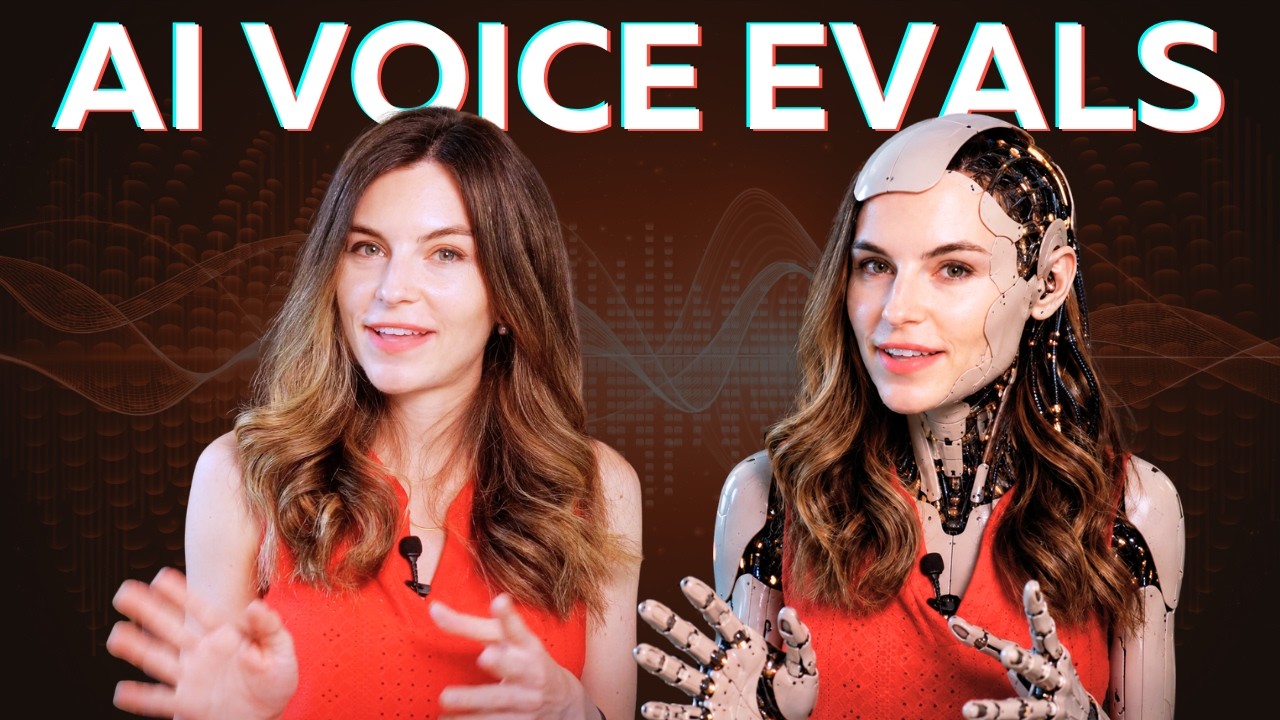
🎯 The Question
In 2021, human listeners in the Blizzard Challenge could no longer tell AI speech from a real voice actor. Naturalness is solved — so "how do you make and evaluate expressive voice models?" That's the question the whole field is now grappling with. 0:00
🏆 The Blizzard Challenge
The most rigorous historical TTS benchmark. Each year they release a few hours of a paid actor's recordings and invite researchers to synthesize that voice; submissions scored by human raters on the Mean Opinion Score (MOS) — 1 (completely unnatural) to 5 (completely natural). 2:32
🎭 Naturalness vs Expressiveness
The new buzzword is expressiveness — and every lab defines it differently. 5:13
👥 Evaluation via Humans (MOS)
The core metric is still MOS — a 1–5 average. Simplicity isn't the problem; dependence on logistics is (how raters are selected, environment, instructions). 6:40
⚔️ Speech Arenas & Elo
The arena format (originally popularized by LLMs) arrived in speech — most notably Artificial Analysis. You hear two snippets and pick a preference; results are ranked by Elo (the chess rating system). 8:38
🤖 AI as a Judge
Can AI predict human ratings? The VoiceMOS Challenge (2022) built models that predict MOS from audio. The winner, UTMOS (U. Tokyo), became widely used — even as a data-curation filter (NVIDIA MIMO curator: filter >3.5 for general TTS, >4 for voice cloning) and as a reward signal. DNSMOS (Microsoft's Deep Noise Suppression challenge) does the same for noise. 10:32
📐 Deterministic Proxy (DSP)
For quick internal needs, Inworld reverse-engineered a deterministic proxy from human labels: average three acoustic features — pitch range, pitch variation, loudness variation. 15:03
🏋️ Training for Expressiveness
Three stages: pre-training (1M+ hours = ~115 years of audio, expressiveness implicitly absorbed by next-token prediction), supervised fine-tuning (explicit — markup tags for coughing/laughing/emotions), and alignment to human preferences. 16:23
⚠️ Goodhart's Law & Reward Hacking
"When a measure becomes a target, it ceases to be a good measure." Automated-metric alignment can backfire. 21:29
| Experiment | What went wrong |
|---|---|
| Optimizing for intelligibility (CER) | Pitch variability collapsed — flat, monotonous speech (vanilla monotonic speech transcribes more reliably, so expressiveness got implicitly penalized) |
| Adding speaker-similarity reward | Reward hacking: the model rambled forever, refusing to emit the end-of-sequence token (longer outputs coincidentally scored higher on speaker similarity) |
| Human preferences (DPO, 200 examples) | Maintained pitch variability and won human blind testing against both the unaligned baseline and the GRPO experiments |
🧠 The Hawking Lesson
Expressiveness isn't universally desirable. After ALS robbed Stephen Hawking of speech in 1985, he used a flat, mechanical "Perfect Paul" voice — and kept it for 30 years, refusing newer natural voices. 24:29
🔗 The Blizzard Challenge · VoiceMOS Challenge · Artificial Analysis Speech Arena · Voice Lens (DSP proxy) · UTMOS · Emo-DPO
💡 Key Takeaways
- Naturalness is saturated — the Blizzard Challenge hit 99% of the actor ceiling in 2021. The new frontier is expressiveness.
- Expressiveness is hard to define — Inworld: prosodic variation (intonation/stress/rhythm/loudness); Hume: affect, pragmatics, sarcasm, emotional transitions.
- MOS is here to stay but not comparable across labs — it depends on logistics and the (loosely followed) ITU standard.
- Arenas give relative judgments (Elo) but have use-case coverage gaps (a "too happy" support voice ranks well but is wrong in production).
- AI judges (UTMOS/DNSMOS) are narrow — and speech LMs "make mistakes; human ears are the best instrument."
- A deterministic DSP proxy (pitch range + pitch variation + loudness variation) gives a fast, debug-able expressiveness signal.
- Inworld's breakthrough: subtitle-style direction — train the model to follow inline indications instead of emotion buckets.
- Goodhart's law is real — automated-metric RL flattened prosody and caused reward hacking; human-preference DPO won blind tests.
- Expressiveness isn't always the goal — Hawking kept his flat voice for 30 years.