Overview
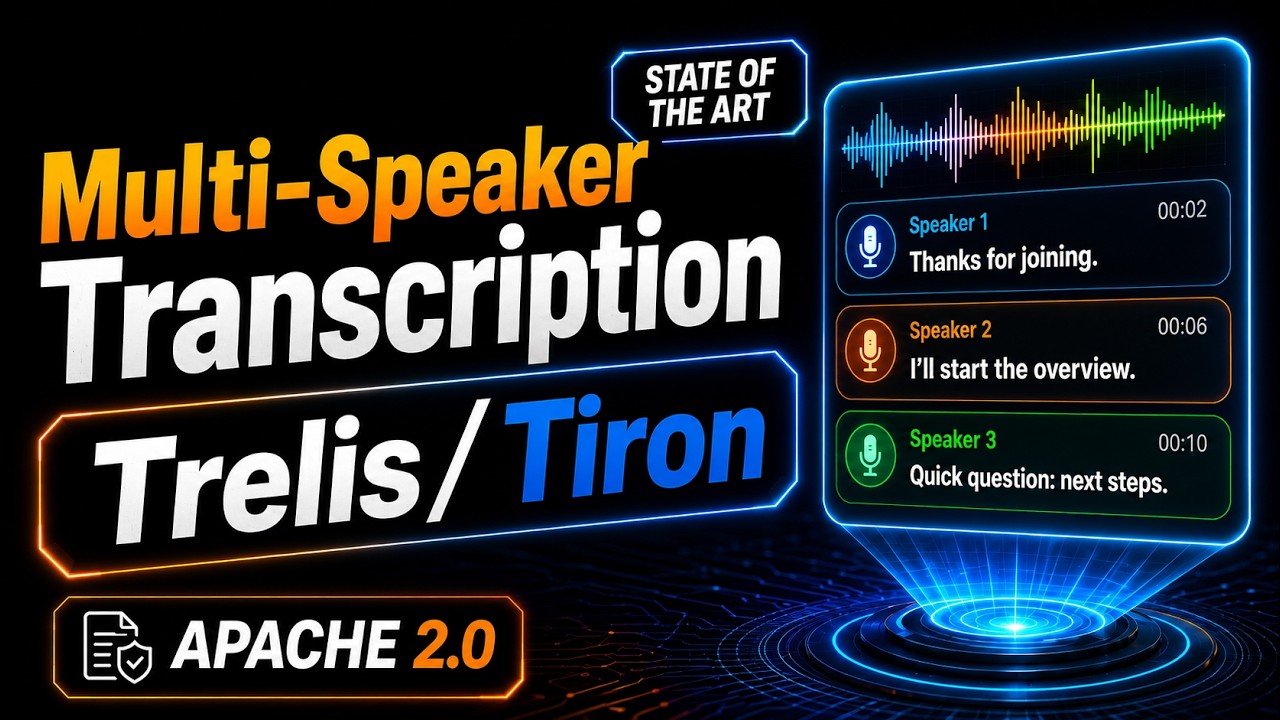
Trelis Tiron is an open-weights model purpose-built for multi-speaker meeting transcription with automatic speaker attribution. Unlike traditional pipelines that bolt a diarization system onto a separate ASR engine, Tiron integrates both into a single model — built on top of Whisper Large with 30-second processing windows. The model is freely available on Hugging Face and can handle up to 8 speakers per session.
Live Demos
The video showcases three demos, each highlighting a different capability of Tiron:
🎙️ Demo 1: Dwarkeish Patel & Ilya Susskever 1:09
A conversation between two speakers. Tiron automatically detects and labels each speaker, attributing every utterance correctly without any pre-configuration.
📺 Demo 2: British Channel 4 Broadcast 2:10
Automatic speaker detection in a news broadcast. Handles different British accents and overlapping dialogue between multiple speakers without being told who they are.
💹 Demo 3: CNBC Fast Money 3:11
Uses pre-specified speaker names instead of automatic detection. Demonstrates Tiron's flexibility — works both in auto-detect and guided modes.
Architecture
4:14 Tiron's architecture builds on Whisper Large, adding a speaker attribution layer. Here's the full processing pipeline:
The key innovation is integrating speaker attribution directly into the transcription pipeline rather than running it as a separate post-processing step. This allows the model to leverage audio context for both tasks simultaneously.
Chunking & Speaker Linking
6:25 To handle recordings longer than the 30-second window, Tiron uses an intelligent chunking process:
Energy-Based Audio Splitting
Audio is split at points of low energy (silence detection). This ensures chunks align with natural pauses in speech rather than cutting mid-utterance. Each chunk is then processed through the Whisper model independently.
Speaker Linking Across Chunks
After individual chunks are transcribed, Tiron links speakers across chunks using voice similarity. If "Speaker 1" in chunk A sounds like "Speaker 1" in chunk C, they're merged into the same identity. This is how the model maintains speaker consistency across an entire recording.
Two-Pass Transcription
7:27 One of Tiron's most important accuracy features is its two-pass approach:
Pass 1 — Standard Timing
Transcribes audio with standard chunk boundaries. This is the baseline pass that covers most of the audio accurately.
Pass 2 — Staggered Timing
Uses offset windows (shifted by ~15 seconds) to catch utterances that fell on chunk boundaries in Pass 1. This eliminates the "boundary problem" common in windowed transcription.
By combining both passes, Tiron ensures that speech occurring at segment edges — where a single pass would split or miss words — is captured accurately. The results are merged to produce a complete, seamless transcript.
Output Format & Final Merging
5:16 The raw output organizes utterances into speaker blocks. Each block contains the speaker label and their transcribed text — clean structured output ready for downstream processing.
Final Merge Step 8:30
After both passes, any remaining unattributed speech is assigned to speakers using two signals:
- Voice similarity scores — matching voice characteristics to known speakers
- Temporal proximity — assigning speech to the nearest known speaker in time
This ensures no speech is left unattributed in the final transcript.
Benchmarks
9:35 Tiron outperforms Assembly AI across key metrics on multi-speaker transcription benchmarks:
| Metric | Tiron | Assembly AI | Winner |
|---|---|---|---|
| Word Error Rate (WER) | Lower | Higher | ✓ Tiron |
| Speaker Attribution Accuracy | Better | Baseline | ✓ Tiron |
| Overlapping Speech Handling | Superior | Struggles | ✓ Tiron |
| Open Weights | Yes | No (API-only) | ✓ Tiron |
| Real-time / Streaming | No | Yes | ✓ Assembly AI |
Overlapping Speech Performance 10:36
Overlapping speech — where two or more speakers talk simultaneously — is one of the hardest challenges in multi-speaker transcription. Tiron handles overlaps significantly better than competing solutions, likely due to its integrated approach where speaker attribution informs the transcription process rather than operating independently.
Specs & Limitations
Model Specifications
⚠️ Current Limitations 5:24
- Non-streaming — processes complete audio files, not real-time audio streams
- Maximum 8 speakers — designed for meetings, not large conferences
- Sequential processing — not optimized for real-time latency
Key Takeaways
Links & Resources
Video Chapters
| Time | Chapter |
|---|---|
| 0:00 | Introduction to Trelis Tiron model |
| 1:09 | Live transcription demo — Dwarkeish & Ilya |
| 2:10 | Channel 4 example — automatic speaker detection |
| 3:11 | CNBC Fast Money — pre-specified speaker names |
| 4:14 | Architecture — Whisper Large + 30s windows |
| 5:16 | Raw output format — speaker blocks |
| 5:24 | Limitations — non-streaming, 8 speaker max |
| 6:25 | Chunking — energy split + speaker linking |
| 7:27 | Two-pass transcription — staggered timing |
| 8:30 | Merging — similarity + proximity |
| 9:35 | Benchmarks — Tiron vs Assembly AI |
| 10:36 | WER & overlapping speech performance |